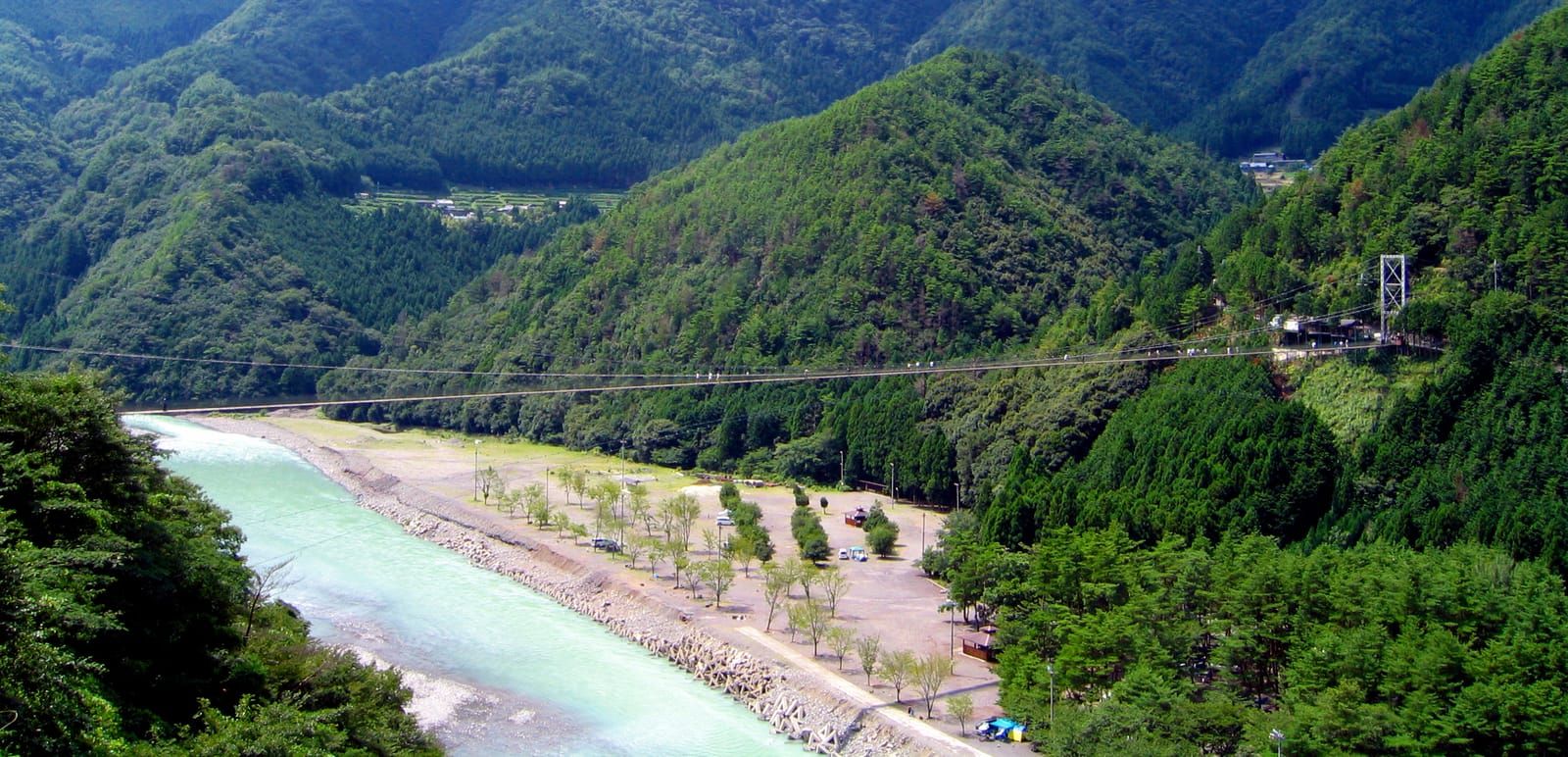
Totsukawa — Japan’s largest village by area, folded into the mountains of southern Nara — has a public-transport story that is itself a reason to go: it’s served by the Yagi–Shingu bus, the longest regular route bus in Japan that doesn’t use an expressway. The numbers, from operator Nara Kotsu’s own page: 169.3 km, 168 stops, running from Yamato-Yagi in the Nara basin all the way to Shingu on the Kumano coast. And the route’s most famous rest stop happens to be the village’s most famous sight — the Tanise suspension bridge, a 297-meter footbridge slung 54 meters above the Totsukawa river.
Getting there at a glance
| Route | How | Time | Notes |
|---|---|---|---|
| 1. Kintetsu + the Yagi–Shingu bus | Rail to Yamato-Yagi Station, then the through-bus south | bus: a few hours to Tanise/Totsukawa; 5+ h for the full run to Shingu | A handful of departures a day — the timetable is the plan |
| 2. Car | National Route 168 down the valley | varies | Flexible; the road is mountainous and slow but scenic |
Fares are distance-based (the full Yamato-Yagi → Shingu run is ¥6,150; shorter rides cost less) — check the current timetable and fare on Nara Kotsu’s official page before you travel.
Step 1 — Get to Yamato-Yagi
Yamato-Yagi Station (Kintetsu) is the northern terminus of the bus. Direct Kintetsu trains reach it from Osaka’s Namba side and from Kyoto — check times for your starting point; it’s an easy rail hop either way.
Step 2 — The bus that is the attraction
The Yagi–Shingu service heads south out of the basin and follows the river gorges down through Gojo and into Totsukawa. Three things make it work as travel rather than endurance:
- Scheduled rest stops. The route builds in breaks — including roughly 20 minutes at Uenoji, the stop right at the Tanise suspension bridge. Riders on the through-bus get enough time for a walk onto the bridge; day-trippers can simply get off here and catch a later bus.
- Totsukawa Onsen. Further south, the bus pauses at the village’s hot-spring quarter — there’s even a free footbath by the bus stop (daytime hours) — the natural overnight base if you’re splitting the ride (browse Totsukawa Onsen stays on Booking.com — accommodation links are monetized via Stay22; a booking may earn us a small commission at no extra cost to you. Disclosure).
- Few departures. This is a handful-of-buses-a-day route. Decide your stops first, then build the day around the current timetable.
Ride the whole thing and you arrive at Shingu — one of the three Kumano grand shrines and the coastal end of the pilgrimage world; Nara Kotsu even hands out a completion certificate for the full run.
 297 meters across, 54 meters up: the bridge is the bus route’s most famous rest stop. Photo: Tamago Moffle / Wikimedia Commons, CC BY-SA 2.0
.jpg)
The bridge itself
The Tanise bridge is a genuine village footbridge, not a theme-park build — locals funded it in 1954 to replace the log bridges the river kept washing away. It sways; that’s the point. Crossing is free, and the far side connects to hamlet lanes and viewpoints over the valley. Peak-season days can bring one-way flow control when it’s crowded — follow the signs on site.
Should you rent a car?
For most of Kansai our honest answer is “no, the train wins” — Totsukawa is the exception that proves the rule. The public-transport option is wonderful as an experience and objectively thin as transport: a handful of departures a day, hours on board, and every plan built backwards from the timetable. A car flips all of that. So here’s the straight comparison:
- Take the bus if the ride itself is the point — the 168-stop epic, the built-in bridge stop, the completion certificate — and your dates can flex around few departures.
- Rent a car if you want the same valley on your own clock: stop at the viewpoints the bus passes, soak at all three hot-spring quarters in one afternoon, and continue over the mountains to Kumano without watching the clock. National Route 168 shadows the bus the whole way — Gojo, Tanise, Totsukawa Onsen, and on toward Shingu — slow, winding mountain driving, and that’s the appeal. Pair it with the Nakahechi valley on the Wakayama side for a full interior circuit. Note this is deep-rural Japan: fuel up early, and carry some cash (why, in our money guide).
The license rules decide it before the price does (same rules as any driving in Japan — per JAF, checked 2026-09-09 for our Osaka JDM driving guide):
- Japan recognizes only 1949 Geneva Convention International Driving Permits — the 1968 Vienna Convention IDPs many European countries issue are not valid. Get the IDP at home before you fly.
- License holders from Switzerland, Germany, France, Belgium, Monaco and Taiwan can’t use an IDP at all: they drive on their home license plus an official Japanese translation issued by JAF, carried together.
Documents sorted, the practical pickup points are Kansai Airport or central Osaka — collect the car there, and Totsukawa is a half-day mountain drive south. Search rental cars on Booking.com for your dates and pickup point. (Car-hire and accommodation links on Beyond Kansai are monetized via Stay22 — a booking may earn us a small commission at no extra cost to you. Disclosure.)
 Where the road ends up: the bus and Route 168 both run down to the Kumano shrine country. Photo: Douglas Perkins / Wikimedia Commons, CC BY 4.0

Staying: Japan’s first “genuine free-flowing onsen” village
Totsukawa’s overnight case is bigger than “it splits the bus ride”: in 2004 the village became the first place in Japan to make a “gensen kakenagashi declaration” — every hot-spring facility in the village runs pure free-flowing source water, no recirculation, no chlorination, no dilution (per the village’s official tourism site). Three spring quarters share the valley: Yusenchi (the oldest, gorge-side), Totsukawa Onsen (the main quarter by the dam lake, where the bus pauses), and tiny Kamiyu up its own side river.
Two inns whose operation we verified on their official sites (2026-09-16): Hotel Subaru, the flagship in the Totsukawa Onsen quarter — a “gensen kakenagashi” member inn with its nine-bath Hoshi-no-Yu spa (check Hotel Subaru on Booking.com) — and Kamiyuso, the lone inn at Kamiyu Onsen, a Japan Secluded Hot Spring Association member with four private-rental rotenburo and a riverside open-air source bath (check Kamiyuso on Booking.com). For everything else, the general Totsukawa search above covers the valley. (Same disclosure as above.)
The onsen constellation continues down the road: from the Totsukawa Onsen quarter, Route 168 rolls on into the Kumano heartland — Hotel Subaru’s own access page puts Kumano Hongu Taisha about 20 minutes away by car, and one valley over sits Yunomine Onsen and the World-Heritage Tsuboyu bath. Drivers can chain Totsukawa’s baths and Kumano’s in a single run; bus riders connect via the Hongu-valley network.
Quick FAQ
- How long does it take to reach the Tanise bridge? From Yamato-Yagi, the bus takes a few hours to Uenoji (the bridge stop) — and the full Yagi–Shingu run is over five hours even with its rest stops. Check Nara Kotsu’s current timetable; departures are few.
- Is there a direct bus? Yes — famously so. The Yagi–Shingu route bus is the direct (and only) public transport through Totsukawa: 169.3 km, 168 stops, Japan’s longest non-expressway route bus. There’s no train anywhere in the village.
- Bus or car — which is better? For the experience (and if the timetable fits): the bus — the 20-minute bridge stop is built in. For flexibility, viewpoints and continuing to the coast: car on Route 168. Both are slow by design; this is not a place to rush.
- Can I stay overnight? Yes — Totsukawa Onsen’s inns split the journey naturally, and the village is a quiet base between Nara and Kumano — with Japan’s first all-village free-flowing-source onsen declaration as the draw. (Yoshino, to the northeast, pairs well on the same trip.)
- Do I need an International Driving Permit to rent a car for this? Yes, for most nationalities — and it must be the 1949 Geneva Convention IDP (1968 Vienna IDPs aren’t valid in Japan). Holders of Swiss, German, French, Belgian, Monaco or Taiwanese licenses instead need their home license plus a JAF-issued Japanese translation, carried together (per JAF, checked 2026-09-09). Sort the documents before booking the car.
Editor’s note
The bus-route facts — longest non-expressway route bus in Japan, 169.3 km / 168 stops, the rest stops including ~20 minutes at Uenoji by the bridge, and the ¥6,150 full-run fare — were checked against Nara Kotsu’s official Yagi–Shingu page on 2026-08-17; the bridge’s 297 m length / 54 m height against Totsukawa village’s official tourism site the same day. The 2004 “gensen kakenagashi declaration” (Japan’s first) and the three spring quarters were checked against the village’s official onsen pages, and Hotel Subaru’s operation (with its ~20-minute drive to Kumano Hongu Taisha) and Kamiyuso’s (the lone Kamiyu inn) against each inn’s official site, all on 2026-09-16. The driving-license rules (Geneva-1949 IDP; JAF translation for six license systems) reuse the JAF-verified wording from our Osaka JDM guide (checked 2026-09-09). Exact departure times are deliberately not quoted (few and subject to change) — always check the current timetable. The 1954 origin of the bridge follows the village’s own account. This guide makes no first-person claims; Totsukawa is within our editor’s home-region coverage (about). Drafted with AI assistance and editor-verified.
Sources
- Yagi–Shingu express bus — Nara Kotsu official (169.3 km / 168 stops / rest stops / fares; retrieved 2026-08-17)
- Riding Japan’s longest route bus — Totsukawa Village official tourism (bridge, onsen; retrieved 2026-08-17)
- Totsukawa Onsen-gō — village official (2004 gensen kakenagashi declaration, the three spring quarters; retrieved 2026-09-16)
- Hotel Subaru — official (operation, kakenagashi member, Hongu ~20 min by car; retrieved 2026-09-16) / Kamiyuso — official (lone Kamiyu inn, private rotenburo, bookable; retrieved 2026-09-16)
- Driving in Japan — JAF official (Geneva-1949 IDP rule, six-country translation list; retrieved 2026-09-09)
- Walking the Kumano Kodo — Beyond Kansai (the Shingu end of the line)