Here’s a fact that lands hard with Western travelers: of all the pilgrimage routes on Earth, only two are UNESCO World Heritage sites — Spain’s Camino de Santiago and Japan’s Kumano Kodo. The two have been officially twinned since 1998, and if you walk both, you can register as a “Dual Pilgrim.” You don’t need to be religious, and you don’t need to be a hardcore trekker. The Kumano Kodo can be a week-long forest trek or a single unforgettable afternoon — and that flexibility is exactly why it belongs on more itineraries.
What it actually is
The Kumano Kodo is not one trail but a network of ancient pilgrimage routes threading the mountainous Kii Peninsula toward three grand shrines known collectively as the Kumano Sanzan:
- Kumano Hongū Taisha — the spiritual hub, deep in the mountains
- Kumano Nachi Taisha — beside Japan’s tallest waterfall
- Kumano Hayatama Taisha — near the coast at Shingū
For over 1,000 years, everyone from retired emperors to commoners walked these paths. In 2004, the routes were inscribed as part of UNESCO’s “Sacred Sites and Pilgrimage Routes in the Kii Mountain Range” — the first time a road was registered as World Heritage in Japan, and only the second such case worldwide after the Camino.
The giant torii at Ōyunohara
Don’t miss Ōyunohara, the original site of Hongū Taisha on a sandbank where the Kumano and Otonashi rivers meet. The shrine stood here until an 1889 flood destroyed much of it, after which the surviving buildings were moved to the present hillside site in 1891. What marks the spot today is staggering: the Ōtorii, the largest torii gate in the world — 33.9 m tall and 42 m wide, erected in 2000, weighing 172 tons. Standing in the rice fields with that black gate rising against the mountains is one of Kumano’s defining images.
From the ground (first-hand): photos genuinely undersell its scale — the gate is far bigger in person than it looks in a frame, and the approach across the open fields is part of the effect.
The routes — yes, including the one to Mie
There are several historic routes, and which you pick shapes the whole trip:
- Nakahechi — the classic. About 70 km, typically walked in 4–6 days, and the most popular; this is the route the imperial family used from the 10th century. Runs from Takijiri toward Hongū and on to Nachi/Shingū.
- Kohechi — the rugged mountain route linking Kumano with Kōyasan (for serious hikers).
- Ōhechi — the scenic coastal route.
- Iseji — the eastern route that connects the Kumano network into Mie Prefecture toward Ise. (So yes — Kumano does extend toward Mie and the Owase area; that’s the Iseji.)
You don’t have to walk all of it
This is the part that surprises people. There are three realistic ways to “do” the Kumano Kodo:
- The full trek — Nakahechi from Takijiri to Hongū (and on to Nachi), 4–6 days, staying in trail-town inns. The classic pilgrimage experience.
- The half-day taster — the Hosshinmon-ōji → Hongū Taisha walk: about 7 km, 2–3 hours, with modest elevation, finishing at the great shrine. It threads ridge-top settlements and forest with panoramic lookouts, and it’s the single best option for travelers who want the feeling of the Kumano Kodo without committing to a multi-day hike.
- Drive (or bus) between the shrines — entirely valid. Many visitors simply travel between Hongū, Nachi, and Hayatama by car or local bus, walking only the short, scenic sections.
From the ground (first-hand): plenty of people here walk, and plenty drive — there’s no “wrong” way. And whichever you choose, the journey through Kumano’s valleys is nostalgic, deeply rural Japan: river gorges, forestry villages, and old stone paths under towering cedars.
Nachi: the iconic finale
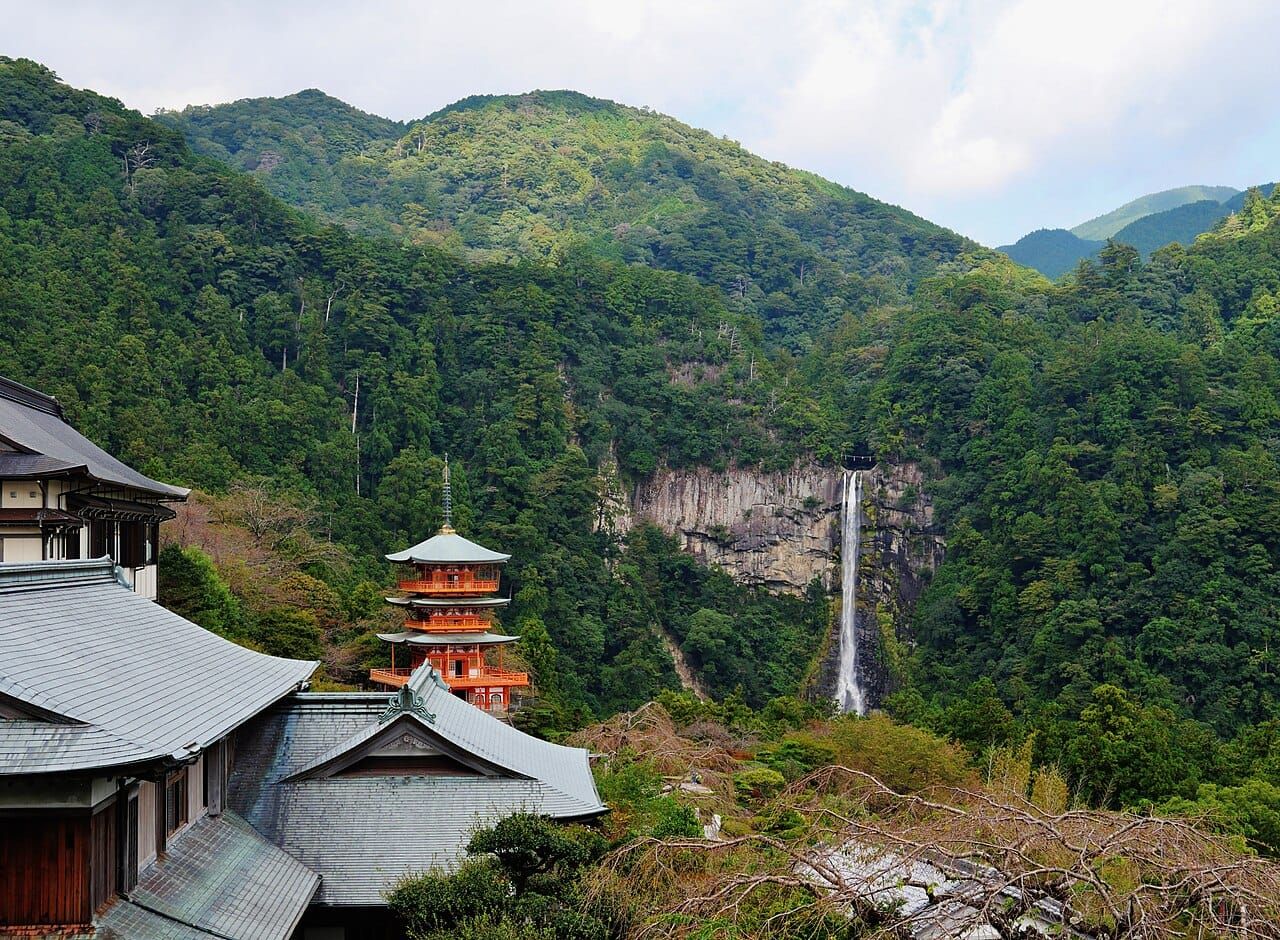
If you do one short walk for the scenery, make it Daimonzaka → Nachi. The Daimon-zaka is a 600 m cobblestone staircase of 267 steps, lined with centuries-old cedars, climbing to Kumano Nachi Taisha and the adjoining Buddhist temple Seiganto-ji. From there, the view of Seiganto-ji’s vermilion three-storey pagoda set against Nachi Falls — at 133 m, the tallest single-drop waterfall in Japan — is considered one of the most iconic scenes in the country.
How to do it comfortably (the logistics that make or break it)
The Kumano Kodo is unusually well set up for foreign walkers:
- Gateway: trains reach Kii-Tanabe from Kyoto (~3 h) or Osaka (~2.5 h); from there a bus runs ~40 min to Takijiri, the Nakahechi trailhead.
- Luggage shuttle: a daily accommodation-to-accommodation bag-forwarding service lets you walk with just a day pack — highly recommended (book well ahead; arrangements through the local Kumano Travel system want roughly 20 days’ notice).
- English signage & maps along the trail, plus a local bus line that parallels the route, so you can shorten any day or bail out without drama.
- Onsen: the hot-spring villages near Hongū (such as Yunomine and Kawayu) are classic post-walk soaks.
- Insurance: the paths are well marked but the terrain is steep in places and the nearest hospitals are a long way down the valley — see the coverage note below.
Recommended · SafetyWing
SafetyWing Nomad Insurance
For a multi-day walk on steep, remote terrain, this is our recommended option — flexible monthly coverage, simple terms, claims in English.
Check SafetyWing plans →Affiliate link — a small commission may go to Beyond Kansai at no extra cost to you. Disclosure.
Becoming a “Dual Pilgrim”
Because the Kumano Kodo and the Camino de Santiago are twinned, completing qualifying portions of both lets you register for the Dual Pilgrim certificate through the Tanabe City Kumano Tourism Bureau — a small but genuinely special bragging right, and a hook that resonates with anyone who’s walked the Camino.
When to go
- Spring & autumn: the sweet spots — comfortable temperatures, beautiful forest.
- Summer: hot and humid; start early and carry water.
- Winter: walkable, but higher sections can see snow (late Dec–late Feb) and daylight is short.
- Japanese long weekends and holidays are the busiest.
Quick FAQ
- Do I have to be religious or super fit? No. The Hosshinmon-ōji → Hongū half-day (7 km) suits most reasonably mobile travelers.
- Can I do it without walking much? Yes — bus or drive between Hongū, Nachi and Hayatama and walk only short scenic stretches like Daimonzaka.
- Does it really connect to Mie? Yes, via the Iseji route toward Ise.
- How do I carry my bags? Use the daily luggage shuttle between trail-town inns (book ~20 days ahead).
- Where do I start? Kii-Tanabe → Takijiri for Nakahechi; or go straight to Hongū/Nachi if you only want the highlights.
Editor’s note
This guide combines a first-hand sense of the Kumano landscape with researched, sourced facts. The Kumano Sanzan, the UNESCO/Dual-Pilgrim status, the Ōyunohara torii dimensions and 1889 flood, the Nakahechi distance and the Hosshinmon-ōji day walk, Nachi Falls and Daimonzaka, the Iseji-to-Mie connection, and the luggage-shuttle logistics were all confirmed against the sources below. The “walk-or-drive, both are fine” view and the impression of the torii’s scale are flagged as opinion/first-hand. Partially drafted with AI assistance and editor-verified.
Sources
- Kumano Kodō — Wikipedia / Dual Pilgrim — Tanabe City Kumano Tourism Bureau / Nakahechi — Tanabe City Kumano Tourism Bureau
- Kumano Hongū Taisha — Tanabe Tourism / Oyunohara — JNTO / Kumano Hongū Taisha — Wikipedia
- Kumano Nachi Taisha — japan-guide / Nachi Taisha — JNTO
- 3-day highlight walk — Kumano Travel / Luggage shuttle — Tanabe Tourism / Kumano Kodo walking guide — Inside Kyoto