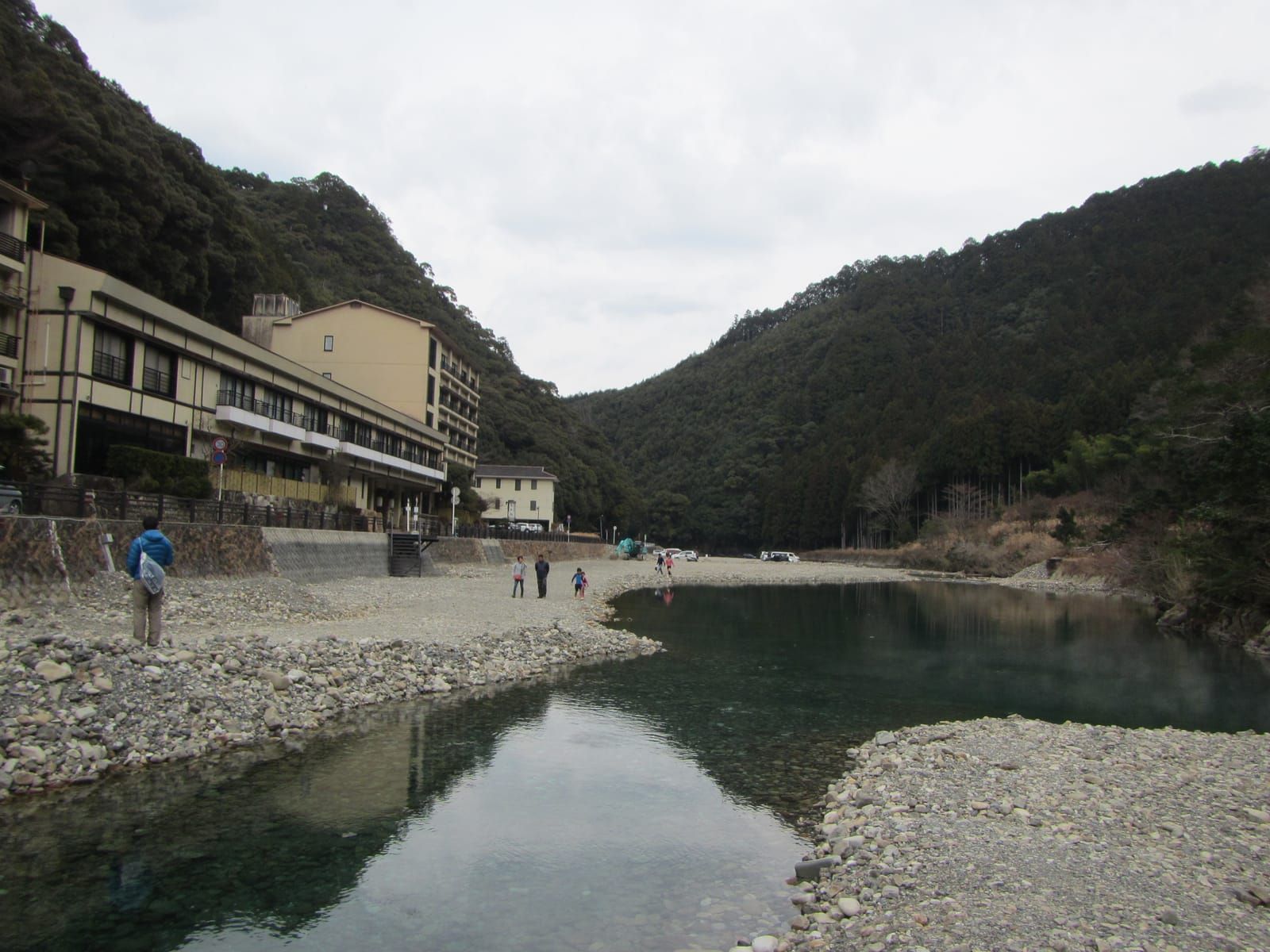
Cold air is the missing ingredient in every onsen photo you’ve ever liked — the steam only shows when the season cooperates. Kansai does winter hot springs absurdly well, and this page is the map of the ones this site has actually fact-checked, town by town, against official sources: what each place does in winter that nowhere else can, and the full verified guide for whichever one bites. One honesty note up front, because it defines this list: Arima, Kansai’s most famous onsen name, isn’t on it — not as a judgment, but because we haven’t done the on-the-ground fact work there yet, and this site doesn’t write summaries of other people’s summaries. These five are our beat.
Kawayu — the river is the bath (December–February only)
Winter is literally the reason Kawayu makes this list: every December through February the village digs its Sennin-buro — a giant open-air pool shaped into the hot-spring river itself, free, swimsuit-friendly, 6:30–22:00. Steam off a river you’re sitting in, mountains close on both sides. The rest of the year you dig your own tub in the gravel; in winter the village does it for you at scale. The one-line pitch: the only bath here is the landscape. → Kawayu Onsen & the Sennin-buro · walk the Kodo to it in winter
Yunomine — the World Heritage tub, best taken in the cold
Ten minutes over the hill from Kawayu, tiny Yunomine is the ancient pilgrims’ bath — and its two-person Tsuboyu hut is inscribed as part of the Kumano World Heritage site, bookable by nobody: first-come 30-minute slots from 6:00, ¥800. A winter morning here — creek steaming down the middle of the village, eggs cooking in the 90°C spout — is the most atmospheric hour in the Kii mountains. The pitch: bathe inside a monument. → Tsuboyu at Yunomine Onsen
 Yunomine’s Tsuboyu: the tub itself is on the World Heritage register. Photo: Nekosuki / Wikimedia Commons, CC BY-SA 4.0

Totsukawa — the village that certified its own honesty
Japan’s largest village made a move no one else had in 2004: the nation’s first all-village “gensen kakenagashi declaration” — every bath in Totsukawa runs pure free-flowing source water, no recirculation, no chlorine, no dilution. Add three separate spring quarters, a one-inn secret at Kamiyu, and the fact that getting here is an adventure in itself (Japan’s longest local bus route, or the mountain drive), and you have Kansai’s deepest-cut winter soak. The pitch: the purist’s choice, certified. → Totsukawa & the Tanise bridge
Kinosaki — the bath street, at its best in crab season
Kansai’s most complete onsen town: one willow-lined canal street, six public bathhouses visited in yukata, inns that hand you a free bath pass at check-in. Winter is when it peaks — Matsuba crab season runs November through March, and nearly every inn’s dinner becomes a crab course. Book early; the town knows what it has. The pitch: the full onsen-town ritual, plus the year’s best dinner. → Kinosaki from Osaka (with the crab-season guide) — and if you’re pairing it with the Tango coast on one rail pass, our 2-day WIDE-pass loop is built around it.
 Winter tables are half the argument: crab in Kinosaki, kue (pictured) in Shirahama. Photo: Snap55 / Wikimedia Commons, CC BY 3.0

Shirahama — the Pacific at bath temperature
The summer beach town turns into a winter sleeper: Sakinoyu’s rock pools sit at the ocean’s edge — 1,350 years of bathing history, ¥500, waves hitting the rocks beside you — and the town’s cold-season table is kue, the once-”phantom” grouper now farmed locally and served as hotpot across the inns. No pandas at Adventure World anymore (returned to China, June 2025) — which, honestly, resets Shirahama to what it always was: sea, steam and seafood. The pitch: an open-air bath with a horizon. → Shirahama in Winter
Which one is yours?
| You want… | Go to |
|---|---|
| The most only-in-winter experience | Kawayu (the Sennin-buro exists Dec–Feb, period) |
| History you can physically sit in | Yunomine (the World Heritage tub) |
| The purist’s water, far from everything | Totsukawa (the 2004 declaration village) |
| A whole town built around bathing — and crab | Kinosaki |
| Ocean drama and a milder coast | Shirahama |
The Kumano trio (Kawayu, Yunomine, Totsukawa) chain naturally by Route 168 and the valley buses — access from Osaka here — while Kinosaki and Shirahama are each a single direct express from Osaka in opposite directions. There is no wrong answer on this page.
Quick FAQ
- What’s the best onsen town in Kansai for winter? Depends on the verb: soak in a river → Kawayu; bathe in a World Heritage site → Yunomine; eat crab in a yukata → Kinosaki; hear waves from the tub → Shirahama; escape everyone → Totsukawa. The table above is the honest version of “best.”
- Why isn’t Arima Onsen on this list? Coverage honesty: we haven’t fact-checked Arima on the ground yet, and this site only ranks what it has verified. It’s famous for good reason — it’s just not our verified beat yet.
- Can I do several in one trip? The three Kumano-area springs chain easily (same valley system); Kinosaki pairs with Amanohashidate on the WIDE-pass loop. Kinosaki + Shirahama in one trip means crossing the whole peninsula — doable with the pass, ambitious in one weekend.
- Do these get crowded in winter? Kinosaki’s crab season is its peak — book early. The Kumano springs and Totsukawa run quiet; Shirahama’s winter is its off-season except at the baths themselves.
Editor’s note
This is a hub page: it introduces no new facts. Every operational claim above — the Sennin-buro’s December–February season, hours and free entry; Tsuboyu’s inscription, first-come 30-minute system and ¥800 fee; Totsukawa’s 2004 first-in-Japan declaration; Kinosaki’s six-bath lineup and November–March crab window; Sakinoyu’s ¥500 ocean-edge pools and Shirahama’s kue and post-panda reality — is sourced and dated in the linked full guides, each verified against official pages (most recently 2026-09-09 to 2026-09-16). The Arima exclusion is a coverage statement, not a review. Drafted with AI assistance and editor-verified.
Sources
- Kawayu Onsen & the Sennin-buro — Beyond Kansai (verified guide) / Tsuboyu at Yunomine — Beyond Kansai (verified guide)
- Totsukawa & Tanise — Beyond Kansai (verified guide) / Kinosaki from Osaka — Beyond Kansai (verified guide incl. crab season) / Shirahama in Winter — Beyond Kansai (verified guide)
- Kawayu Onsen — Tanabe City Kumano Tourism Bureau official (the Sennin-buro source of record) / Yunomine Onsen — same bureau, official