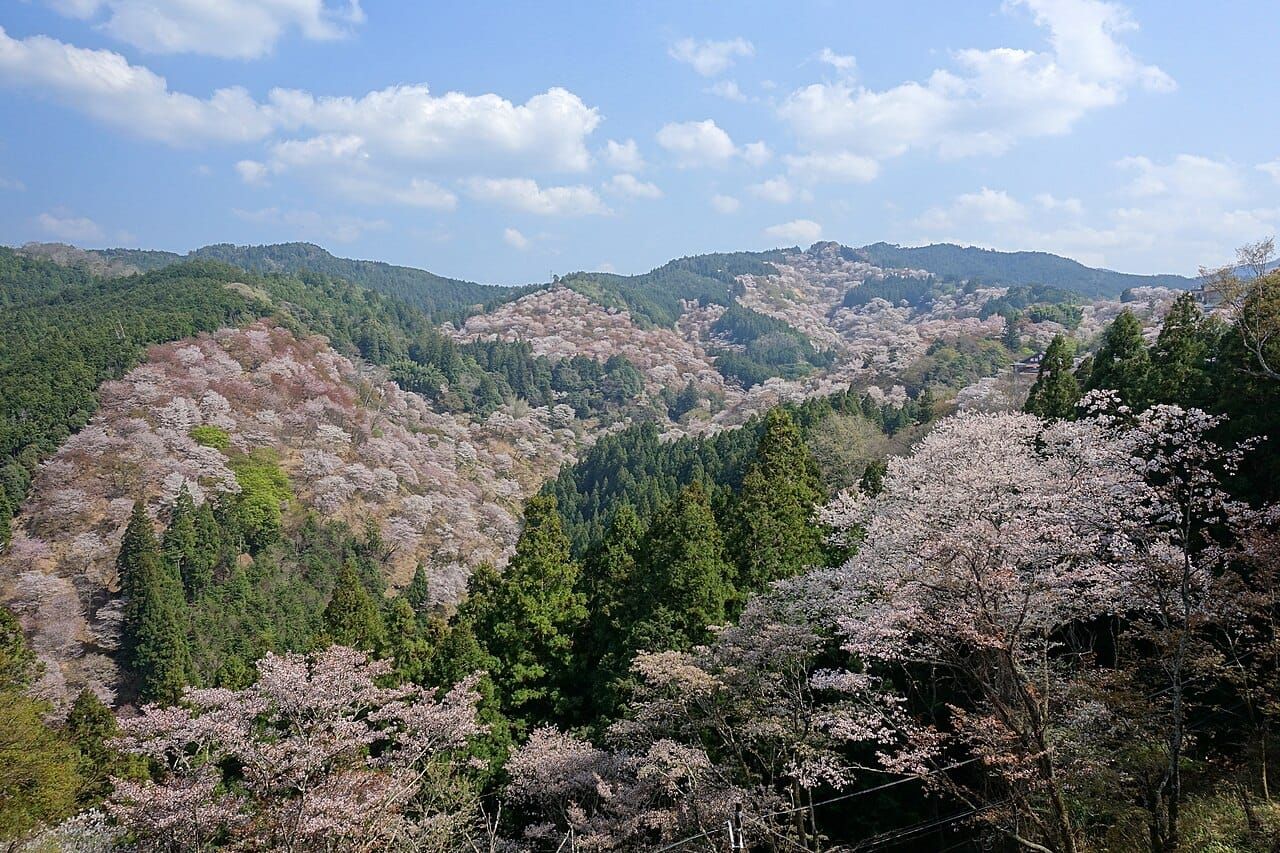
Open almost any English guide and Mount Yoshino (Yoshinoyama) gets the same one-line treatment: “Japan’s most famous cherry-blossom spot — around 30,000 trees.” It’s true, and on a clear morning in April it’s one of the most overwhelming sights in the country. But that single line quietly buries the more interesting story. Those 30,000 trees aren’t landscaping; they’re a thousand years of religious offerings. The mountain was once the seat of a rival emperor, a hiding place for Japan’s most romantic tragic hero, and a stage for the most famous cherry-blossom party in Japanese history. It’s a UNESCO World Heritage site, the spiritual home of Japan’s mountain-ascetic religion — and, for a certain kind of visitor, the setting of a cult mahjong anime.
Come for the sakura. But give Yoshino a full day, because almost everything that makes it special is the part the photos don’t explain.
Why are there 30,000 cherry trees? (The answer most guides skip)
Start with the question nobody seems to ask: why does one mountain have 30,000 cherry trees in the first place?
The answer is religious, not decorative. Roughly 1,300 years ago, En no Gyōja, the legendary founder of Shugendō — Japan’s syncretic mountain-worship tradition that fuses Shinto, Buddhism, and esoteric practice — is said to have carved the fierce guardian deity Zaō Gongen out of the wood of a wild mountain cherry tree. From that moment the cherry became a sacred tree in Yoshino, and for over a millennium devotees planted and donated cherry saplings as acts of faith. Generation after generation of believers kept offering trees to the mountain, and that accumulated devotion is exactly why Yoshino ended up with more cherry trees than anywhere in Japan.
Most are Shiroyamazakura (white mountain cherry), among roughly 200 varieties in total. Knowing this changes how the view lands: when you stand on the slope and the whole hillside is foaming pink, you’re not looking at a park — you’re looking at thirteen centuries of prayer.
Getting there: take the slow train on purpose
From Osaka, the simplest route is the Kintetsu Limited Express from Osaka-Abenobashi (next to Tennoji) directly to Yoshino Station, the end of the line. From the station, it’s a short walk to the Senbon-guchi base of the Yoshino Ropeway — the oldest surviving aerial cable line in Japan — which lifts you up to the temple district in about three minutes. If you’d rather walk, the climb up takes roughly 20 minutes, and a shuttle bus runs during cherry-blossom season.
Our take (opinion): the ropeway is a charming piece of history and worth riding once, but the real pleasure is the train ride in. The line threads through rural Nara to a small terminus that feels a world away from the Osaka megalopolis you left an hour earlier. It’s an unhurried, slightly nostalgic approach — the kind of journey that puts you in the right frame of mind before you’ve even arrived. If you can, go by rail and let the trip be part of the experience rather than just transport.
⚠️ Check before you go: outside the cherry-blossom and autumn-leaf seasons, the ropeway pauses on some weekdays, with substitute buses running instead. Confirm the current schedule before your visit, especially if you’re coming midweek in summer or winter.
The four bands of blossom — and why “peak season” lasts for weeks
Yoshino’s cherry trees aren’t planted in tidy avenues. They blanket the mountainside in four bands that climb with the elevation:
- Shimo Senbon (lower) — closest to the station and the temple town
- Naka Senbon (middle) — the heart of the village, with the best-known viewpoints
- Kami Senbon (upper)
- Oku Senbon (innermost / highest) — the quiet, remote top of the mountain
Because each band sits higher than the last, the bloom doesn’t happen all at once — it rolls slowly up the mountain over more than two weeks. The lower Shimo Senbon trees open in late March to early April; the bloom front then climbs through Naka and Kami Senbon, finally reaching the highest Oku Senbon trees around mid-to-late April. (As a recent reference point, in 2026 the lower mountain reached full bloom around April 2 and the upper around April 10.)
This staggering is a genuine practical advantage: unlike a city park where “peak” might be a three-day gamble, Yoshino gives you a much wider window to catch full bloom somewhere on the mountain. The classic panorama — an entire hillside of blossom captured in a single frame — has its own name: hitome senbon, “a thousand trees at a glance.”
Where to take it in: the most celebrated panorama is from the Hanayagura Observatory, perched around 600 m above sea level, about an hour’s walk above the upper ropeway station. From here the blossoms (or autumn leaves) spill down the slopes with the great roof of Kinpusen-ji’s Zaōdō rising out of them. Go early. Hanayagura by mid-morning to noon in peak season can be shoulder-to-shoulder; arrive soon after dawn and you’ll have one of Japan’s signature views close to yourself.
Night viewing: Yoshino’s illuminations are more modest than the big urban light-ups, but several areas are lit in the evenings through the main spring season — roughly from late March to mid-April, in the early-evening-to-night hours — giving the lantern-lit streets a different mood after the day-trippers have gone.
Practical note: treat Yoshino as a mountain, not a stroll. The lower temple district is easy enough, but reaching the upper bands and Hanayagura takes real legs. Wear proper shoes, pace yourself, and budget more time than the map distances suggest. In peak season the approach is also lined with food stalls and small shops, so the climb naturally becomes a slow, grazing kind of walk — which is half the fun.
Kinpusen-ji: the National Treasure most visitors walk straight past
Partway up the mountain stands Kinpusen-ji, founded by En no Gyōja in the late 7th century and the head temple of Shugendō. Its main hall, the Zaōdō, is a National Treasure and the second-largest traditional wooden building in Japan, surpassed only by Tōdai-ji’s Great Buddha Hall in Nara city. The present structure was rebuilt around 1592, during the era of Toyotomi Hideyoshi, who is believed to have donated it; it rises roughly 34 metres tall.
Inside are three colossal statues of Zaō Gongen, the tallest around 7 metres high — among the largest hidden (secret) wooden Buddhist images in Japan. Painted a vivid, almost electric blue, with bristling hair and a furious expression, they are the guardian deities of Shugendō. The hall’s doors are normally closed, and the statues are revealed to the public only during the Gokaichō special openings, held for limited periods twice a year, in spring and autumn. If your visit lines up with one, prioritise it — standing beneath those three blue giants is a very different experience from seeing a closed hall.
Don’t rush past the Niōmon, the temple’s imposing north-facing, two-storey gate that stands over 20 metres tall. Between the gate, the hall, and the views back down the valley, Kinpusen-ji rewards the travelers who treat Yoshino as more than a photo backdrop — which is exactly the point of coming here.
A mountain layered with a thousand years of history
This is where Yoshino quietly out-ranks almost any other cherry spot in Japan: the mountain is steeped in some of the most dramatic episodes in Japanese history, and you can walk straight through them.
Yoshimizu Shrine (in Naka Senbon) is the keystone. Founded in the 8th century as living quarters for Shugendō practitioners, it later played two outsized historical roles. In 1185, after the Genpei War and a fatal falling-out with his elder brother — the first shogun, Minamoto no Yoritomo — the tragic hero Minamoto no Yoshitsune fled here with his lover Shizuka Gozen (a celebrated shirabyōshi court dancer) and his loyal warrior-monk Benkei. The shrine preserves the Senkyō-no-Ma, the room where they are said to have hidden from Yoritomo’s pursuers; Shizuka was eventually captured at Yoshino, and their parting on the mountain became one of the most retold love stories in Japanese art and theatre.
A century and a half later, the same shrine became, briefly, the seat of an emperor. In 1336–37 Emperor Go-Daigo fled the capital and established a rival Southern Court here in the Yoshino mountains, opening the Nanboku-chō (Northern and Southern Courts) period — decades in which Japan had two competing imperial lines, the northern one in Kyoto under the Ashikaga, and Go-Daigo’s southern one confined to Yoshino. Go-Daigo died here in 1339; his tomb lies near Nyoirin-ji, a Pure Land temple about a kilometre from Kinpusen-ji. For a quiet cherry mountain, Yoshino carried a remarkable amount of imperial weight.
Yoshimizu has one more claim: it offers one of the finest hitome senbon views, and it was here that Toyotomi Hideyoshi is said to have held his legendary cherry-blossom party — a reminder that Yoshino has been Japan’s blossom-viewing capital for many centuries, not just in the Instagram era.
Higher up, in Kami Senbon, the small Yoshino Mikumari Shrine is dedicated to a female deity of water and safe childbirth; its current main hall, an elegant example of Momoyama-period architecture, was built in 1604 by Hideyoshi’s son Hideyori. And straddling the border of Naka and Kami Senbon, Chikurin-in is famed for its strolling garden, Gunpōen — a large pond garden traditionally attributed to the great tea master Sen no Rikyū, threaded with cherry trees that make it a destination in its own right come April.
The quiet pilgrimage: Yoshino as anime “holy ground”
Here’s the angle the guidebooks miss entirely. Yoshino is the real-world setting of Saki Achiga-hen episode of Side-A, a spin-off of the competitive-mahjong series Saki; its fictional Achiga Girls’ Academy is placed in Nara, and the town has even hosted an anime “holy site” summit. For fans, walking the same streets and stations the characters do is a low-key seichi junrei (sacred-site pilgrimage) — with a neat irony worth savouring: an actual sacred mountain doubling as a fictional one. (To be precise, it’s the Achiga-hen spin-off rather than the original Saki.) Even if mahjong anime isn’t your thing, it’s a small reminder that Yoshino wears its layers lightly — ancient pilgrimage route and modern fan pilgrimage on the same path.
What to eat: persimmon-leaf sushi and Yoshino kuzu
Yoshino’s food is, fittingly, a product of the mountains.
Kakinoha-zushi (persimmon-leaf sushi) is Nara’s most iconic dish and was born in this region. Pressed sushi of salted mackerel is wrapped in a persimmon leaf — not for decoration, but because the leaf’s natural tannins preserved the fish in the era before refrigeration. The mackerel itself was carried roughly 100 km inland from the Kumano coast along the old “Mackerel Road,” and the persimmon leaf kept it edible on the journey while lending the rice a subtle, earthy fragrance. Unwrapping each little leaf-parcel is part of the pleasure.
The other local star is Yoshino kuzu (kudzu starch). Yoshino’s cold climate and clean water make it ideal for refining high-grade kudzu via the traditional yoshino-zarashi method, and it turns up as silky kuzumochi, translucent kuzukiri (starch noodles), warabi-mochi, and various sweets. Much of it is naturally vegan/vegetarian, which makes Yoshino an easy stop for plant-based travelers — not something you can say about every old temple town.
Practical note: in peak season the approach is dense with stalls and small confectioners; off-season, far fewer are open, so don’t count on grazing your way up the mountain in, say, midweek November — plan a proper meal in the village instead.
Beyond spring: autumn, and the case for the off-season
Yoshino is sold as a one-week-a-year destination, and that’s a shame. The same slopes that turn pink in April turn deep red, orange, and gold from mid/late October through late November, as the leaves of those tens of thousands of cherry trees colour the whole mountain. The best autumn spots include the hill leading up from the station, the area around Yoshimizu Shrine, the Takagiyama viewing platform, and the remote Oku Senbon, near Saigyō-an — the hermitage associated with the wandering poet-monk Saigyō, beside the Kokeshimizu spring.
The off-season’s real luxury is space. Yoshino in autumn (or quiet summer) has none of the April crush, and you can actually hear the mountain. As part of Yoshino-Kumano National Park (established back in 1936) and the 2004 UNESCO World Heritage listing — “Sacred Sites and Pilgrimage Routes in the Kii Mountain Range,” shared with Kōyasan and Kumano — it’s a place built for slow walking, not jostling.
Our take (opinion): if your trip doesn’t line up with the blossoms, don’t write Yoshino off. A quiet autumn afternoon here, with the Zaōdō rising out of red maples and barely a tour group in sight, may be the better visit.
Where to stay: sleep on the mountain
To really slow down, stay overnight in a shukubo (temple lodging). Chikurin-in spent centuries housing Shugendō practitioners and today welcomes all travelers as a refined ryokan-style inn, with its celebrated garden on the doorstep; Nyoirin-ji, near Emperor Go-Daigo’s tomb, also offers shukubo lodging. Staying over means you can be at Hanayagura at first light, watch the day-trippers arrive and leave, and have the lantern-lit streets to yourself in the evening — the single best way to dodge Yoshino’s crowds.
Quick FAQ
- How long do I need? Half a day at minimum; a full day to reach the upper bands and the temples, and ideally an overnight in spring or autumn.
- When do the cherries bloom? Roughly late March (Shimo Senbon) to mid/late April (Oku Senbon); early-to-mid April is the safest single bet, but the long window is the whole point.
- Can I see the giant Zaō Gongen statues? Only during the spring and autumn Gokaichō openings — check the temple’s current dates and plan around them if you can.
- Is it a hard walk? The lower temple district is easy; reaching Kami/Oku Senbon and Hanayagura takes stamina. Wear real shoes.
- Train or ropeway? Ride the historic ropeway once if it’s running; either way, the Kintetsu train ride in is the quietly nostalgic highlight.
- Is there food for vegetarians/vegans? Yes — Yoshino kuzu sweets and many local items are plant-based, though far more stalls are open in peak season.
Editor’s note
This guide is built from researched, sourced facts. Place names, the temple’s status and dimensions, the religious origin of the cherry trees, the historical episodes (the Southern Court, Yoshitsune and Shizuka, Hideyoshi’s hanami), the food traditions, and the Saki Achiga-hen connection were all confirmed against the sources listed below. Impressions — the nostalgic train, the stamina the climb demands, the case for the off-season — are flagged as opinion rather than stated as fact. Partially drafted with AI assistance and editor-verified.
Sources
- Kinpusenji Temple (official, EN) / Kimpusen-ji — Wikipedia / Kinpusenji — japan-guide
- Mount Yoshinoyama — japan-guide / Yoshino Cherry Blossoms — JNTO / Mt. Yoshino — MATCHA
- History of Yoshino’s cherry trees — Daiwa Sakura Aid / Why Yoshino’s cherry trees have spiritual roots — Japan Tourism Agency
- Yoshimizu Shrine — japan-guide / Yoshimizu Shrine — Wikipedia / Yoshimizu-jinja — JNTO
- Emperor Go-Daigo — Wikipedia / Southern Court — Wikipedia / Shizuka Gozen — Wikipedia / Minamoto no Yoshitsune — Wikipedia
- Chikurin-in Temple — japan-guide / Chikurin-in Gunpoen garden — shizenstyle / Yoshino Mikumari Shrine — japan-guide / Nyoirinji — Tripadvisor
- Hanayagura Observatory — Visit Nara / Yoshino night illumination / full bloom — japan-guide blog
- Yoshino Ropeway — Wikipedia / Osaka to Yoshino access — japan-guide
- Kakinoha-zushi — Food in Japan / Yoshino Hon Kudzu — GOOD LUCK TRIP
- Mt. Yoshino through the seasons — JNTO / Mount Yoshino in Fall — LIVE JAPAN / Yoshino-Kumano National Park — JNTO
- Saki Achiga-hen — Saki Wiki / Saki holy-site summit — Anime News Network