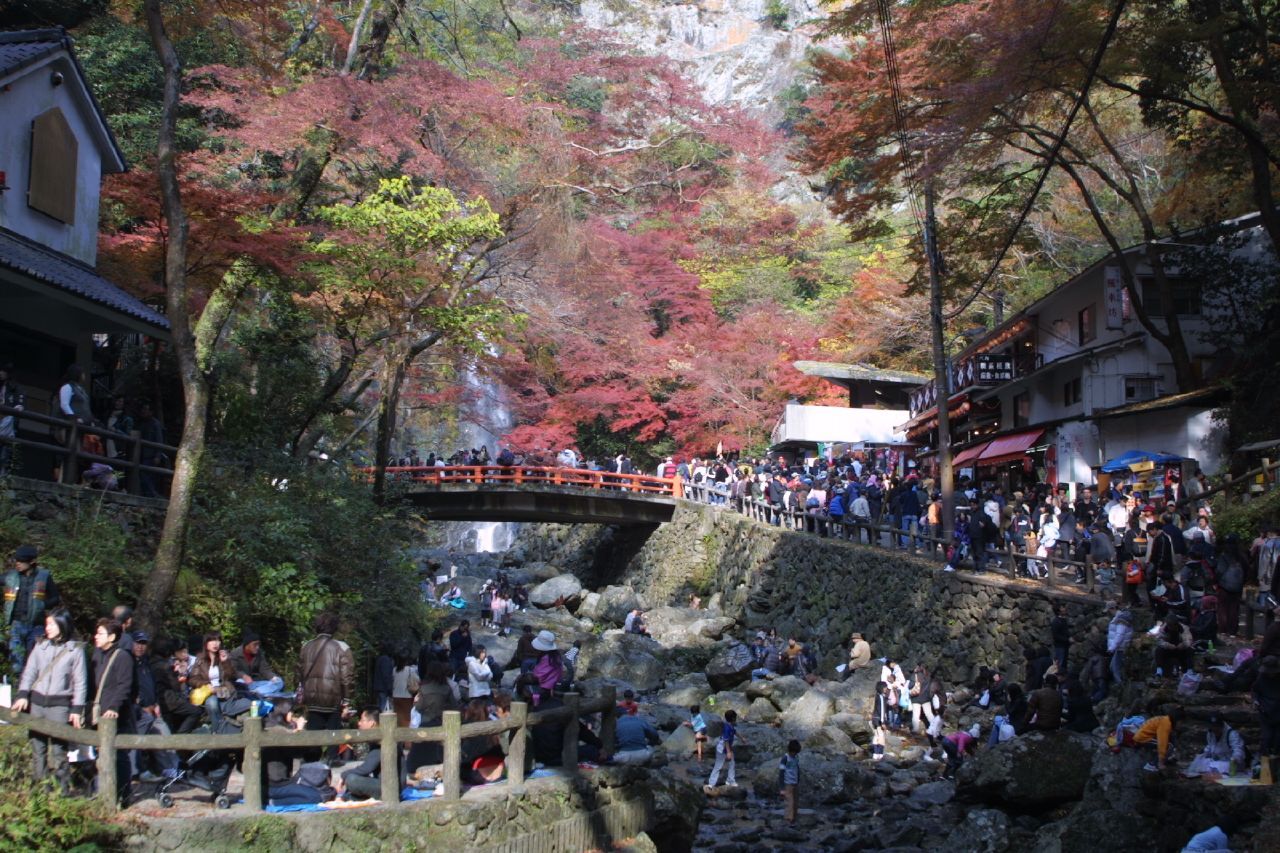
Every November, Kyoto’s famous gardens absorb a continent’s worth of visitors while the rest of Kansai turns exactly the same colors in near silence. This is the anti-itinerary: six autumn trips outside Kyoto city, each built on places we’ve already verified in depth — plus the one local valley that taught me what momiji season means before I ever saw a Kyoto garden. General leaf timing in the region runs roughly mid-November to early December in the lowlands, earlier at altitude — exact peaks shift yearly (see the Editor’s note).
1. Minoo — Osaka’s maple valley (the local’s default)
Twenty-odd minutes from Umeda on the Hankyu line, Minoo is where northern Osaka actually goes for autumn — and, full disclosure, the valley I grew up next to, which makes me biased and right. A gentle ~40-minute riverside walk from Hankyu Minoo Station climbs past temples to the Minoo Great Falls, white water against red maples. The tourism association lists the valley’s peak as roughly mid-November to early December, with the trail-side temples (Ryūanji, Saikōji) and Katsuō-ji — the daruma temple up the road — rounding out a full day. Fried momiji tempura (yes, battered maple leaves) is the local snack-gimmick that’s older than it sounds — our dedicated Minoo guide covers the trail, the timing and the crowd windows in full. Two bookable pieces for a full Minoo day, below: advance tickets for Katsuō-ji skip the window queue on peak weekends, and for the overnight version, Minoo Sanso Kaze no Mori is the hillside onsen ryokan above the town.
Book ahead · Klook
Katsuō-ji Temple — advance ticket (Minoo)
Advance tickets skip the temple’s window queue on peak foliage weekends.
Check availability →Affiliate link — a small commission may go to Beyond Kansai at no extra cost to you. Disclosure.
Book ahead · Klook
Minoo Sanso Kaze no Mori — onsen ryokan
The hillside onsen ryokan above Minoo town — the overnight version of the maple valley day.
Check availability →Affiliate link — a small commission may go to Beyond Kansai at no extra cost to you. Disclosure.
And the small-and-private version of that same overnight: Meitokuan, a three-room ryokan inside the Minoo quasi-national park itself, bookable through Wabunka as a one-night experiential stay — welcome drink and sweets, a guided look at the house’s Jibutsudō hall and teahouse, breakfast included, for 1–4 guests with English-speaking guidance. Know what’s extra before booking: the sushi-kaiseki dinner, the tea ceremony and the ~2-hour guided forest hike are paid options, not part of the base plan — and free cancellation ends 16 days before arrival. From ¥18,150 per person (listing checked 2026-10-02).
Premium stay · Wabunka
Meitokuan — a three-room ryokan inside Minoo’s national park (Osaka)
Sleep inside the maple park: Meitokuan, a three-room ryokan — breakfast included; dinner, tea ceremony and the forest hike are paid add-ons. 16-day cancellation window.
Check dates on Wabunka →Affiliate link — a small commission may go to Beyond Kansai at no extra cost to you. Disclosure.
2. Yoshino — the cherry mountain nobody visits in autumn
Mount Yoshino holds Japan’s most famous spring crowds — and in autumn the same slopes of 30,000 trees turn color for almost nobody. The 七曲り switchbacks below the village blaze red in mid-to-late November; the ropeway, the temple street and Kinpusen-ji’s great hall are all quieter than any Kyoto approach. Our full guide covers access (the nostalgic rail option included) and the mountain’s layers.
 Yoshino’s Nanamagari bend in mid-November — spring’s most famous mountain, autumn’s emptiest. Photo: Nankou Oronain / Wikimedia Commons, CC BY-SA 3.0

3. Koyasan — foliage at 800 meters (book first, then tell friends)
The mountain monastery runs cooler than the lowlands, so its color arrives earlier — late October into mid-November — framing the Danjo Garan’s vermilion pagoda and the Okunoin cedars’ understory. One hard-earned warning from our shukubō guide: late-October–November foliage weekends sell out the temple lodgings far ahead. The overnight is the point (here’s how); book it before you book anything else.
4. Taima-dera — twin pagodas in the maples
On the Nara side of the Nijō hills, Taima-dera keeps the only surviving pair of original pagodas from Japan’s earliest temple age — East (Nara period) and West (early Heian) — and in late November the maples frame them both. It’s a compact, uncrowded half-day from Osaka’s Abenobashi side, and our spot entry has the verified details.
5. Takeda Castle — when momiji season is cloud season
The sea-of-clouds window — late autumn, officially — is also the valley’s color season: the dawn fog burns off to reveal red hillsides under the stone walls. Two spectacles, one very early alarm. All the logistics (4:30 a.m. gates, Ritsuunkyō viewpoints, the November-weekend Unkai bus) are in the guide.
6. Kinosaki — the November double
November in Kinosaki stacks the year’s two best reasons at once: the canal willows and surrounding hills turn, and crab season opens — the town’s culinary high point. It’s the corridor’s busiest booking month (our Northern Hyogo hub explains the full Takeda+Kinosaki autumn pairing); reserve early, bathe often.

Planning the season
- Order by altitude: Koyasan (late Oct–mid Nov) → Takeda/Yoshino/Minoo (mid–late Nov) → city fringes and Kinosaki valley floor (late Nov–early Dec). One region, a five-week season.
- Weekends are the crowds’ choice even outside Kyoto — Minoo and Katsuō-ji fill on peak Saturdays. Weekday mornings are the cheat code everywhere.
- The Kumano option: for walkers, autumn is the Kumano Kodo’s sweet spot — stable weather, colored ridgelines, and trail-town inns that still have space once the leaf-hunters cluster in the north.
Quick FAQ
- Is any of this as good as Kyoto? Different, and often better as an experience: 80% of the color at 10% of the density. For pure garden-craft, Kyoto still wins — go at 7 a.m.
- Best single day trip from Osaka? Minoo — station-to-falls on foot, no transfers, tempura maple leaves included.
- Best overnight? Koyasan for atmosphere; Kinosaki for comfort (baths + crab).
- When exactly is peak? It moves every year with the weather — treat mid-Nov–early-Dec (lowlands) as the planning window and check forecast trackers in the final weeks.
- Wettest risk? Early-season typhoon remnants are largely done by mid-October; late November is typically the region’s most stable photography weather.
Editor’s note
Leaf-season timing is time-sensitive and shifts every year — the windows above (Minoo mid-Nov–early-Dec per the local tourism association’s foliage pages; Koyasan earlier at altitude; Takeda’s late-autumn cloud season per Asago’s official site) were compiled 2026-07-28 for planning purposes, not as guarantees; check current-year foliage forecasts before locking dates. Destination facts follow our fact-checked guides and verified spot entries linked above. First-person remarks are area-level impressions within our editor’s stated Kansai experience range (Minoo/Osaka, Yoshino); no visit-specific claims are made for the other destinations. Drafted with AI assistance and editor-verified.
Sources
- Minoo autumn foliage — Minoh Tourism Association pages (peak window; retrieved 2026-07-28) / Minoo Park foliage reference — Walkerplus
- Mount Yoshino — Beyond Kansai (audited) / Koyasan guide / Takeda Castle (Asago official data) / Kinosaki (tourism association data)
- Taima-dera — Beyond Kansai spot entry (verified twin pagodas)
- Meitokuan experiential stay — Wabunka listing (inclusions vs paid options, 16-day cancellation; retrieved 2026-10-02)