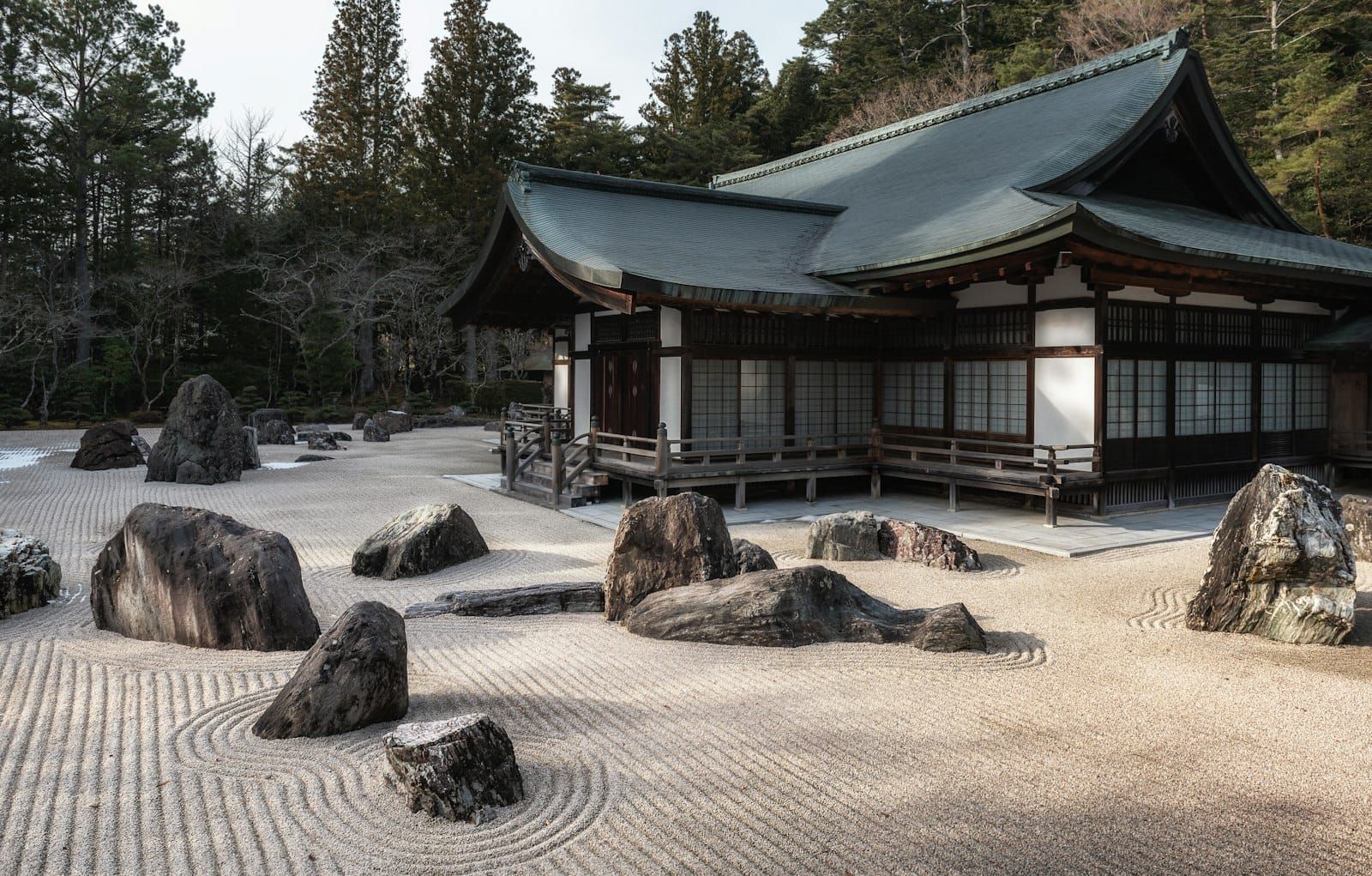
Of the 117 temples on Koyasan, 52 are shukubō — working monasteries that take overnight guests. That number comes straight from the mountain’s own Shukubō Association, and it’s why a Koyasan temple stay isn’t a gimmick: you sleep inside a monastery on the mountain Kōbō Daishi founded in 816, eat the monks’ shōjin ryōri, and — if you get up when the bell suggests — join the morning prayer service. This guide covers what the night involves, which shukubō to pick (six compared below), and how to book it in English without reading a word of Japanese.
What a shukubō stay includes
The standard package, per the Shukubō Association’s own description:
- A tatami guest room in the temple — futon bedding, often facing an inner garden. Walls are traditional (read: thin); this is part of the deal.
- Shōjin ryōri dinner — Buddhist vegetarian cuisine: seasonal vegetables, tofu in more forms than you knew existed (Koyasan is the home of kōya-dōfu, freeze-dried tofu), sesame goma-dōfu as the local masterpiece. No meat, no fish.
- The morning service (otsutome) — early-morning sutra chanting in the main hall, which overnight guests are welcomed to join. This, plus a dawn walk in Okunoin, is the heart of the overnight.
- And yes — beer and sake are fine. The association notes alcohol is freely available at dinner under its monastic euphemism, hannya-tō (“wisdom hot water”). Monastic, not puritanical.
Many temples additionally offer ajikan meditation or sutra-copying (shakyō) — offerings vary temple by temple, so check the individual listing when you book.

Best shukubō, compared (six we’d actually pick between)
There is no official “best Koyasan temple stay” — the association doesn’t rank its members, and neither do we. What follows is a factual comparison of six frequently booked shukubō, from documented sources (each fact’s check date is in the Editor’s note):
| Shukubō | Price guide* | Meals (shōjin ryōri) | Morning service | Booking in English |
|---|---|---|---|---|
| Ekō-in (恵光院) | envelope* (peak dates run far higher — see note) | Yes; Klook’s date-based plans may be breakfast-only — check inclusions | Daily service + goma fire ritual; also runs the Okunoin night tour | Easiest tier: own English site (books ~11 months out), official portal instant booking, or Klook below |
| Fudō-in (不動院) | envelope*; Klook showed both breakfast and 2-meal plans | Yes — 2-meal plans listed on Klook | Morning service (praised in guest reviews) | Official portal instant booking, or Klook below |
| Fukuchi-in (福智院) | envelope* | Yes — local vegetables, kōya-dōfu | Morning prayer ceremonies | Official site + phone; the draw: Koyasan’s only natural hot-spring baths (its own claim) |
| Ichijō-in (一乗院) | envelope* | Yes — with a website-exclusive upgrade plan | — (not stated on the page we checked) | Own English online booking, ~11 months ahead, best-rate guarantee |
| Rengejō-in (蓮華定院) | envelope* | Yes — classic Koyasan style (no meat, fish, or pungent vegetables) | Yes, plus meditation and shakyō | English site; online reservation system |
| Sekishō-in (赤松院) | envelope* | Yes — tempura, kōya-dōfu, goma-dōfu | Yes — guests welcome at the daily service | English site; online booking + phone; sits at the Okunoin entrance |
* Price guide: temples set their own rates by room and season; the association’s listings put a typical night in the low-to-mid ¥10,000s per person with two meals, climbing steeply for famous houses, private baths and foliage weekends. On the peak-autumn date we sampled (Oct 11), Klook’s remaining inventory ran US$600–1,000+ per night — book early or aim off-peak.
The two you can book on Klook (date-based availability calendar, English interface, instant confirmation). One honest note: compare what the plan includes — temple-direct bookings typically bundle dinner and breakfast with the service, while some Klook plans are room-plus-breakfast only:
Book the temple · Klook
Ekō-in temple stay (shukubō) — Koyasan
Ekō-in — the do-everything shukubō: daily goma fire ritual, English-first staff, and the temple that runs the Okunoin night tour. Check dates and what each plan includes.
Check availability →Affiliate link — a small commission may go to Beyond Kansai at no extra cost to you. Disclosure.
Book the temple · Klook
Fudō-in temple stay (shukubō) — Koyasan
Fudō-in — small, warmly reviewed, with two-meal shōjin ryōri plans listed. A quieter alternative when Ekō-in is full.
Check availability →Affiliate link — a small commission may go to Beyond Kansai at no extra cost to you. Disclosure.
The other four book best via their official sites (linked in Sources) — and the temples also list on the big platforms: browse Koyasan temple lodgings on Booking.com to compare dates across temples in one screen. (Accommodation links on Beyond Kansai are monetized via Stay22 — a booking may earn us a small commission at no extra cost to you. Disclosure.) For the full decision tree — official portal vs request service vs direct — see our shukubō booking guide.
Autumn on the mountain (book this section first)
Koyasan sits at 800 meters, so foliage comes early — late October into early November is the mountain’s peak, and it is the single hardest window of the year to book: shukubō inventory for foliage weekends thins out months ahead, and what’s left runs at the prices you saw above. Three rules for an autumn stay:
- Book the temple before anything else — trains and tours can be arranged later; a foliage-weekend futon cannot.
- Weekdays beat weekends by a wide margin, for both price and calm.
- No room left? Do autumn as a day trip and save the overnight for another season — the tour below bundles the foliage sights with transport from Osaka.
Book ahead · Klook
Koyasan autumn leaves & orange-picking day tour (from Osaka)
Seasonal: a one-day autumn-leaves tour from Osaka pairing Koyasan’s foliage with orange picking — the no-planning version of the season.
Check availability →Affiliate link — a small commission may go to Beyond Kansai at no extra cost to you. Disclosure.
What it costs (honest framing)
The association doesn’t publish a flat rate — each temple prices its own rooms and seasons. Budget roughly the price of a good ryokan night — most commonly the low-to-mid ¥10,000s per person with dinner and breakfast — and internalize two things:
- You’re paying for an experience, not hotel amenities. Shared bathrooms are common, heating is seasonal, service is monastic.
- Autumn is the exception to every price rule — see the section above.
The etiquette (it’s easy)
- Shoes off at the entrance; follow the slippers regime.
- Dinner and the morning service run on the temple’s schedule, not yours — being on time is the whole etiquette.
- The morning service is optional but attending is the point; sit, listen, follow the lead on offering incense if invited.
- Quiet hours are real: monastery first, lodging second.
- Photography inside halls: ask first.
The itinerary this unlocks
The shukubō’s superpower is being on the mountain at dawn: arrive via Nankai from Osaka by mid-afternoon, evening at the illuminated Danjo Garan, temple dinner, then Okunoin after dark — either the monk-guided night tour (run from Ekō-in) or the 5 a.m. walk — morning service, breakfast, and down the cable car by midday. Our Koyasan Temple Stay plan lays this out as a full 2-day itinerary, and the complete Koyasan guide covers the sights.

An add-on for the daytime: a private morning inside Shōjōshin-in
Everything above is about the overnight. The gap in most Koyasan plans is the daytime between check-ins — and there’s now a private-tour answer to it. To be clear up front: this is a 180-minute daytime experience, not lodging — it doesn’t replace anything in the comparison table. Booked through Wabunka (a premium private-experience platform; details checked on the listing 2026-09-18), it opens Shōjōshin-in — one of the mountain’s special head temples, steps from the Okunoin approach — for a private group of 1–10 guests with an English-speaking guide included: a tour of rooms day visitors don’t see (including the gold-leafed jōdan-no-ma and the Kanjōdō’s Amida statue, a registered Important Cultural Property), a zukō powdered-incense-making session using natural aromatics like Koyasan’s umbrella-pine, and a sesame-tofu tasting with an exclusive lunch course at the Tempu Terrace complex across the lane. From ¥47,310 per person, free cancellation until 4 days before. The listing itself recommends it for guests already sleeping at a shukubō — which is exactly how we’d slot it: arrive, do this, then check in for the evening arc.
Private experience · Wabunka
Private Buddhist experience at Shōjōshin-in — Koyasan (180 min)
A private 180-minute Buddhist experience at Shōjōshin-in — temple tour, incense-making and a devotional-cuisine lunch, English guide included, 1–10 guests. A daytime add-on to your temple stay, not lodging.
Check dates on Wabunka →Affiliate link — a small commission may go to Beyond Kansai at no extra cost to you. Disclosure.
Quick FAQ
- How do I book a shukubo in English? The easiest routes are the Kōyasan Shukubō Association’s official English portal (instant booking at participating temples — Ekō-in and Fudō-in included) and Klook’s date-based listings for those two temples; Ekō-in, Ichijō-in, Rengejō-in and Sekishō-in also run their own English booking pages. Full walkthrough: our booking guide.
- How much does a Koyasan temple stay cost? Most commonly the low-to-mid ¥10,000s per person per night including dinner and breakfast, per the association’s listings — but foliage-season dates can run several times that; the remaining peak-October inventory we sampled on Klook was US$600–1,000+ a night. Book early or go off-peak.
- Do I need to attend the morning prayer service? No — it’s optional at every temple we compared, and guests of any or no faith are welcome. It’s also the best part: the service plus a dawn Okunoin walk is what the overnight exists for.
- Can I visit Koyasan without staying overnight? Yes — Koyasan works as a day trip: about two hours from Namba by Nankai train and cable car, or a guided Kansai day tour with a Koyasan course if you’d rather skip the transfers (and in autumn, the seasonal foliage tour above). You’ll miss dawn Okunoin — which is the argument for the overnight.
- One night or two? One night delivers the full arc (dinner → dawn Okunoin → service). Two suits sutra-copying, meditation sessions, and slow temple-hopping.
Editor’s note
This guide makes no personal-experience claims — it describes the shukubō system as documented by the mountain’s institutions and each temple’s own pages, and its comparison names temples as factual examples, not a ranking. Checked 2026-07-28 (Shukubō Association): 117/52 count, package contents, hannya-tō, price envelope. Checked 2026-07-29: the portal’s English instant booking (Ekō-in and Fudō-in among participants), Ekō-in’s English site and ~11-month direct window, Fukuchi-in’s only-natural-onsen claim and meals. Checked 2026-09-09: Klook date-based listings for Ekō-in (breakfast-plan inventory; US$1,037 on the Oct 11 sample) and Fudō-in (breakfast and two-meal plans; from US$608 same date); Ichijō-in’s English online booking, upgrade plan and ~11-month window; Rengejō-in’s shōjin ryōri description, morning service, meditation/shakyō and online reservation system; Sekishō-in’s meals, daily service, Okunoin-entrance location and online/phone booking. Cells marked ”—” could not be confirmed on the pages we checked and are deliberately left blank. Checked 2026-09-18 (Wabunka listing): the Shōjōshin-in private experience’s 180-minute duration, 1–10-guest private format, included English-speaking guide, from-¥47,310-per-person pricing, free cancellation until 4 days prior, tour contents (jōdan-no-ma, Kanjōdō Amida statue as registered Important Cultural Property, zukō incense-making, Tempu Terrace lunch) and its location by the Okunoin approach — it is a daytime experience, not accommodation, and is presented as such. Prices change with dates — always confirm on the listing. Drafted with AI assistance and editor-verified.
Sources
- Staying at a Koyasan shukubō — Kōyasan Shukubō Association official (package, hannya-tō; retrieved 2026-07-28)
- About Koyasan — Shukubō Association official (117 temples / 52 shukubō) / Official English reservation portal (instant-booking temples; retrieved 2026-07-29)
- Ekō-in official English site (retrieved 2026-07-29) / Fukuchi-in official (natural onsen claim; retrieved 2026-07-29)
- Ichijō-in official (English booking, upgrade plan; retrieved 2026-09-09) / Rengejō-in official (retrieved 2026-09-09) / Sekishō-in official stay page (retrieved 2026-09-09)
- Shōjōshin-in private Buddhist experience — Wabunka listing (duration, group size, guide, price, cancellation; retrieved 2026-09-18)
- Koyasan shukubō booking guide — Beyond Kansai (portal / request / direct decision tree)