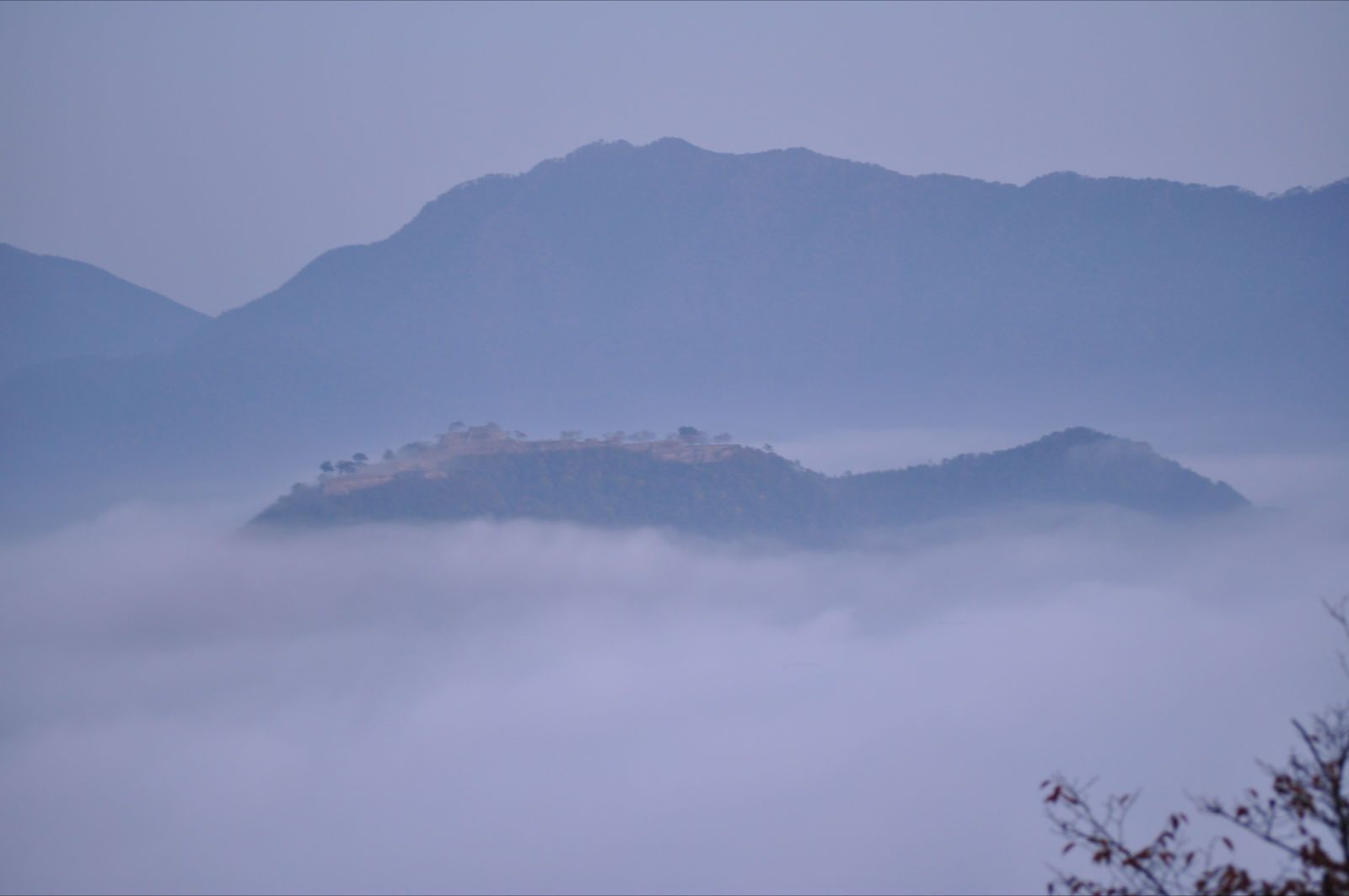
The photo everyone has seen — stone ramparts floating on a white ocean of cloud, “Japan’s Machu Picchu” — is real, but it comes with fine print no one puts under the picture: it only happens on certain autumn dawns, you have to be on a mountainside by first light, and the famous shot isn’t even taken from the castle. Here’s the honest, logistics-first guide to Takeda Castle Ruins (Asago, Hyōgo) — when the sea of clouds actually appears, the two places to watch it, and how to get there from Osaka without a car.
The one-paragraph version: go in late autumn (the officially acknowledged peak season), on a morning after a clear, windless night with a big day-night temperature gap (10°C or more), and be in position from dawn until about 8:00 a.m. Watch the castle in the clouds from the Ritsuunkyō viewpoints across the valley; or stand inside the clouds on the castle itself — the gates open at 5:00 a.m. in season, earlier than almost any sight in Japan.
What Takeda Castle is
A 16th-century mountaintop fortress reduced to its stone walls, running along a 353 m ridge above the town of Takeda. There’s no keep and no buildings — which is exactly why it photographs like a lost city when the valley fog rises. The ruins are a designated National Historic Site, and the walls themselves — long stone terraces stacked along the ridgeline — are worth the climb even on a fog-free afternoon.
 No keep, no buildings — just terraces of stone along the ridge. Photo: Reggaeman / Wikimedia Commons, CC BY-SA 3.0

When the sea of clouds actually appears
The city’s official castle site is refreshingly direct: “the season when the sea of clouds appears most readily is late autumn” (晩秋). The 2026 “Summer & Sea-of-Clouds Season” runs June 1 – December 6, but don’t read that as “clouds all season” — it’s the extended-hours period. For the fog itself, local guidance says the odds stack up when:
- the day-night temperature difference is 10°C or more
- the night was clear and the morning is windless
- you’re watching from around dawn until about 8:00 a.m. — after that the sun burns it off
That combination is most common from roughly late September through early December. It is never guaranteed; photographers check the forecast the night before and accept a miss rate.
The two places to see it (pick by the photo you want)
1. Ritsuunkyō (立雲峡) — the classic shot. The viewpoints sit on the mountainside across the valley, looking back at the castle floating in fog. From the trailhead parking area it’s a climb on foot: about 5 minutes to Viewpoint 3, about 20 minutes to Viewpoint 2, and about 40 minutes to Viewpoint 1 — the highest and the one with the postcard angle. Headlamp, warm layers, decent shoes; you’ll be walking up in the dark.
2. The castle itself — inside the cloud. During the season the site opens at 5:00 a.m. (trail gates from 4:30 a.m. on the west route). You won’t see the castle floating — you’ll be on it, with stone walls emerging from white on either side. Different photo, arguably a better memory.
Admission (castle): ¥500 for adults (high-school age up), free for junior-high students and younger; groups of 20+ pay ¥450. Cash or PayPay only at the ticket machines — no cards.
Hours (2026 season, Jun 1 – Dec 6): site open 5:00–17:00; ascending trail gates: west trail (from Yamashiro-no-Sato) 4:30–16:30, station-back and Hyōmai-shrine trails 5:00–16:30, south trail 5:00–16:00. Descent gates close at 18:00–18:30. Dates and hours change each season — check the official site before a dawn mission.
Getting there from Osaka (no car)
- Train: the station is JR Takeda (竹田) on the Bantan Line. A small number of Limited Express Hamakaze services from Osaka stop at Takeda directly (roughly one usable departure each way per day — verify the current timetable); otherwise ride to Himeji and take the Bantan Line north (local trains, transfer en route). Wadayama, one stop beyond Takeda, is the junction with the Kōnotori route from Osaka.
- From the station up: the seasonal Tenkū bus climbs from Takeda Station to the Takeda-jōseki stop in about 15 minutes (¥300 adult / ¥150 child; ¥500 day pass) — a walk to the gate remains. On foot, the station-back trail and the Hyōmai-shrine trail each take about 40 minutes (the shrine route is the steep one).
- For the dawn view: trains don’t run early enough. Options: stay overnight in Takeda’s small castle town and walk/taxi up in the dark; in November, Zentan Bus runs an early-morning “Unkai bus” on weekends and holidays only; on November weekdays it’s your feet or a taxi.
- Cash note: the gate takes cash or PayPay only, and this is small-town Japan — carry yen before you arrive (where to source yen without the markup — our money guide).
- Cover the dawn mission: you’ll be walking steep mountain trails in the dark, in a rural valley a long way from a hospital — the kind of outing travel medical coverage exists for (below).
Recommended · SafetyWing
SafetyWing Nomad Insurance
Steep mountain trails in the dark, in a rural valley a long way from a hospital — flexible monthly coverage with claims in English, for exactly this kind of dawn mission.
Check SafetyWing plans →Affiliate link — a small commission may go to Beyond Kansai at no extra cost to you. Disclosure.
 Worth the climb even without fog — the walls run the whole ridgeline. Photo: Brakeet / Wikimedia Commons, CC0

A realistic plan
- Afternoon before: train to Takeda (via Himeji or the Hamakaze), walk the old temple street below the castle, sleep in the castle town — or in Himeji/Wadayama if lodgings are full.
- 4:00–4:30 a.m.: check the sky. Clear, still, big temperature drop? Go. (Ritsuunkyō for the classic photo; the west trail from 4:30 a.m. if you’d rather be on the walls.)
- Dawn–8:00 a.m.: the window. Then breakfast in town feeling extremely smug.
- Onward: the Bantan Line continues north toward the Tajima region — home of the beef that made Kobe famous — and connects toward Kinosaki Onsen, which is exactly how we’d chain it into a Northern Hyōgo loop.
Quick FAQ
- Is the sea of clouds guaranteed in autumn? No. Right conditions (clear, windless, ≥10°C day-night gap, dawn timing) raise the odds; nothing guarantees it.
- Castle or Ritsuunkyō? For the photo of the floating castle: Ritsuunkyō (Viewpoint 1, ~40 min uphill walk). To stand inside the fog on the ramparts: the castle, gates from 4:30–5:00 a.m. in season.
- How much and how do I pay? ¥500 (adult), cash or PayPay only. Junior high and younger free.
- Can I do it as a day trip from Osaka? For a daytime visit, yes. For the dawn sea of clouds, realistically no — stay the night nearby.
- Summer visit worth it? Yes for the walls and the valley views — just don’t expect the cloud sea; late autumn is the season for that.
Editor’s note
This guide makes no personal-experience claims — it’s built from official and local-operator information. Admission, 2026 season dates, opening hours and trail-gate times were checked against the City of Asago’s official Takeda Castle pages on 2026-07-27; the cloud-sea conditions, Ritsuunkyō walk times and Unkai-bus operation against the Asago city portal’s official viewing guide; the Tenkū bus fares and times against Zentan Bus information. Hamakaze stopping patterns at Takeda Station change by season — confirm the current timetable before relying on it. Hours, fees and bus schedules here are 2026-season values and will change; the official pages below are the source of truth. Drafted with AI assistance and editor-verified.
Sources
- Takeda Castle Ruins official site — City of Asago (retrieved 2026-07-27) / 2026 Summer & Sea-of-Clouds season hours (official) / Admission fees (official)
- Early-morning Takeda Castle & Ritsuunkyō viewing guide — Asago city portal “Asabura”
- Tenkū bus (Takeda Castle loop bus) — Zentan Bus official
- Hamakaze (limited express) — Wikipedia (Takeda stop since 2016)