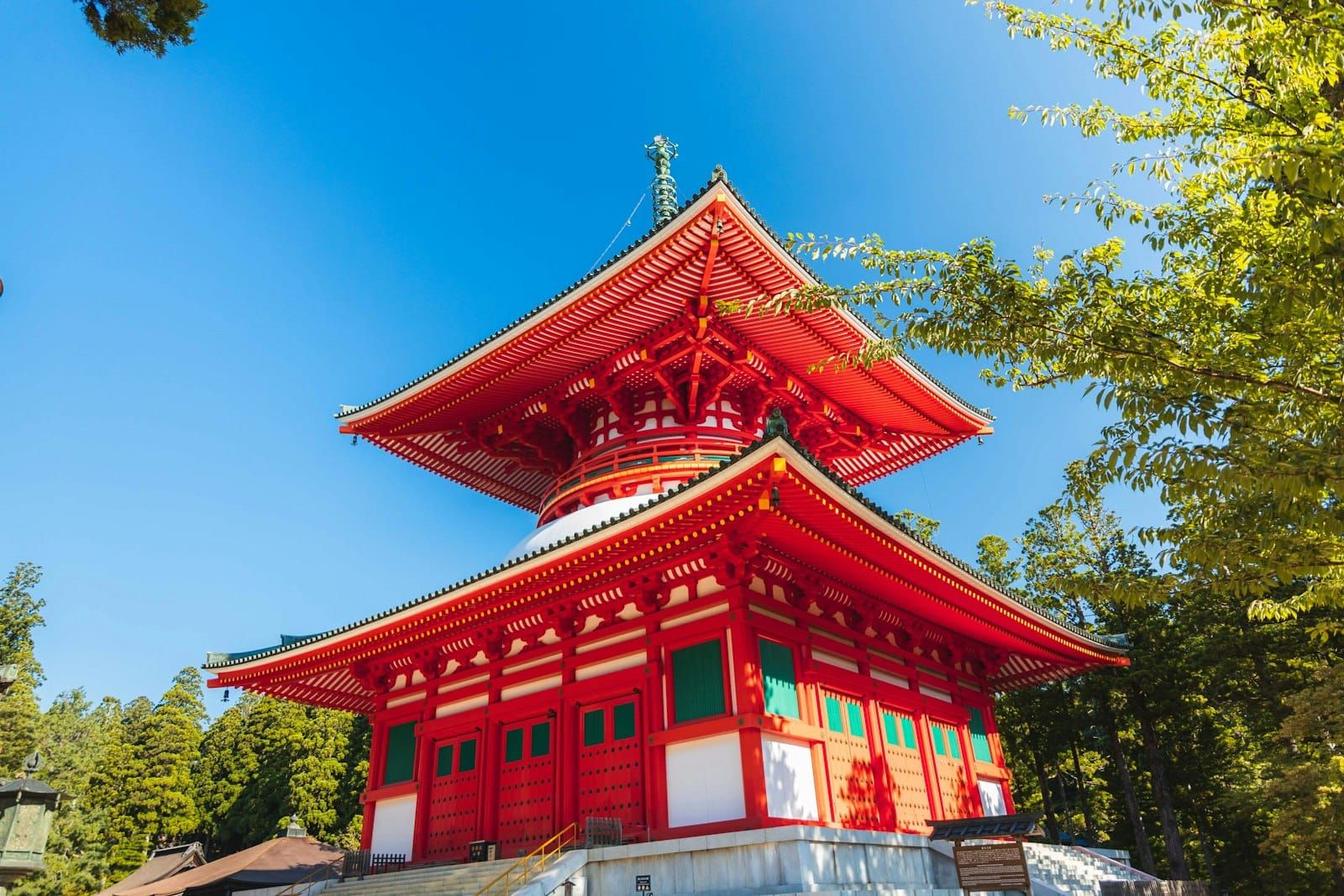
Koyasan is not a temple you visit. It’s a working monastic town on a 800-meter-high mountain basin — founded by the monk Kōbō Daishi (Kūkai) in 816 as the headquarters of Shingon Buddhism, and still home to 117 temples twelve centuries later. Since 2004 it’s been part of the UNESCO World Heritage “Sacred Sites and Pilgrimage Routes in the Kii Mountain Range” — the same inscription as the Kumano Kodo. Day-trippers see a fraction of it. Here’s how the mountain actually works, what’s genuinely unmissable, and why the right answer is almost always to sleep in a temple.
Orientation: one street, three centers
The town runs along a single east–west spine you can walk end to end in under an hour, with Nankai Rinkan buses shuttling along it. Three sites anchor everything:
- Okunoin (east end) — the cemetery-forest and Kōbō Daishi’s mausoleum. The spiritual heart.
- Danjo Garan (west-center) — the ceremonial temple complex Kūkai laid out first.
- Kongōbuji (center) — the head temple of Shingon Buddhism.
Okunoin — the walk that makes the trip
A roughly two-kilometer path through towering cedars and more than a hundred thousand graves and memorials — samurai lords, monks, company memorials, moss-swallowed stupas — ending at the Tōrōdō (Lantern Hall) and, behind it, Gobyō, the mausoleum where the faithful hold Kōbō Daishi remains in eternal meditation. Beyond the Gobyō bridge, photography, food and drink are prohibited — it is an active sacred site, not a museum.
The timing trick: the path is at its best before the tour buses — go at dawn (or on the atmospheric evening side). Staying overnight on the mountain is what makes a 5–6 a.m. Okunoin walk possible; it’s the single strongest argument for the temple stay.

Danjo Garan — Kūkai’s mandala in buildings
The Garan is the complex Kūkai began laying out in 816, conceived as a three-dimensional mandala. The grounds are free to wander; the two great interiors charge separately:
- Konpon Daitō — the huge vermilion “Fundamental Great Pagoda,” its interior a mandala of statues and painted pillars. ¥500.
- Kondō (Golden Hall) — the Garan’s main ceremonial hall. ¥500.
Evening is special here: the pagoda lit against the dark is one of the mountain’s defining sights, steps from the main street.
Kongōbuji — the head temple (and that rock garden)
The administrative and spiritual head temple of Shingon Buddhism. Inside: painted sliding-door rooms, the chamber associated with Toyotomi Hidetsugu’s forced suicide, and the Banryūtei — at about 2,340 m², one of Japan’s largest rock gardens, its stones laid as two dragons emerging from a sea of raked gravel.
- Admission: ¥1,000 (junior-high and up), ¥300 elementary, preschoolers free
- Hours: 8:30–17:00 (reception to 16:30), open year-round
Combined ticket note: a common ticket (共通内拝券, around ¥2,500) covering Kongōbuji, the Kondō, Konpon Daitō and other sites is sold on the mountain — worth it if you’re entering everything. Confirm current price at the ticket windows — and have yen on you for them (how to source it smartly).
Getting there from Osaka
The route is a small adventure in itself, and entirely part of the experience:
- Nankai Kōya Line from Namba to the mountain-foot terminus Gokurakubashi (the Limited Express Kōya is the comfortable direct option; an express surcharge of about ¥790 applies over base fare).
- Cable car from Gokurakubashi up the cliff to Koyasan Station — five steep, scenic minutes.
- Nankai Rinkan bus from the station into town (walking the road is prohibited; the bus is the way). All-in from Namba, plan on roughly two hours.
The ticket to buy: Nankai’s Kōyasan World Heritage Ticket bundles the Namba round trip, the cable car, two days of unlimited mountain buses, and sight discounts — around ¥3,400 with one limited-express leg, or ¥2,860 with regular trains (prices as referenced 2026-07-28; confirm current pricing on Nankai’s site). For a standard overnight visit it’s the obvious buy. (Koyasan is Nankai territory, not JR — the Kansai WIDE Area Pass does not apply here.)

A realistic plan (and the overnight argument)
- Day trip (doable, rushed): arrive late morning, Kongōbuji → Garan → afternoon Okunoin, last cable car down. You’ll see the sights and miss the mood.
- Overnight (the right answer): arrive mid-afternoon, check into a shukubō (temple lodging — which temple to pick and how to book it in English, compared), evening Garan illumination, dawn Okunoin before the buses, morning prayer service at your temple, descend after lunch. Same sights, completely different trip. Our Koyasan Temple Stay plan packages this into a 2-day itinerary.
- Season note: the mountain sits at ~800 m — meaningfully cooler than Osaka year-round, snowy in winter. Pack a layer even in summer.
One more piece for the overnight version: the awkward daytime gap between arriving and shukubō check-in now has a private answer — a 180-minute experience inside Shōjōshin-in, a special head temple by the Okunoin approach, combining a tour of its normally-unseen rooms, a zukō powdered-incense-making session and a lunch course at the Tempu Terrace complex opposite. Private for 1–10 with an English-speaking guide, from ¥47,310 per person, free cancellation to 4 days out (Wabunka listing, checked 2026-10-02).
Private experience · Wabunka
Private Buddhist experience at Shōjōshin-in — Koyasan (180 min)
A private daytime experience at Shōjōshin-in — temple tour, incense-making and lunch, English guide included. Fills the arrival-to-check-in gap of the overnight plan.
Check dates on Wabunka →Affiliate link — a small commission may go to Beyond Kansai at no extra cost to you. Disclosure.
Quick FAQ
- How long do I need? One overnight covers the big three properly. A rushed day trip works but sacrifices Okunoin’s best hours.
- Is it expensive to enter? The town and Okunoin are free. Paid interiors: Kongōbuji ¥1,000, Kondō ¥500, Konpon Daitō ¥500 — or the ~¥2,500 combined ticket.
- Can I use a JR pass? No — access is the private Nankai line. Use the Kōyasan World Heritage Ticket instead.
- Is Okunoin open at night? The cemetery path is accessible around the clock; the dawn and evening walks are the memorable ones. Interior halls keep daytime hours.
- Does it combine with Kumano? Yes — same UNESCO inscription, and hardy walkers link them via the Kohechi route. For most, it pairs naturally with a Wakayama coast itinerary.
Editor’s note
This guide makes no personal-experience claims. Kongōbuji admission (¥1,000/¥300), hours (8:30–17:00, reception 16:30) and the Banryūtei’s ~2,340 m² scale were checked against the official Wakayama prefectural tourism listing on 2026-07-28; the mountain’s 117 temples via the Kōyasan Shukubō Association; founding (816, Kōbō Daishi) and the 2004 UNESCO inscription per the official Kongōbuji site and our audited Kumano guide. World Heritage Ticket prices (~¥3,400/¥2,860) and the ~¥790 express surcharge are reference figures from route guides — confirm current fares on Nankai’s official pages before travel. Fees and hours change; official pages below are the source of truth. Drafted with AI assistance and editor-verified.
Sources
- Kongōbuji — Wakayama Prefecture official tourism site (fees, hours, Banryūtei; retrieved 2026-07-28)
- Kōyasan Kongōbuji official site (founding, Kōbō Daishi)
- Kōyasan Shukubō Association (117 temples / 52 shukubō) / official shukubō booking site
- Kōyasan World Heritage Ticket — japan-guide (price reference)
- Walking the Kumano Kodo — Beyond Kansai (2004 UNESCO Kii-range inscription, audited 2026-07-14)
- Shōjōshin-in private experience — Wabunka listing (duration, price, cancellation; retrieved 2026-10-02)