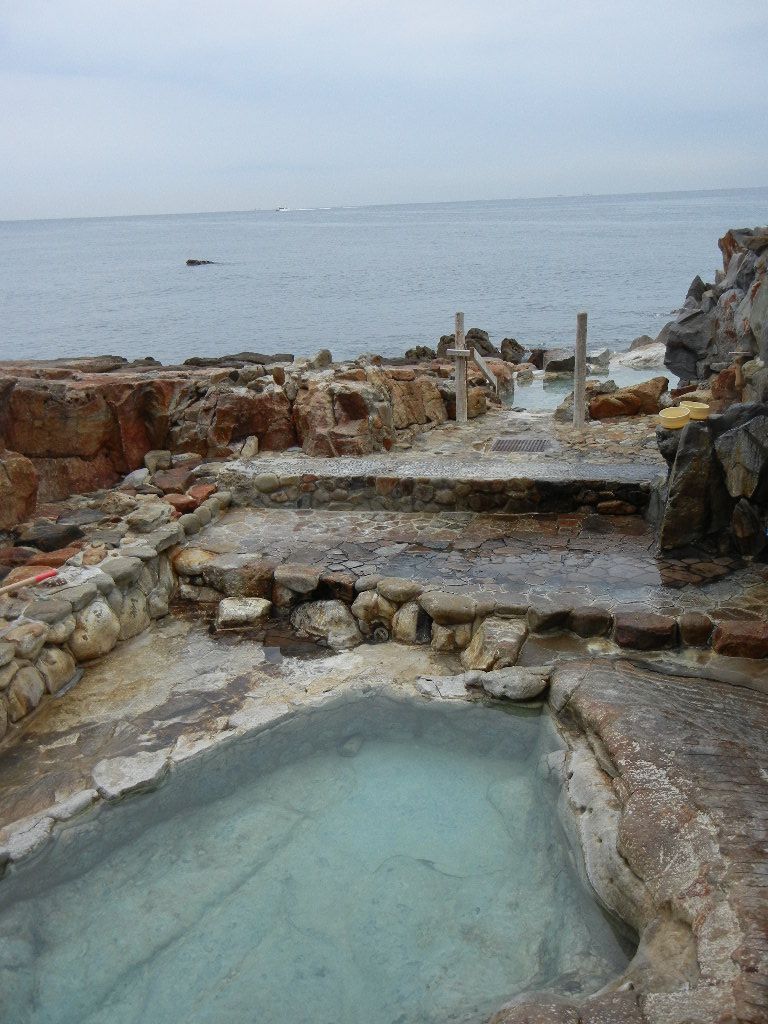
Shirahama sells itself on a summer postcard — white sand, turquoise water — and then quietly becomes a better trip after the beach season ends. This is one of Japan’s oldest documented hot-spring towns, with 1,350 years of bathing history, and winter is when that identity takes over: steam off open-air rock pools, a grouper hotpot that exists here in a way it doesn’t elsewhere, and trains you don’t need to reserve weeks out. (Getting here is the easy part — a direct express from Osaka, ~2.5 hours.) Here’s the winter version of the town, with the facts checked against the official pages on 2026-09-16.
The bath that makes winter worth it: Sakinoyu
Sakinoyu is the last survivor of the ancient “seven baths of Yuzaki” referenced in classical poetry — and it is exactly what the photo above shows: rock pools at the edge of the Pacific, close enough that you feel the waves hitting the rocks while you soak. Per the tourism association’s official page: ¥500 (ages 3 and up), gender-separated, open 8:00–17:00 from October through March (longer hours in summer). Winter is its best season by feel — cold air, hot sulfur-and-salt water, ships crossing the horizon — just note the 17:00 close means it’s an afternoon stop, not an evening one.
Round out the soak circuit at Muro-no-yu near the Yuzaki bus stop — ¥420, closed Tuesdays, and unusual for drawing two different spring sources into one small bathhouse so you can compare them side by side (per its official listing). Between the two you get the whole span of Shirahama bathing: the wild ocean edge and the neighborhood institution.
Winter’s table: kue
The town’s cold-season dish is kue — longtooth grouper, historically nicknamed the “phantom fish” for its rarity. The tourism association’s own feature is blunt that it isn’t phantom anymore: Kindai University’s fisheries lab spent 20 years establishing stable aquaculture, and farmed “Kishu Hon-Kue” has been served in town since 2007 — so the winter menus are a fixture, not a lottery. The hotpot (kue nabe) is the standard form, with sashimi, sushi, tempura and rice-bowl variations across the town’s restaurants, ryokan and minshuku (all per the association’s kue feature). The practical move is to make dinner part of the room: book an inn plan with the kue course attached, and the evening plans itself.
 Kue nabe before the broth: the winter standard of the Nanki coast. Photo: Snap55 / Wikimedia Commons, CC BY 3.0

Adventure World, honestly, in 2026–27
Older guides will tell you Shirahama’s headline attraction is giant pandas. That era is over: the pandas were returned to China in June 2025, and the park’s own site now leads with other animals — worth knowing before you promise a panda day to anyone. What Adventure World actually is now, per its official site (checked 2026-09-16): a combined safari-and-marine park headlined by penguins — ten species, about 470 birds, which the park bills as the only place in Japan with all ten — plus the safari zones and marine live shows. Two winter-specific notes: a PINGU collaboration runs October 1, 2026 – February 28, 2027, squarely across the season, and the park takes scheduled closure days — check the official operating calendar before building your day around it.
Where to stay
Two inns whose operation we verified on their official sites (2026-09-16): Shiraraso Grand Hotel, thirty seconds from Shirarahama Beach with two onsen bath areas — and, decisively for this guide, a kue kaiseki plan on its official menu (check Shiraraso Grand Hotel on Booking.com). And Kaishu, on the tip of the Yuzaki cape with free-flowing onsen from Japan’s classical “three ancient springs” tradition and its landmark mixed-bathing (bathing-wear) open-air pool at the water line (check Kaishu on Booking.com). For the rest of the town, browse Shirahama stays on Booking.com. (Accommodation links on Beyond Kansai are monetized via Stay22 — a booking may earn us a small commission at no extra cost to you. Disclosure.)
 Winter’s early sunsets put Engetsu Island’s window in reach before dinner. Photo: Motokoka / Wikimedia Commons, CC BY-SA 4.0

The shape of a winter overnight
Arrive on the midday Kuroshio, drop bags, Sakinoyu before its 17:00 close, kue dinner at the inn, and the beach to yourself in the morning — with Sandanbeki’s cliffs and Engetsu Island’s sunset window slotting in around it. Continuing down the coast? Winter is also the wild-coast drive’s quietest season. And if you’re weighing Kansai’s two famous winter onsen-and-seafood towns against each other, the other one is Kinosaki with its crab season — opposite coast, same logic.
Quick FAQ
- Is Shirahama worth visiting in winter? Yes — differently. The beach is a walk, not a swim; the payoff shifts to the open-air baths (steam over the Pacific), the kue table, and rooms that don’t need summer-level booking lead times.
- Can you bathe at Sakinoyu in winter? Yes — it’s open year-round; October–March hours are 8:00–17:00, ¥500, gender-separated (official, checked 2026-09-16). Go in the afternoon; it closes before dinner.
- What is kue, and do I need to pre-book it? Longtooth grouper — the coast’s winter hotpot fish, once rare, now stably farmed as Kishu Hon-Kue. The reliable route is an inn plan with the kue course included; the town’s restaurants also serve it in season.
- Are there still pandas at Adventure World? No — they were returned to China in June 2025. The park’s current headline is its ten-species penguin colony, the safari zones, and (this winter) the PINGU collaboration through February 28, 2027.
- Do I need a car? Same answer as summer: no for the town itself (local buses link the station, beach and Yuzaki), yes if you’re continuing along the coast.
Editor’s note
This is a seasonal guide with no personal-experience claims. Sakinoyu’s ¥500 fee, October–March 8:00–17:00 hours, gender separation and “last of the Yuzaki seven” history; Muro-no-yu’s ¥420 fee, Tuesday closure and twin springs; the kue facts (phantom-fish history, Kindai University aquaculture, Kishu Hon-Kue since 2007, hotpot as the standard form); and Adventure World’s current lineup (pandas returned June 2025, ten penguin species / ~470 birds, PINGU collaboration Oct 1 2026 – Feb 28 2027, scheduled closure days) were checked against the Nanki-Shirahama Tourism Association’s and Adventure World’s official pages on 2026-09-16. Shiraraso Grand Hotel’s kue kaiseki plan and Kaishu’s operation were confirmed on each property’s official site the same day. Hours and seasonal programs change — confirm before travel. Drafted with AI assistance and editor-verified.
Sources
- Sakinoyu — Nanki-Shirahama Tourism Association official (¥500, seasonal hours incl. Oct–Mar 8:00–17:00, history; retrieved 2026-09-16)
- Muro-no-yu — Nanki-Shirahama Tourism Association official (¥420, Tuesday closure, two springs; retrieved 2026-09-16)
- Kue feature — Nanki-Shirahama Tourism Association official (phantom-fish history, Kindai aquaculture, Kishu Hon-Kue, nabe as standard; retrieved 2026-09-16)
- Adventure World — official (current animal lineup, penguins ×10 species, PINGU collaboration dates, operating calendar; retrieved 2026-09-16; panda repatriation June 2025 per prior official-site check 2026-07-28)
- Shiraraso Grand Hotel — official (beachfront, kue kaiseki plan; retrieved 2026-09-16) / Kaishu — official (Yuzaki cape, free-flowing onsen, mixed open-air bath; retrieved 2026-09-16)
- How to get to Shirahama from Osaka — Beyond Kansai (the access leg)