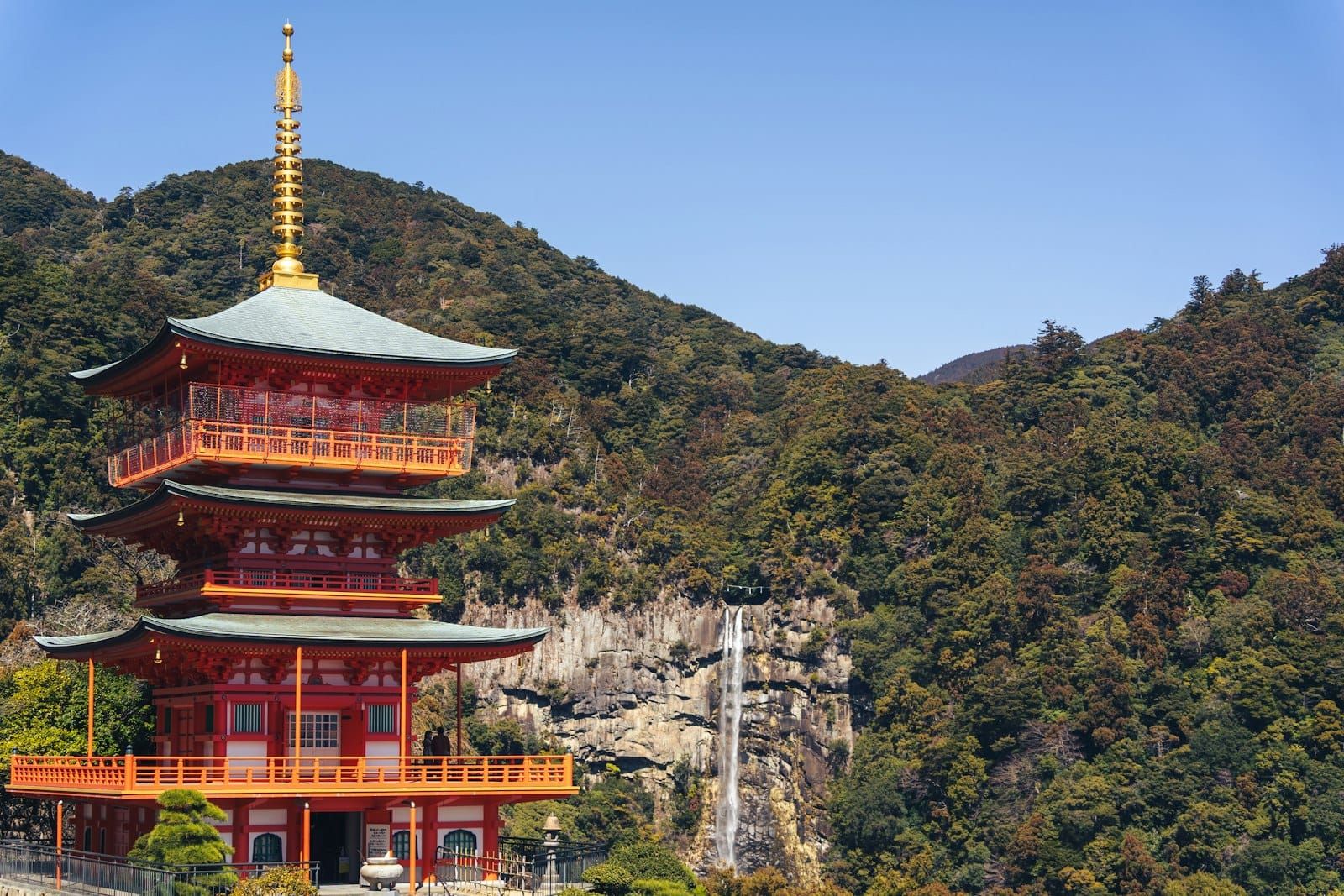
Our Kumano coverage so far has gone in from the west — Kii-Tanabe and the valley bus to Hongu, the Nakahechi trail, the onsen villages. This guide is the other door: the Pacific side, where the Kuroshio express ends its run at the tuna port of Kii-Katsuura and a local bus climbs to Nachi Falls, the tallest single-drop waterfall in Japan, with the vermilion pagoda of Seiganto-ji in front of it. It is a longer train ride than Tanabe, but it has what the mountain side lacks: a harbour town with cave-bath hotels you reach by boat, a fish market, and a shrine complex you can walk up to on a cedar-lined stone staircase that is the Kumano Kodo.
The short answer: ride the Limited Express Kuroshio from Shin-Osaka or Tennoji to Kii-Katsuura — about 4 hours (all seats reserved; covered by the Kansai WIDE Area Pass). From the station, the Nachisan bus takes about 20 minutes to Daimonzaka (¥430) or 25 minutes to the top (¥630). Walk the Daimonzaka steps up, see the shrine, the temple pagoda and the falls, bus back down, and sleep in a Katsuura onsen hotel.
Osaka → Nachi at a glance
| Leg | How | Time | Fare (adult, one way) |
|---|---|---|---|
| Shin-Osaka / Tennoji → Kii-Katsuura | Limited Express Kuroshio (all reserved) | ~4 h from Shin-Osaka (Kuroshio 16 does Kii-Katsuura → Shin-Osaka in 4 h 02, → Tennoji in 3 h 44) | about ¥7,460 (route search); ¥0 extra on the Kansai WIDE Area Pass |
| Kii-Katsuura Station → Daimonzaka | Kumano Gobo Nankai Bus, Nachisan line (routes 31/32) | ~20 min | ¥430 |
| Kii-Katsuura Station → Nachisan (top) | same bus | ~25 min | ¥630 |
| Daimonzaka → shrine complex on foot | the stone staircase + the approach | ~30 min + ~20 min | free |
| Round trip, hop-on-off | ”Nachisan” bus ticket, sold only at the Kii-Katsuura station office | — | ¥1,200 (child ¥600); mobile free pass ¥1,260 |
Figures: Kuroshio times from JR West’s online timetable for 2026-10-27; bus durations from the operator’s English page and the Tanabe City Kumano Tourism Bureau; bus fares from the Nachikatsuura Tourism Organization (the operator’s own fare table is a PDF we could not read — and note the operator has applied for a fare increase of about 10% from February 25, 2027). All retrieved 2026-10-27.

Step 1 — The Kuroshio to Kii-Katsuura
The Kuroshio runs down the whole Kii Peninsula coast from Kyoto/Shin-Osaka via Tennoji, Wakayama and Shirahama to Shingu, and Kii-Katsuura is the second-to-last stop. Three things to know:
- It is slow and it is the only train. Four hours from Shin-Osaka is normal — the line hugs the coast. There is no faster alternative by rail; the highway bus is for Shirahama, not Katsuura.
- Every seat is reserved (“全車指定席”). With a pass, reserve before boarding — JR West’s rule is that non-reserved seating does not exist on these trains.
- Frequency is modest. From the far end, Shingu shows six Kuroshio departures a day toward Osaka (6:27 to 17:46 on the day we checked). Build the trip around a specific train in each direction, not around “the next one”.
Pass or ticket? A route search on 2026-10-27 priced Shin-Osaka → Kii-Katsuura at ¥7,460 one way (fare plus reserved limited-express fee). The Kansai WIDE Area Pass — ¥12,000 for five days — covers Kuroshio reserved seats and, on JR West’s official area map, the line all the way to Kii-Katsuura and Shingu. A return trip to Nachi alone roughly pays for the pass; add Shirahama or Kinosaki on the other days and it is a bargain. (The cheaper Kansai Area Pass stopped being sold on September 30, 2026, and never covered this far anyway.)
Step 2 — The bus up to Nachisan
Outside Kii-Katsuura station, the Kumano Gobo Nankai Bus Nachisan line (not “Kumano Kotsu”, which no longer exists under that name) runs Kii-Katsuura Station → Nachi Station → Daimonzaka → Nachi-no-Taki-mae (the falls) → Nachisan. Per the operator: Daimonzaka in about 20 minutes, the falls stop in about 24, the terminus in about 25. Walking times from the stops: Daimonzaka 2 minutes to the foot of the steps; the falls 5 minutes from Nachi-no-Taki-mae; Seiganto-ji 15 minutes from the Nachisan terminus.
- Fares (one way): Daimonzaka ¥430, Nachisan ¥630 (tourism organization). The round-trip “Nachisan” ticket is ¥1,200 and lets you hop on and off between Nachi Station and Nachisan as often as you like — but it is sold only at the Kii-Katsuura station ticket office. A mobile version, the Nachi-area World Heritage free pass, is ¥1,260 via Jorudan.
- Timetable: the current table (effective April 1, 2026) is published only as a PDF; we could not read it, so we do not quote frequencies or the last bus here. Winter timetable reductions are common on Kumano routes — check the operator’s local-bus page or the station office when you arrive, and treat the last afternoon bus down as the hard limit of your day.
- Fare increase pending: the operator applied on 2026-10-21 to raise fares (about 10% on average) from February 25, 2027; the figures above will change then.
If the thinned winter timetable worries you, there is a bus-tour version of this day from Osaka: a coach from Umeda (meeting point the Mainichi Newspaper building, 7:30) to Nachi Falls, Seiganto-ji and Nachi Taisha, then Kumano Hayatama Taisha in Shingu, back in Umeda at 20:15, lunch included. The honest caveats, from the listing (2026-10-27): the guide speaks Japanese only — no English, it needs at least 15 participants to run, and it is a 13-hour day — but it removes every transfer, and the one review by non-Japanese guests describes the guide looking after them. Free cancellation up to 24 hours before.
Note: Japanese-speaking guide (no English).
Book ahead · Klook
Kumano Nachi Taisha & Hayatama Taisha full-day bus tour from Osaka (Japanese-speaking guide)
Osaka → Nachi Falls, Nachi Taisha & Hayatama Taisha by coach, 7:30–20:15, lunch included. Japanese-speaking guide (no English); runs with 15+ participants; free cancellation 24 h before.
Check availability →Affiliate link — a small commission may go to Beyond Kansai at no extra cost to you. Disclosure.
Step 3 — Daimonzaka, the shrine, the temple, the falls
Get off at Daimonzaka and walk up. The Daimon-zaka is about 600 metres of stone steps — 267 of them — between centuries-old cedars, about 30 minutes, and then roughly 20 minutes more up the approach (467 steps on the final stretch, per the tourism organization) to the shrine complex. It is the last section of the Nakahechi route of the Kumano Kodo, and the single most photographed walk in Kumano for good reason.
At the top, three things, with 2026 prices from the official sites:
- Kumano Nachi Taisha — the grand shrine; grounds free, prayers 9:00–11:00 and 12:30–15:00; treasure hall ¥300, 8:30–15:30, closed Wednesdays.
- Seiganto-ji — the Buddhist temple next door, open 7:00–16:30; its vermilion three-storey pagoda (the one in every photo, with the falls behind) is ¥500, 8:30–16:00.
- Nachi Falls (Hirō Shrine) — the waterfall is a shrine object: 133 m high, 13 m wide. The upper viewing platform is ¥500 (official shrine site; the tourism organization still shows an older ¥300), with the grounds open about 7:00–16:30 and the platform until 16:00.
The temple says it plainly on its access page: the road toll for cars is ¥800 and parking at the shrine is 30 spaces — another reason the bus-and-stairs version is the right one.
All three Kumano shrines in one day, with the Daimonzaka climb built in: if the train-and-overnight plan is more than your schedule allows, Klook’s best-reviewed Kumano day tour does the whole Sanzan from Osaka — Hongu Taisha (50 min), then Nachi Taisha, Hirō Shrine, Seiganto-ji and Daimonzaka (2 h 20, with the option to walk up from Daimonzaka to the shrine, about 20 minutes), Hayatama Taisha (20 min) and a stop at Totsukawa Onsen. Meeting points are Q Plaza Shinsaibashi at 7:00 or the National Bunraku Theatre at 7:15, back in Osaka around 19:50–20:00; small group of up to 20, runs from a single booking; English is provided by the driver and an audio guide, not a separate live guide; meals are not included; free cancellation up to 24 hours before (Klook, checked 2026-10-27; rated 5.0 from 241 reviews). It is a long, self-guided-at-each-stop day — the trade-off for seeing all three shrines without a night on the coast.
Book ahead · Klook
Kumano Kodo & Kumano Sanzan full-day pilgrimage tour from Osaka (Hongu, Nachi & Daimonzaka, Hayatama)
Hongu, Nachi (with the Daimonzaka walk) and Hayatama in one day from Shinsaibashi or Nippombashi, 7:00–about 20:00. English-speaking driver and audio guide; small group; meals extra; free cancellation 24 h before.
Check availability →Affiliate link — a small commission may go to Beyond Kansai at no extra cost to you. Disclosure.
Recommended · SafetyWing
SafetyWing Nomad Insurance
Four hours from Osaka, stone steps in the rain and a thinned winter bus timetable: this is the kind of day travel medical cover is for — flexible monthly coverage, claims in English.
Check SafetyWing plans →Affiliate link — a small commission may go to Beyond Kansai at no extra cost to you. Disclosure.
 Bokido, Hotel Urashima’s bath inside a sea cave — open 5:00–10:00 and 13:00–23:00. Photo: 663highland / Wikimedia Commons, CC BY 2.5

Where to sleep: Katsuura’s onsen hotels (official sites checked 2026-10-27)
Kii-Katsuura’s hotels are the reason to overnight here rather than rush back. Three we could verify:
- Hotel Urashima — the famous one: a resort on its own headland, reached by its boat “Urashima-maru” (about 5 minutes) from the pier 7 minutes’ walk from the station, roughly every 15 minutes with the last boat around 18:40 (a microbus runs after the boats stop, and boats are suspended in bad weather). Its signature Bokido cave bath — a natural sea cave about 25 m wide and 50 m deep opening onto the Pacific — is open 5:00–10:00 and 13:00–23:00 with a morning/afternoon gender swap. The Nisshokan wing reopened after renovation on August 1, 2026 (check Hotel Urashima on Booking.com).
- Kumano Bettei Nakanoshima — the hotel on its own island, also a 5-minute boat ride from the waiting room just before the sightseeing pier; boats from 5:40 to 22:20 from the pier side; six source springs and free-flowing baths on the rocks (check Nakanoshima on Booking.com).
- Kamenoi Hotel Nachikatsuura — the walkable one, about 10 minutes from the station, with its own source (200 litres a minute, per the hotel) and an open-air bath that looks across the bay toward the Nachi mountains (check Kamenoi Hotel Nachikatsuura on Booking.com).
For everything else on your dates, browse Kii-Katsuura stays on Booking.com. (Accommodation links on Beyond Kansai are monetized via Stay22 — a booking may earn us a small commission at no extra cost to you. Disclosure.)
The tuna market (and the 7 a.m. auction tour)
Katsuura is one of Japan’s big fresh-tuna ports. The Nigiwai Market by the harbour is open 8:00–16:00, closed Tuesdays, with a daily tuna-cutting show and a free foot bath outside (6:00–22:00) — per Wakayama Prefecture’s bulletin. For the auction itself, the tourism organization runs a guided viewing on Mondays, Wednesdays, Fridays and Sundays: meet at 7:00 at the foot bath beside the market, watch until about 7:50, ¥3,400 per person, book at least three days ahead, maximum eight people; not held on market closure days (posted 2026-10-20).
Pairing Nachi with Hongu
The classic loop is coast + mountain: Nachi one day, Hongu Taisha and the Kawayu/Yunomine onsen villages the next. From Kii-Katsuura, continue one stop on the Kuroshio to Shingu (about 17 minutes), then the Shingu → Hongu Taisha bus, about 80 minutes (Hongu tourism association), which also serves Kawayu and Yunomine. In the other direction, you can leave Osaka via Tanabe and return via Katsuura, which is exactly what the WIDE pass is for. Walking a stage? The full Kumano Kodo overview explains the routes, and the winter walking guide what changes in the cold months.
Winter on this coast: short days, mild air
Japan Meteorological Agency 1991–2020 normals for Shionomisaki, the cape south of Katsuura and the nearest observatory (retrieved 2026-10-27):
| Month | Mean | Daily high | Daily low |
|---|---|---|---|
| November | 15.5 °C | 18.7 °C | 12.4 °C |
| December | 10.6 °C | 13.8 °C | 7.5 °C |
| January | 8.3 °C | 11.4 °C | 5.2 °C |
| February | 8.8 °C | 12.4 °C | 5.3 °C |
This is the mild end of Kansai — winter lows stay above freezing on the coast — but the mountain shrine at Nachisan sits higher and colder than the port, and the real winter constraint is daylight: the National Astronomical Observatory lists sunset at 16:51 on December 15 for Wakayama city, and Katsuura is a minute or two earlier. Combine that with the temple’s 16:30 close and a thinned bus timetable, and a December Nachi day means being on the Daimonzaka steps by early afternoon at the latest.
Quick FAQ
- How do I get from Osaka to Nachi Falls? Kuroshio limited express from Shin-Osaka or Tennoji to Kii-Katsuura (about 4 hours, all reserved seats), then the Kumano Gobo Nankai Bus Nachisan line to Daimonzaka (~20 min, ¥430) or the Nachisan terminus (~25 min, ¥630).
- Is it covered by the Kansai WIDE Area Pass? Yes — Kuroshio reserved seats, and the line to Kii-Katsuura and Shingu on JR West’s official area map (¥12,000 / 5 days). Reserve seats before boarding.
- Can I do Nachi Falls as a day trip from Osaka? Technically — eight hours on trains for a few hours on site. The sane version is one night in a Katsuura onsen hotel.
- How long is the Daimonzaka walk? About 600 m and 267 steps, around 30 minutes, then roughly 20 more minutes to the shrine complex (Tanabe City Kumano Tourism Bureau).
- What do the sights cost? Nachi Falls viewing platform ¥500; Seiganto-ji pagoda ¥500; Nachi Taisha treasure hall ¥300 (official sites, 2026-10-27). The shrine and temple grounds are free.
- Which Katsuura hotel has the cave bath? Hotel Urashima — the Bokido sea-cave bath, reached by the hotel’s own boat from the harbour.
- Can I combine Nachi with Hongu? Yes: one stop on to Shingu, then about 80 minutes by bus to Hongu Taisha, Kawayu and Yunomine.
Editor’s note
This is an access guide built from official and operator information. Nachi is within our editor’s home-region coverage (about), but no personal-experience claims are made here. Checked 2026-10-27: Kuroshio times and stop pattern on JR West’s online timetable; the Kansai WIDE Area Pass’s price, reserved-seat coverage and area map on JR West’s official page; bus route, durations, walking times and the ¥1,200 round-trip ticket on Kumano Gobo Nankai Bus’s English page, bus fares on the Nachikatsuura Tourism Organization’s access pages, and the pending fare increase on the operator’s news page; Daimonzaka’s length, steps and times on the Tanabe City Kumano Tourism Bureau’s site; admission, hours and the 133 m falls on the official sites of Kumano Nachi Taisha and Seiganto-ji; the three hotels’ boats, baths and access on their official sites; the market’s hours from Wakayama Prefecture’s bulletin and the auction tour from the tourism organization’s notice; the Shingu–Hongu bus time from the Hongu tourism association; temperatures from JMA 1991–2020 normals for Shionomisaki; sunset from the National Astronomical Observatory’s almanac for Wakayama. The Shin-Osaka–Kii-Katsuura fare is from a route search, not JR’s pages. Bus frequencies and the last bus were not verifiable (PDF timetable) — confirm locally. Drafted with AI assistance and editor-verified.
Sources
- Kuroshio 16 timetable (Kii-Katsuura 8:49 → Shin-Osaka 12:51) — JR West JR-Odekake (2026-10-27; retrieved 2026-10-27) / Shingu station departures — JR West (6 Kuroshio/day)
- Kansai WIDE Area Pass — JR West official (price, Kuroshio reserved seats, area map; retrieved 2026-10-27) / Kansai Area Pass sales ended 2026-09-30 — JR West
- Nachisan line — Kumano Gobo Nankai Bus official English page (stops, durations, ¥1,200 round trip; retrieved 2026-10-27) / Local bus timetables — same (PDF) / Fare-increase application, 2026-10-21 — same / Nachi-area free pass ¥1,260 — Jorudan mobile ticket
- Route bus fares (¥430 / ¥630) — Nachikatsuura Tourism Organization official (retrieved 2026-10-27) / From the station — same / Tuna auction viewing tour — same (2026-10-20)
- Daimon-zaka — Tanabe City Kumano Tourism Bureau official (600 m, 267 steps, ~30 min; retrieved 2026-10-27) / Nachisan — same (25 min bus)
- Nachi Falls viewing platform ¥500, 133 m — Kumano Nachi Taisha official (retrieved 2026-10-27) / Treasure hall — same / Access — same (bus ~30 min, toll ¥800)
- Seiganto-ji hours and pagoda ¥500 — official (retrieved 2026-10-27)
- Hotel Urashima — official (Bokido hours, boat access, 2026 renewal; retrieved 2026-10-27) / Bokido — official / Access — official
- Kumano Bettei Nakanoshima — official (boat times; retrieved 2026-10-27) / Kamenoi Hotel Nachikatsuura — official (10-min walk, own source; retrieved 2026-10-27)
- Katsuura Nigiwai Market hours — Wakayama Prefecture bulletin, Nov 2024 (retrieved 2026-10-27)
- Shingu → Hongu bus 80 min — Hongu Tourism Association official (retrieved 2026-10-27)
- JMA 1991–2020 normals — Shionomisaki (retrieved 2026-10-27) / Sunrise/sunset December 2026, Wakayama — National Astronomical Observatory of Japan
- Shin-Osaka → Kii-Katsuura fare — Ekitan route search (retrieved 2026-10-27)
- Kumano Hongu & Kawayu from Osaka — Beyond Kansai / Walking the Kumano Kodo — Beyond Kansai