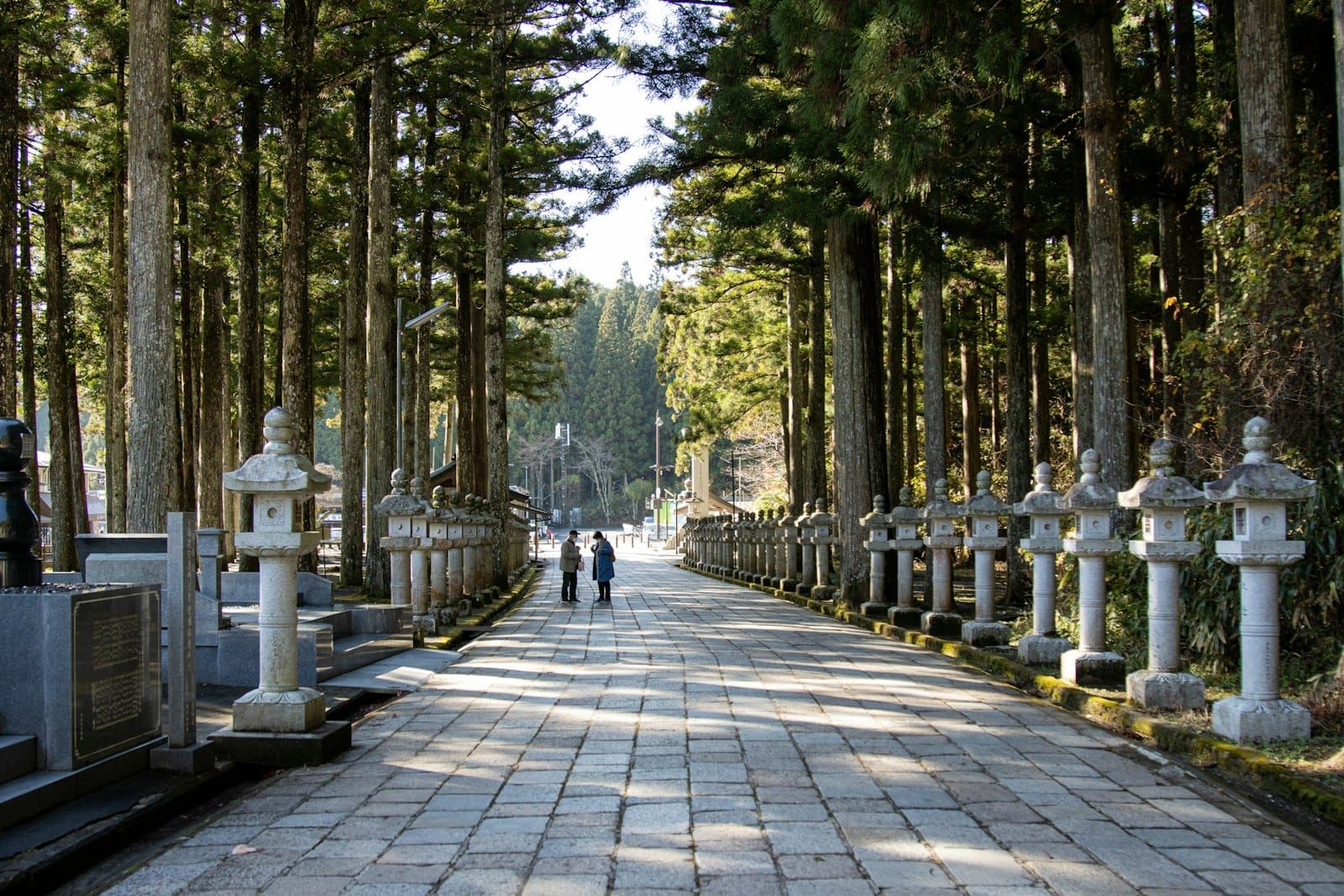
Koyasan — the monastic town Kōbō Daishi founded in 816 — sits at 800 meters on a mountaintop, and getting there is a three-stage ritual in itself: private railway up the foothills, cable car up the cliff, bus into town. It’s simpler than it sounds, because one operator (Nankai) runs all three and sells one ticket that bundles them. The single most important fact: this is not a JR route — your JR pass doesn’t apply, and the trip starts at Namba, not Osaka or Shin-Osaka Station.
Osaka → Koyasan at a glance
| Stage | How | Notes |
|---|---|---|
| 1. Train | Nankai Kōya Line from Namba to Gokurakubashi | The Limited Express Kōya is the comfortable direct option (express surcharge ~¥790 over base fare); ordinary expresses also run — some involve a change at Hashimoto |
| 2. Cable car | Gokurakubashi → Koyasan station | A five-minute funicular up the cliff face; timed to meet the trains |
| 3. Bus | Koyasan station → town center stops | The station sits outside town; the mountain buses take you to Okunoin, the Garan and the temples |
Plan on roughly two hours door to door from Namba depending on connections. The Kōyasan World Heritage Ticket (around ¥3,400 from Osaka; a version without the express surcharge is cheaper) bundles the round trip, cable car and mountain buses with discounts — confirm the current price and versions on Nankai’s official page before buying.
The route, stage by stage
Namba → Gokurakubashi. Nankai’s Kōya Line leaves from Namba — if you’re staying in the Namba/Shinsaibashi area, the trip literally starts at your doorstep. The Limited Express Kōya runs through with reserved seats; cheaper expresses do the same route, some with a cross-platform change at Hashimoto, where the line turns into a genuine mountain railway — the last stretch of single-track curves through forest is one of Kansai’s great rail sections.
The cable car. At Gokurakubashi the funicular carries everyone up the cliff to Koyasan station in about five minutes; departures are timed to the trains, so there’s no real transfer anxiety.
The bus into town. The mountaintop station is outside the town proper — ride the bus to the center (for the Danjo Garan and Kongōbuji) or all the way to the Okunoin-mae end for the great cemetery. Buses are covered by the World Heritage Ticket.

Rather not manage the three stages at all? Guided one-day tours from Osaka include a Koyasan course with the transport handled — the no-transfer version of the mountain:
Book ahead · Klook
Kansai hidden-gems day tour (incl. Koyasan course)
A Kansai hidden-gems day tour from Osaka with a Koyasan course — transport included, for travelers who’d rather not juggle train, cable car and bus.
Check availability →Affiliate link — a small commission may go to Beyond Kansai at no extra cost to you. Disclosure.
Timing your arrival (this matters more here than most places)
If you’re staying in a shukubō temple lodging — and you should — aim to check in by mid-afternoon: temple dinners are served early, and arriving late compresses the best parts of the stay. The clean pattern: late-morning train from Namba, lunch in town, temple check-in, evening Garan walk, dawn Okunoin. How to choose and book the temple (official portal, request service, or direct) is its own decision — our shukubō booking guide walks through it, and some shukubō also list on Booking.com under Koyasan for date-based comparison. (Accommodation links on Beyond Kansai are monetized via Stay22 — a booking may earn us a small commission at no extra cost to you. Disclosure.) Staying overnight also unlocks the mountain after dark — Okunoin at night is a different world from the day-trip version.

Quick FAQ
- How long does it take from Osaka to Koyasan? Roughly two hours from Namba to the town center, depending on connections: train to Gokurakubashi, five-minute cable car, then the bus into town.
- Is there a direct train from Osaka to Koyasan? There’s no single-seat ride to the top — everyone uses the train + cable car + bus chain. The Limited Express Kōya is direct as far as rails go (Namba → Gokurakubashi); the cable car and bus finish the job, timed to connect.
- Which ticket is best? For nearly everyone: the Kōyasan World Heritage Ticket — round trip, cable car, unlimited mountain buses and discounts in one purchase (~¥3,400 with the express; confirm current pricing on Nankai’s page). JR passes are not valid on any stage; with a JR-only pass, Koyasan is a separate ticket.
- Day trip or overnight? The mountain works as a day trip, but the overnight is the point — dawn Okunoin before the tour buses, and temple lodging as the experience itself.
Editor’s note
The route mechanics — Nankai Kōya Line from Namba, the ~¥790 express surcharge, the Gokurakubashi cable car, mountain buses, the World Heritage Ticket’s ~¥3,400 bundle, and the JR-pass exclusion — follow the access section of our complete Koyasan guide, checked against official sources on 2026-07-28 (the World Heritage Ticket price is flagged as an approximate pending re-check against Nankai’s current page — confirm before purchase). No new fares or times are introduced here. Drafted with AI assistance and editor-verified.
Sources
- Koyasan World Heritage Ticket — Nankai Electric Railway official
- Nankai official English visitor site (Koya Line / rapi:t / Koyasan access; replaced dead link, retrieved 2026-08-31)
- Koyasan — the complete guide — Beyond Kansai (founding, access, sights)
- Koyasan temple stay guide — Beyond Kansai (check-in timing, shukubō system)
- Koyasan shukubō booking guide — Beyond Kansai (how to choose and book the temple)