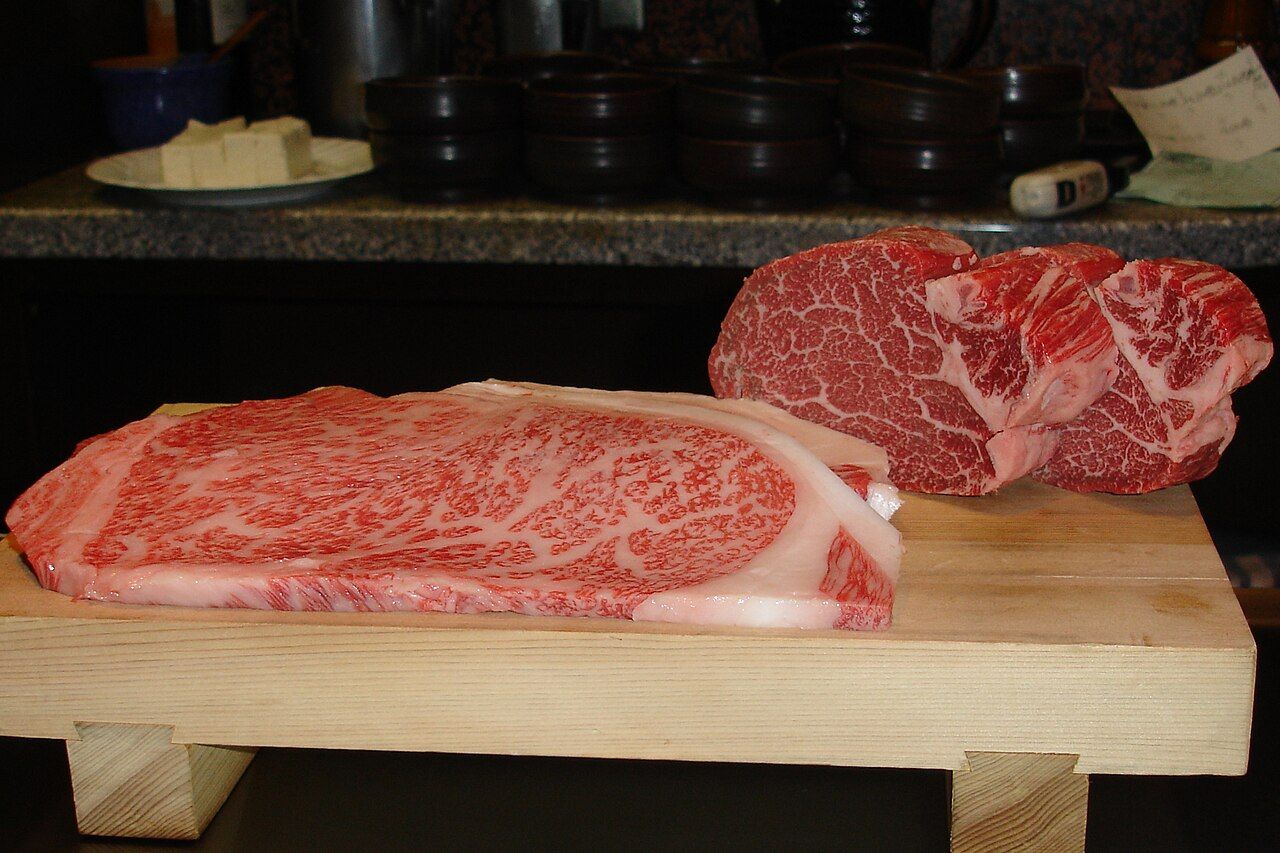
If you’ve eaten incredible beef in Spain or the US — say a thick, dry-aged ribeye, or a slab of Galician Rubia Gallega old-cow steak — and assumed Kobe beef is just a fancier version of that, you’re in for a surprise. It isn’t a better steak. It’s a different category of experience. And before you spend serious money on it, it helps to understand what “Kobe,” “Tajima,” and “wagyu” actually mean, because the labels are widely abused.
Tajima, Kobe, wagyu: untangling the words
- Wagyu simply means “Japanese cattle” — a broad category (and, confusingly, the name is now used for crossbred cattle abroad, too).
- Tajima-gyu is a specific strain of Japanese Black cattle from the Tajima region of northern Hyogo Prefecture.
- Kobe beef is not a different cow — it’s the premium designation given to the very best Tajima beef that meets a strict set of standards.
The clean way to remember it: all Kobe beef is Tajima beef, but not all Tajima beef qualifies as Kobe. Kobe cattle must be Tajima-gyu born, raised, and slaughtered in Hyogo.
The bloodline behind Japanese beef
Tajima cattle were bred for generations within a closed genetic pool, developing a narrow bone structure, calm temperament, and a remarkable capacity for fine, evenly distributed marbling. That genetics matter far beyond Hyogo: an astonishing 99.9% of all registered Japanese Black breeding females in Japan trace their lineage back to a single Tajima bull, Tajiri-go. In a real sense, Tajima is the origin of Japan’s brand-name wagyu.
What makes a steak legally “Kobe”
Kobe is one of the most tightly controlled food brands in the world. To carry the name, the meat must hit, among other criteria:
- a Beef Marbling Standard (BMS) score of 6 or higher,
- a yield grade of A4, A5, B4, or B5,
- and a carcass weight capped under ~500 kg — a rule that specifically discourages farmers from overfeeding cattle just to boost yield.
Only about 3,000–5,000 carcasses qualify as Kobe beef each year. Every Tajima animal gets a 10-digit ID that lets its entire history — lineage, birth, farm, slaughterhouse, wholesaler — be traced. If a restaurant can’t show you a certificate or the official Kobe Beef mark, treat the “Kobe” claim with suspicion.
Why it tastes nothing like a Western steak
Here’s the part that genuinely changes the experience — and it’s not just marketing. Tajima beef’s fat has an unusually low melting point: around 12°C, versus about 25°C for ordinary Japanese Black wagyu. Your body is ~36–37°C, so this fat begins to dissolve the instant it touches your tongue. That’s the literal, physical source of the famous “melt-in-your-mouth” sensation and the light, clean finish.
So compare the philosophies:
- A Rubia Gallega steak from Galicia is, in the words of many who love it, an umami bomb — intense, mineral, deeply beefy lean meat with rich, characterful fat, eaten in big, satisfying portions.
- Kobe / top Tajima is the opposite end of the spectrum: refined, delicate umami and a fat so soft it vanishes. It’s about elegance and texture, not heft.
Our take (opinion): neither is “better” — they’re different pleasures. If you arrive expecting a giant, chewy, char-crusted steak, the best Kobe beef can even feel too soft and rich. Go in expecting a refined, melting, almost buttery experience and you’ll understand the fuss.
How to eat it (so you’re not disappointed)
- Order small. Kobe is extraordinarily rich; a modest portion is often more satisfying than a large one, and a little goes a long way.
- Teppanyaki (grilled before you on an iron plate) is the classic showcase; sukiyaki and shabu-shabu are also superb and let the fat express itself.
- Don’t drown it. Minimal seasoning — often just salt — lets the marbling speak.
- Quality over quantity is the whole point: this is a “taste a few exquisite bites” food, not an “eat a 400 g slab” food.
Where to try it
You’re in the right region: Kobe city and Hyogo Prefecture are the home turf, with specialist teppanyaki and steak houses. Look for restaurants that display the official Kobe Beef certification/mark and can state their supplier — given how often the name is misused, that verification is worth seeking out.
Quick FAQ
- Is Kobe beef just expensive wagyu? No — it’s a strictly certified top grade of Tajima beef from Hyogo, with hard standards (BMS ≥6, A/B 4–5, <500 kg).
- What’s the difference from Tajima beef? Kobe is Tajima beef — the highest-graded slice of it. All Kobe is Tajima; not all Tajima is Kobe.
- Why does it melt like that? Its fat melts at ~12°C, far below normal wagyu (~25°C) and well below body temperature.
- How is it different from a Western steak? Western steaks (e.g. Rubia Gallega) prize intense, beefy lean meat in big portions; Kobe prizes delicate umami and melting fat in small ones.
- How do I avoid fakes? Look for the official Kobe Beef mark/certificate and ask about the supplier.
Editor’s note
This guide pairs an informed food perspective with researched, sourced facts. The Tajima–Kobe relationship, the Tajiri-go bloodline statistic, the Kobe certification criteria, the annual carcass numbers, and the ~12°C fat melting point were all verified against the sources below. The Rubia Gallega comparison and the “order small / manage expectations” advice are flagged as informed opinion. Partially drafted with AI assistance and editor-verified.
Sources
- Tajima Beef: the origin of wagyu — Food in Japan
- 神戸肉流通推進協議会 — Kobe Beef Marketing & Distribution Promotion Association (official body, Japanese; replaced two dead third-party links, retrieved 2026-08-31)
- Kobe & Kobe beef — Feel Kobe (city tourism official, English; retrieved 2026-08-31)
- Kobe Beef vs Wagyu differences — Imperia Caviar