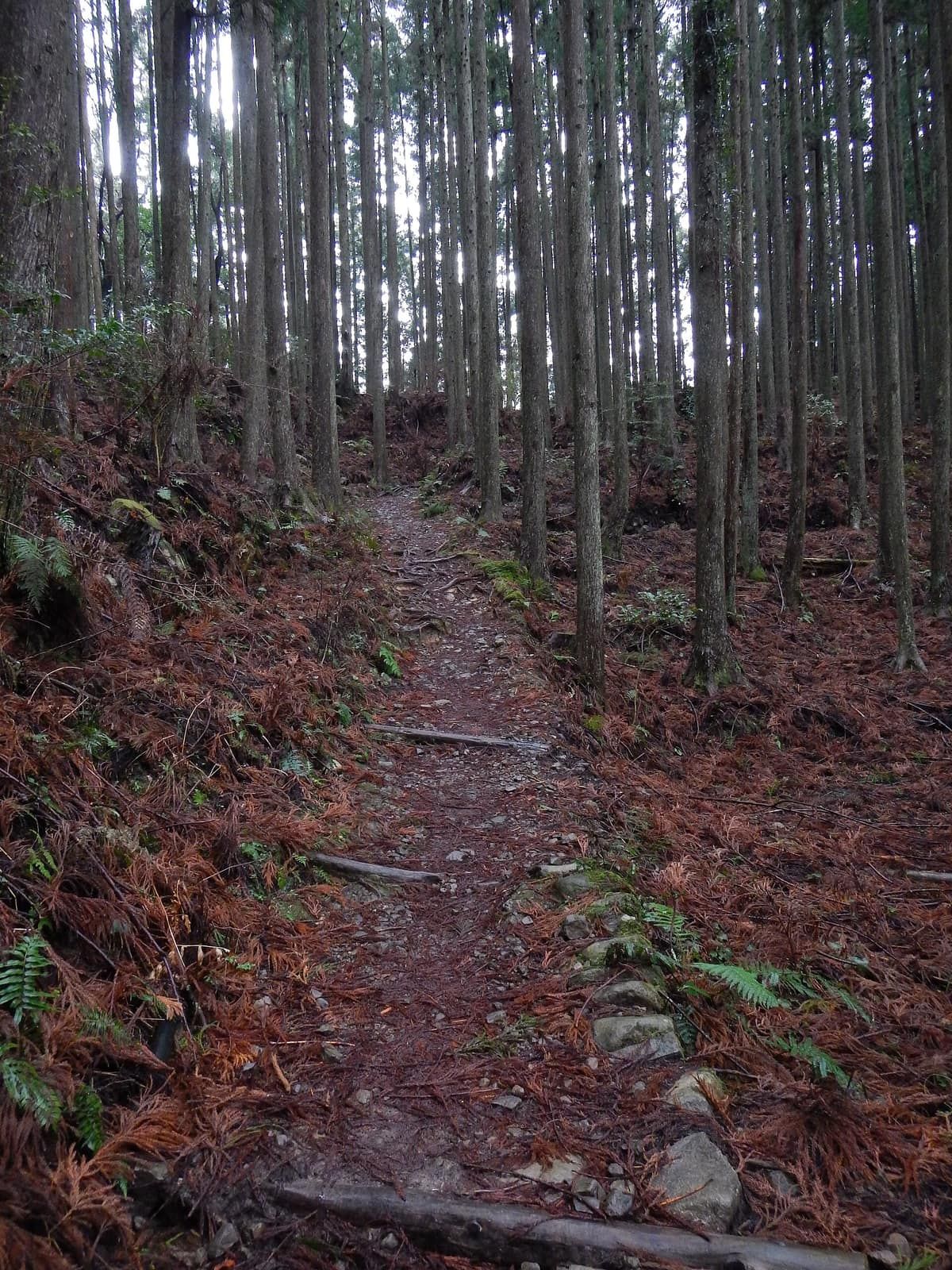
Look at the hero photo for a second: roots, wet stone, fern litter, and a gradient. That’s the honest texture of the Nakahechi, and it answers most packing questions before they’re asked. This guide turns the Tanabe City Kumano Tourism Bureau’s own preparation guidance (their backpack-contents and safety pages, checked 2026-09-16) into a working packing plan — then explains the piece of Kumano logistics that transforms the whole walk: the luggage system that lets you carry only a day pack. The stages themselves live in our day-by-day Nakahechi guide; this is what goes on your back while you walk them.
The official list, annotated
The bureau’s guidance is refreshingly specific. The load-bearing items:
- Rain jacket — year-round, no exceptions. The official wording is that rain gear is essential “at least all year-round in Kumano.” This is a wet, forested mountain corridor; the jacket is the one item you pack before your toothbrush.
- Broken-in walking shoes. Official emphasis is on footwear that’s already molded to your feet — the trail surface above rewards grip and punishes brand-new boots. (Note it says walking/hiking shoes, not mountaineering boots — this is a village-to-village trail, not an alpine one.)
- Layers, not cotton. The official advice: dress in layers and avoid cotton; add a fleece or light down jacket depending on season.
- Water: 500 ml–1 L for short walks, up to 2 L or more for full stages. Villages and vending machines punctuate the route, but the long forest stretches between them don’t.
- A real blister kit. The official first-aid list runs bandages, blister covers, antiseptic, gauze and tape, painkillers, allergy and stomach medicine — the blister covers are the line the trail itself wrote.
- Your phone, treated as gear. The bureau lists it as weather station, map/GPS, camera, translator, alarm and pre-loaded emergency numbers in one. Carry a battery pack; the forest eats charge.
Season by season
- Spring & autumn (the peak seasons, officially): the layers system as written — the fleece earns its slot at oji-shrine rest stops even when the walking is warm.
- Summer: the bureau runs a dedicated heat-safety advisory — lightweight long pants and long sleeves are its hot-weather recommendation, partly because the season brings out biting insects; water goes to the 2 L end and then some.
- Winter: officially less severe than the June–August rainy heat, but nights can reach 0°C — the light-down option, gloves and a hat enter the pack, and the shorter daylight matters more than the cold: start stages early.
The luggage system (this is the unlock)
You do not haul your travel bag over those roots. Per the bureau’s official luggage page (2026-09-16):
- The daily luggage shuttle moves your main bag inn-to-inn while you walk with a day pack — with real conditions attached: it works between accommodations booked through KUMANO TRAVEL (the bureau’s own reservation system), wants booking at least 20 days in advance, takes no last-minute on-site changes and gives no refunds for reduced bag counts after confirmation, and bags must be fully enclosed, nothing dangling.
- Missed the 20-day window? The official fallback is Japan’s next-day shipping trio — Yamato TA-Q-BIN, Japan Post Yu-Pack, Sagawa — from convenience stores and hotels at roughly ¥940–2,510 per bag by size. Ship the big bag ahead to your post-walk hotel and the problem dissolves.
- Day-trippers and stage-walkers: Kii-Tanabe station-area storage runs about ¥400–700 per day (tourist information center, cafés, coin lockers — lockers max three days).
 Chikatsuyu, mid-route: shops, a bus stop, beds — the trail’s built-in reset button. Photo: Nekosuki / Wikimedia Commons, CC BY-SA 4.0

Plan the escape routes with the gear
Packing for the Nakahechi includes packing information: the bus line parallels the route, so any over-ambitious day can be shortened at the next road crossing — carry the current timetable (paper or screenshot; don’t count on signal). The two structural outs are Chikatsuyu at the route’s midpoint and the Hosshinmon-ōji shortcut that turns the long Hongu day into its celebrated final 7 km — both mapped in the stage guide. And the finish line is a bath: the trail decants into the Hongu valley’s hot-spring villages, where Tsuboyu’s 30-minute World-Heritage tub and Kawayu’s dig-your-own riverbed are the actual reward for carrying the pack right.
 What the pack is for: Yunomine’s waters at the end of the trail. Photo: Nekosuki / Wikimedia Commons, CC BY-SA 4.0

Recommended · SafetyWing
SafetyWing Nomad Insurance
Multi-day walking on steep, remote terrain with hospitals a valley away is the textbook case for travel medical cover — flexible monthly coverage, claims in English.
Check SafetyWing plans →Affiliate link — a small commission may go to Beyond Kansai at no extra cost to you. Disclosure.
Two inns that solve packing problems
Both verified on official listings (2026-09-16), and each fixes a different logistics gap:
- Kiri-no-Sato Takahara — the ridge-top lodge at the top of Day 1’s first climb, with balconies over the valley (its name means “village of mist” — mornings often prove it) and staff support in English and Spanish per its official site. Sleeping here shortens the brutal version of Day 1 into two humane halves. Check Kiri-no-Sato Takahara on Booking.com.
- Minshuku Chikatsuyu — the riverside minshuku at the route’s midpoint, listed on the bureau’s official KUMANO TRAVEL system with an onsen bath and dinner, breakfast and packed-lunch service — that packed lunch is the answer to “what do I eat mid-stage?”, which no convenience store on the ridge will solve. Check Minshuku Chikatsuyu on Booking.com.
(Accommodation links on Beyond Kansai are monetized via Stay22 — a booking may earn us a small commission at no extra cost to you. Disclosure.)
Quick FAQ
- Do I need hiking boots for the Kumano Kodo? Broken-in walking or hiking shoes, per the official guidance — grip and familiarity matter more than ankle armor on this surface. New boots are the classic blister factory.
- How does the luggage shuttle work? Inn-to-inn daily transfer for KUMANO TRAVEL bookings, reserved 20+ days ahead, strict no-change terms. Inside that window, next-day shipping (¥940–2,510/bag) to your post-walk hotel is the official fallback.
- How much water should I carry? Officially 500 ml–1 L for short sections and 2 L or more for full stages — refill in villages, don’t count on the forest.
- What’s the one non-negotiable item? The rain jacket — official guidance calls rain gear essential year-round in Kumano.
- Can I bail mid-stage if I’ve overpacked the day? Yes — the parallel bus line is the route’s built-in escape hatch; Chikatsuyu and Hosshinmon-ōji are the standard cut points (stage guide).
Editor’s note
This is a preparation guide with no personal-experience claims about a continuous through-walk. All packing guidance — year-round rain gear, layers/no-cotton, fleece-or-light-down by season, broken-in shoes, 500 ml–2 L water, the first-aid list with blister covers, the phone’s listed roles, summer long-sleeve/insect and heat-safety advice, and winter’s 0°C nights — is drawn from the Tanabe City Kumano Tourism Bureau’s official preparation, tips and heat-safety pages; the luggage-shuttle terms (KUMANO TRAVEL bookings, 20-day lead, no on-site changes, enclosed bags), the ¥940–2,510 shipping alternatives and the ¥400–700 Tanabe storage rates from the bureau’s official luggage page — all retrieved 2026-09-16. Kiri-no-Sato Takahara’s language support is per its official site; Minshuku Chikatsuyu’s onsen and meal services per its official KUMANO TRAVEL listing (both 2026-09-16). Terms and prices change — recheck the official pages when you book. Drafted with AI assistance and editor-verified.
Sources
- Trekking backpack contents — Tanabe City Kumano Tourism Bureau official (rain gear, layers, water, first aid, phone; retrieved 2026-09-16)
- Tips & safety — Tanabe City Kumano Tourism Bureau official (footwear, no-cotton layers, seasons, winter 0°C nights; retrieved 2026-09-16) / Heat safety — official (summer long sleeves, insects; retrieved 2026-09-16)
- Luggage shuttle & storage — Tanabe City Kumano Tourism Bureau official (20-day lead, terms, shipping ¥940–2,510, storage ¥400–700; retrieved 2026-09-16)
- Kiri-no-Sato Takahara — official (ridge location, English/Spanish support; retrieved 2026-09-16) / Minshuku Chikatsuyu — KUMANO TRAVEL official listing (onsen, meals incl. packed lunch; retrieved 2026-09-16)
- Kumano Kodo Nakahechi day by day — Beyond Kansai (the stages this list is packed for)