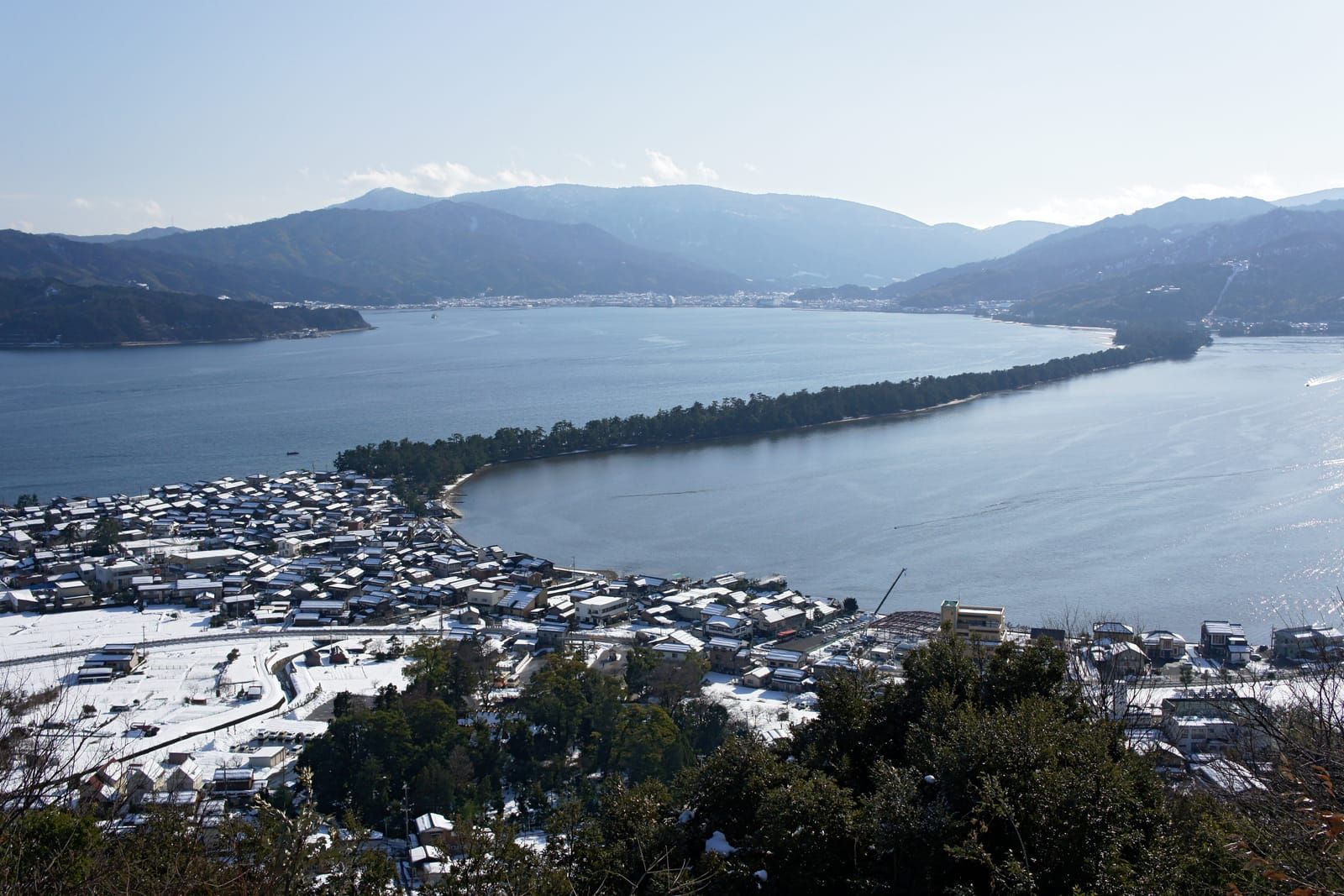
Amanohashidate — the pine-covered sandbar counted among Japan’s Three Views since the seventeenth century — is the most accessible of northern Kyoto’s Sea-of-Japan sights: a direct limited express runs from Kyoto Station, and the station at the other end sits right at the sandbar’s southern foot. Here’s the clean version of the trip, plus the one railway detail that catches pass holders.
Kyoto → Amanohashidate at a glance
| Route | How | Total time | Fare (one way) |
|---|---|---|---|
| 1. Hashidate limited express | Direct, Kyoto Station → Amanohashidate Station | ~2 h | Ltd. express fare (JR + Tango Railway sections — see the pass caveat) |
| 2. Highway bus | Kyoto Station → Amanohashidate | ~2 h | ¥3,200 (¥3,400 peak); 5/day, reservation required |
| 3. Car | Kyoto Jukan Expressway | ~2 h | tolls/fuel vary |
Seasonal services and fares shift — check the latest schedule on the official pages before you build a day around one departure. If you’d rather hand the whole day to someone else, Kyoto-departure guided tours (Amanohashidate day trips included) run with transport handled — browse Kyoto tours on Viator. (Affiliate link — a small commission may go to Beyond Kansai at no extra cost to you. Disclosure.)
Route 1 — The Hashidate limited express (and the pass caveat)
The Limited Express Hashidate runs direct from Kyoto Station in about 2 hours. The catch worth knowing: the final stretch runs on the Kyoto Tango Railway (the private “Tantetsu” line operated by WILLER TRAINS), not JR — so on a JR-only rail pass, the non-JR section is charged separately. The Kansai WIDE Area Pass covers the whole run including the Tantetsu section (sold on Klook as well as officially — affiliate link; small commission possible at no extra cost to you, disclosure). Seat reservations are recommended on weekends. This is the comfortable, flexible option, with more departures than the bus.
Route 2 — The highway bus
Tankai’s highway bus from Kyoto Station does the trip in about 120 minutes for ¥3,200 one way (¥3,400 in peak periods) — 5 departures a day, reservation required, bookable online (2% online discount) or by phone. It usually beats the train on price and matches it on time; the trade-offs are fixed departures and highway scenery. Full details of both routes — plus the seasonal direct bus that continues to Ine — are in our Ine access guide, which uses the same corridor.
Route 3 — Driving
About 2 hours from Kyoto via the Kyoto Jukan Expressway. A car makes sense if Amanohashidate is one stop on a bigger Tango Peninsula loop — our 3-day northern Kyoto itinerary is built exactly that way.
 You can walk or cycle the sandbar itself — thousands of pines line the path between the two shores. Photo: Shift / Wikimedia Commons, CC BY-SA 3.0

Arriving: what’s where
Amanohashidate Station is on the southern shore, steps from the sandbar’s entrance, the rotating bridge and the boat piers. The two famous overhead views sit on opposite shores — Amanohashidate View Land on the station side, Kasamatsu Park across the bay — and the classic day walks or cycles the sandbar between them. For the hour-by-hour version with lift fares, the ¥1,200 bike-and-boat combo and the full loop, use our one-day itinerary; which viewpoint to prioritize and the culture along the bar are in the full Amanohashidate guide.
Continuing to Ine: the funaya boathouse village is about an hour up the coast on the Tankai local bus — capped at ¥400 thanks to the area’s zone-fare system. Same-day pairing works well; here’s how to split the day, and why staying overnight in Ine beats the day trip.
 The bay view from the Kasamatsu side — the “bridge to heaven” angle. Photo: 663highland / Wikimedia Commons, CC BY 2.5

Quick FAQ
- How long does it take from Kyoto to Amanohashidate? About 2 hours whichever way you go — direct limited express, highway bus, or car.
- Is there a direct train from Kyoto? Yes — the Hashidate limited express runs direct from Kyoto Station. Just note the final section is the private Tango Railway, charged separately on JR-only passes.
- Train or bus — which is better? Near-identical journey times. The train wins on comfort, frequency and flexibility; the bus wins on a fixed cheap price (¥3,200) if its 5-a-day timetable fits. With a JR pass covering the JR section, the train usually wins overall despite the Tantetsu top-up.
- Can I combine Amanohashidate and Ine in one day? Yes — they’re an hour apart on the same ¥400-capped bus line. Do the sandbar in the morning and Ine’s boathouses in the afternoon, or flip it and sleep in Ine.
Editor’s note
All route facts here — the Hashidate’s ~2-hour direct run and the Tango Railway pass caveat, the highway bus’s ¥3,200/¥3,400 fare, 5 daily departures and reservation requirement, the ~2-hour drive via the Kyoto Jukan Expressway, and the ¥400 zone-capped local bus onward to Ine — were verified against Tankai’s and the operators’ official pages on 2026-07-27 for our Ine access guide, which shares this corridor; no new figures are introduced in this article. Viewpoint and sandbar details follow our fact-checked Amanohashidate guide. Timetables change seasonally — confirm on the official pages below. Drafted with AI assistance and editor-verified.
Sources
- Kyoto highway bus line — Tankai official (¥3,200 fare, ~120 min, 5/day, reservation)
- Local route buses & zone fare cap — Tankai official (¥400 cap to Ine)
- Kyoto Tango Railway (WILLER TRAINS) — official
- Amanohashidate — Beyond Kansai (viewpoints, the sandbar, Three Views history)
- How to get to Ine from Kyoto — Beyond Kansai (the same corridor, continued)