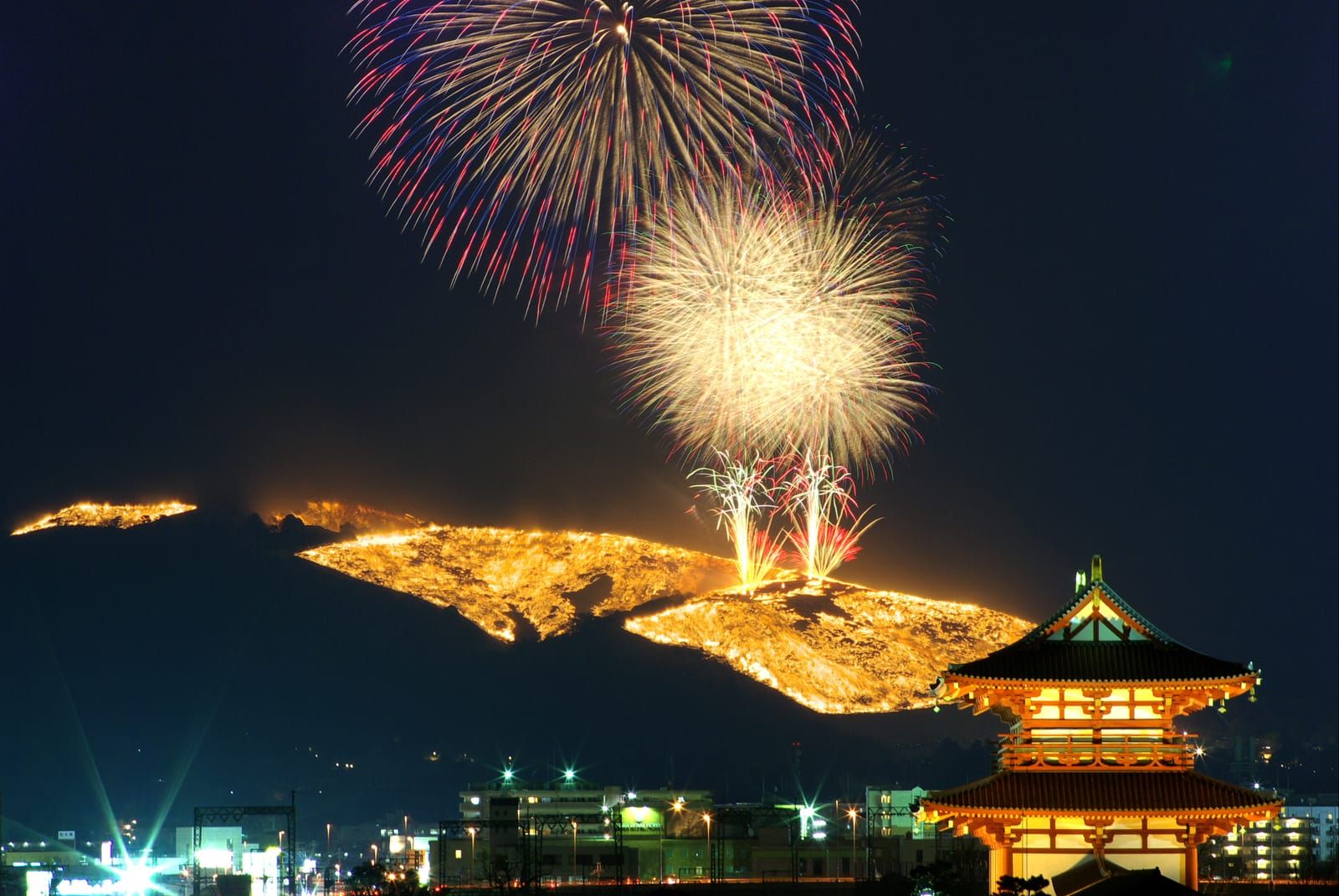
Once a year, on the fourth Saturday of January, Nara sets fire to the grassy hill that rises behind its deer park. The Wakakusa Yamayaki (“burning of Mt. Wakakusa”) is a torch procession, a fireworks display and then a controlled burn of about 33 hectares of hillside, watched from the whole city. It is one of the few Kansai winter events with a published English timetable, and — unusually for Japan — it has no rain date: it happens, or it is cancelled. Here is the 2027 schedule as the organizers published it, where to stand, and how to get there from Osaka.
The short answer: Saturday January 23, 2027. Fireworks at 18:15, the hill is lit at 18:30, and it burns for up to an hour. Arrive in Nara by mid-afternoon, watch the torch procession leave Kasuga Taisha’s Tobihino meadow at 17:05 if you want the ritual, and pick your viewing spot — anywhere in the city with a view of the hill works — before 17:30.
Yamayaki 2027 at a glance
| Item | Detail (official site, checked 2026-10-27) |
|---|---|
| Date | Saturday January 23, 2027 — the event is held on the 4th Saturday of January |
| Cancellation rule | Held in light rain or snow; cancelled in severe weather with no postponement. Go/no-go is announced on the official site by 10:00 on the day |
| Fireworks | 18:15 (the city tourism association describes “about 500 or more” shells) |
| Burn | 18:30, lasting until around 19:30; about 33 ha, 3.8 km perimeter |
| Paid viewing | Foothill paid area (standing) and the Nara Park Bus Terminal rooftop — 2027 prices to be posted early November, sales from mid-November 2026 |
| Summit | Closed — no access on foot or by car on the day |
| Traffic | Restrictions roughly 15:00–20:00; full closure (including buses and taxis) around 18:00–19:30; the Shin-Wakakusayama Driveway closed about 14:00–20:00; no event parking |
The day’s timetable
The organizers’ published sequence (times approximate for the procession):
| Time | What happens | Where |
|---|---|---|
| 16:45 | Sacred-fire ceremony (Goshinka Hōtai-sai) at the great bonfire | Tobihino meadow, Kasuga Taisha grounds |
| 17:00 | Fire brigade send-off ceremony (about 300 firefighters assemble) | Stage at the foot of Mt. Wakakusa |
| 17:05 | Torch procession departs Tobihino | via Mizuya bridge (~17:25) |
| 17:25 | Torches lit | near Mizuya Shrine |
| 17:40 | Rite at Nogami Shrine | foot of the hill |
| 18:15 | Great bonfire lit; fireworks | foot of the hill |
| 18:30 | The hillside is lit | Mt. Wakakusa |
| ~19:30 | Burn complete | — |
Watch the procession from the pavements — following or running alongside it is prohibited, and the organizers say they will restrict passage along the route if crowds build. Daytime extras on the same day include a deer-cracker throwing contest at the foot of the hill (10:00–13:30, per the city tourism association).

Where to watch
The official FAQ’s own line is the useful one: “anywhere in Nara city with a view of Mt. Wakakusa” works — this is a hill burning above a low-rise city, not a stadium event. The organizers list four main areas:
- Foothill paid viewing area — standing room at the base of the hill, closest to the fire and the fireworks. Reception at the Nara Kasugano International Forum Iraka from 14:30, entry from 15:00, no admission after 17:30; paper ticket. The 2027 price had not been posted at the time of writing (2026 tickets were sold in advance; check the official ticket page from early November).
- Nara Park Bus Terminal rooftop — the other paid option, with the burn framed above the park.
- The park itself — the Kasugano-enchi and Ukigumo-enchi lawns and the areas around the Great Buddha Hall approach; free, flat, and where most of the crowd goes. Arrive before the procession leaves at 17:05 if you want a front row.
- Heijō Palace site — the wide-open former palace grounds west of the centre, further away but uncrowded, with the whole hill in profile.
One warning from the organizers, worth planning around: right after the fireworks (around 18:30) the foothill paid area and the Great Buddha Hall intersection become extremely crowded, and the walk back to Kintetsu Nara Station can take about an hour. Watching from the Kasugano lawns and leaving a little after the crowd — the hill keeps burning until about 19:30 — is the sane version.
Getting there from Osaka
- Kintetsu: Osaka-Namba → Kintetsu Nara on the rapid express, about 36 minutes, ¥680 (route search, 2026-10-27). This is the right station: the event reception is about a 20-minute walk east from Exit 2, through the park.
- JR: Osaka → JR Nara on the Yamatoji Rapid, about 50 minutes, ¥840 — but JR Nara is roughly a 40-minute walk from the reception area (organizers’ figure), so Kintetsu wins for this event.
- Bus on the day: the city loop bus (outer circuit) to Todaiji Daibutsuden · Kasuga Taisha-mae then 5 minutes on foot — note that the last bus on the day departs at 15:35 because of the road closures.
- Do not drive. There is no event parking, the roads around the park are restricted from about 15:00 and fully closed, including to buses and taxis, around 18:00–19:30.
For the rest of the city — Tōdai-ji, the old town, the Nishinokyō temples — our Nara guide beyond the deer park is the daytime plan, and Nara’s medicine heritage is the quieter afternoon. If you’d rather do the event as an evening from an Osaka base, Kintetsu makes that easy; our Osaka base guide covers Namba, which is the right side of the city for the Kintetsu line.
Sleeping in Nara instead: two inns by the park that we list in the Nara city guide — the classic ryokan Asukasou, a few minutes from Kōfuku-ji (check Asukasou on Booking.com), and the natural-onsen business hotel Onyado Nono Nara by JR Nara (check Onyado Nono Nara on Booking.com) — spare you the hour-long shuffle back to the station after the burn. (Accommodation links on Beyond Kansai are monetized via Stay22 — a booking may earn us a small commission at no extra cost to you. Disclosure.)
Mt. Wakakusa on any other day
The hill is open to walk (for a small fee, in its own season) when it is not on fire, and the view back over the city is the point. If your dates miss January 23, the way to see it with transport handled is a Klook day tour from Osaka: Nippombashi 9:00–18:00, about four hours in Nara Park covering Tōdai-ji, Mt. Wakakusa and Kasuga Taisha, then two hours at the Ikoma Sanjō amusement park on the way back; guides in English and Chinese; meals not included; free cancellation up to 24 hours before (Klook, checked 2026-10-27). It is a general Nara day with an amusement-park detour, not a Yamayaki event — on the day of the burn itself, go by Kintetsu as above.
Book ahead · Klook
Nara Park, Mt. Wakakusa & Ikoma Sanjo Amusement Park — full-day guided tour from Osaka
Nara Park, Tōdai-ji, Mt. Wakakusa and Kasuga Taisha plus the Ikoma Sanjō amusement park, from Osaka Nippombashi 9:00–18:00. English/Chinese guide; meals extra; free cancellation 24 h before.
Check availability →Affiliate link — a small commission may go to Beyond Kansai at no extra cost to you. Disclosure.

January in Nara: dress for standing still
Japan Meteorological Agency normals (1991–2020) for the Nara observatory, retrieved 2026-10-27:
| Month | Mean | Daily high | Daily low | Snowfall (monthly total) |
|---|---|---|---|---|
| December | 6.8 °C | 11.6 °C | 3.0 °C | 0 cm |
| January | 4.5 °C | 8.7 °C | 0.8 °C | 1 cm |
You will be outdoors from about 17:00 to 19:30, standing on open lawn, with the temperature falling through the evening toward a low that averages just above freezing. Treat it as a winter-sports-spectator problem: insulated boots, a hat, gloves, something to sit on, and a hot drink from a convenience store on the way in. Snow is rare but not unknown (the January normal is a token 1 cm), and the event goes ahead in light snow.
Quick FAQ
- When is the Wakakusa Yamayaki in 2027? Saturday January 23, 2027 — fireworks 18:15, the hill lit at 18:30 (Wakakusa Yamayaki Executive Committee, official site).
- What if it rains? It is held in light rain or snow and cancelled outright in severe weather — there is no postponement date. The decision is posted on the official site by 10:00 on the day.
- Is it free? Watching from the park lawns, the Heijō Palace site or anywhere with a view of the hill is free. The foothill area and the bus-terminal rooftop are paid; 2027 prices are due in early November 2026.
- Where is the best place to watch? Closest: the paid foothill area (entry 15:00–17:30). Free and easy: the Kasugano-enchi / Ukigumo-enchi lawns in Nara Park. Uncrowded with the full profile: the Heijō Palace site.
- How do I get there from Osaka? Kintetsu rapid express from Osaka-Namba to Kintetsu Nara (about 36 minutes), then a 20-minute walk east through the park. Avoid JR Nara (40 minutes’ walk) and do not drive.
- How cold is it? Nara’s January normals: mean 4.5 °C, lows 0.8 °C (JMA 1991–2020) — and you are outside after dark.
Editor’s note
This is an event-logistics guide and makes no personal-experience claims. The 2027 date, the fourth-Saturday rule, the full timetable, the no-postponement and 10:00 go/no-go rules, the viewing areas and paid-area reception times, the summit closure, the traffic restrictions, the “about an hour back to Kintetsu Nara” warning, the walking times from Kintetsu Nara (20 min) and JR Nara (40 min), and the 15:35 last bus were read from the Wakakusa Yamayaki Executive Committee’s official site (Japanese and English pages) on 2026-10-27; the date and severe-weather cancellation were cross-checked on the Nara City Tourism Association’s event page, which is also the source for the “about 500 or more” fireworks figure and the deer-cracker contest. Train fares and times are from a route search on 2026-10-27, not from the operators’ pages. Temperatures are JMA 1991–2020 normals for Nara. The paid-area price for 2027 was not yet published; we will add it when it is. Drafted with AI assistance and editor-verified.
Sources
- Wakakusa Yamayaki 2027 — Executive Committee official site (date, timetable; retrieved 2026-10-27) / English page (schedule; retrieved 2026-10-27) / About (4th Saturday rule, procession times) / FAQ (no postponement, 10:00 decision, viewing anywhere with a view) / Access (walking times, bus, traffic restrictions, no parking) / Tickets (2027 prices in early November, sales mid-November) / Highlights (33 ha, 3.8 km, 300 firefighters)
- Wakakusa Yamayaki 2027 — Nara City Tourism Association official (2027/1/23, cancelled in severe weather, fireworks, deer-cracker contest; retrieved 2026-10-27)
- JMA 1991–2020 normals — Nara (retrieved 2026-10-27)
- Osaka-Namba → Kintetsu Nara / Osaka → JR Nara fares and times — Ekitan route search (retrieved 2026-10-27)
- Nara City beyond the deer park — Beyond Kansai / Best area to stay in Osaka — Beyond Kansai