If Kyoto and Osaka are Kansai’s polished face, Wakayama is its wild edge — a long, deeply-indented Pacific coastline, mountains thick with sacred forest, white-quartz beaches, ancient hot springs, and the single most important pilgrimage landscape in Japan. It’s also, crucially, a driving region: the headline sights are strung along the coast and tucked up mountain valleys, and the reward for the extra travel time is a nostalgic, deeply rural Japan that day-trippers from Osaka simply never see.
Wakayama rewards travelers who slow down. You can tick off a highlight or two on a day trip, but the prefecture really opens up over two or three days of coastal driving, with a night in an onsen town and a morning among ancient shrines. This is the overview; several of the highlights below open into their own deep-dive guides.
Wakayama City and the northern coast
Most trips begin in Wakayama City, whose landmark is Wakayama Castle — first built in 1585 on the orders of Toyotomi Hideyoshi, badly damaged in World War II, and rebuilt in 1958. Its hilltop keep gives a good orientation to the region before you head south.
A short hop away, the artificial island of Wakayama Marina City packs an easy half-day. Its Kuroshio Market is a lively fish market where a tuna-cutting show runs free most days (12:30 and 15:00, with an extra 11:00 show on weekends and holidays — check the market’s schedule) — and you can grill your own just-bought seafood at a seaside terrace. Right next door, Porto Europa is a small, Mediterranean-themed amusement park (water ride, coaster, Ferris wheel) that’s an easy add-on for families.
Shirahama: white sand, sea cliffs, and a 1,350-year-old onsen
Further down the coast, Shirahama is Kansai’s premier beach resort and the prefecture’s easiest crowd-pleaser:
- Shirarahama Beach is a ~620 m stretch of brilliant white sand that’s about 90% quartz — so pure it’s officially a “sister beach” to Hawaii’s Waikiki. In the summer holidays it fills with young crowds; the rest of the year it’s a gorgeous, calmer stroll.
- Adventure World combines a safari park, zoo, aquarium and rides (about 120 species / 1,600 animals). It was long famous for its giant panda breeding program, but its last four pandas returned to China in June 2025 — don’t plan a visit around pandas; the safari and marine shows are now the draw.
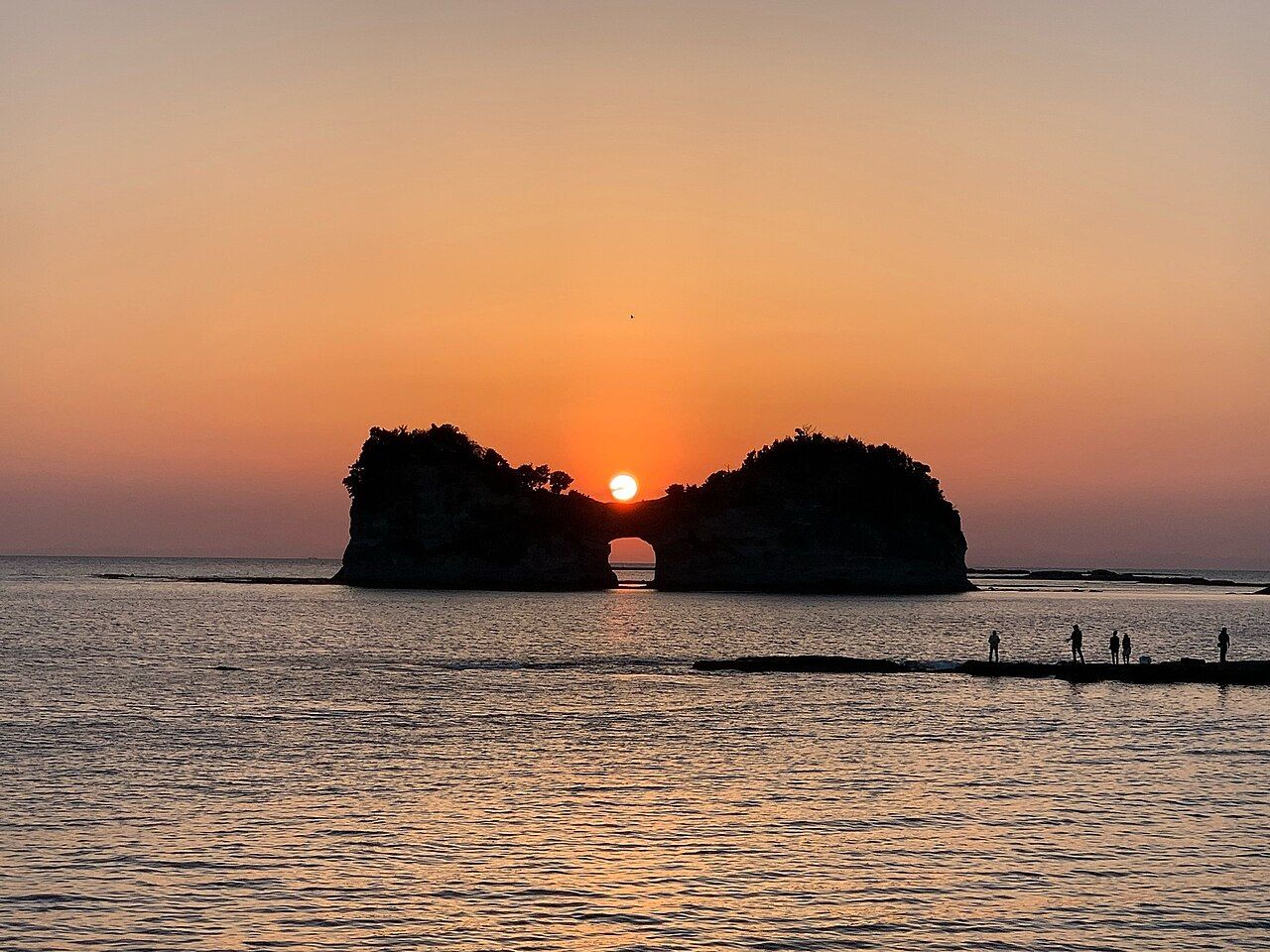
- Sandanbeki is a wall of sea cliffs up to ~50 m high, with an elevator dropping 35 m to sea caves that once hid the boats of a medieval naval clan. Nearby Engetsu Island is a 130 m rock with a natural “moon” hole, and on certain evenings the setting sun lines up perfectly through it — one of Wakayama’s signature photographs.
- Shirahama Onsen is one of Japan’s “Three Ancient Hot Springs,” with over 1,350 years of history and mentions in the 8th-century Manyōshū and Nihon Shoki. Soaking in a cliffside open-air bath above the Pacific here is the classic Shirahama experience.
Kumano: the sacred heart
Inland and to the south lies Kumano, a landscape of sacred mountains, three grand shrines (Kumano Sanzan — Hongū, Nachi, Hayatama), and the Kumano Kodo, the 1,000-year-old pilgrimage network that is, with Spain’s Camino de Santiago, one of only two pilgrimage routes recognized as UNESCO World Heritage (complete both and you can become a “Dual Pilgrim”).
The iconic image is Nachi: the towering scarlet pagoda of Seiganto-ji set against Nachi Falls — at 133 m, the tallest single-drop waterfall in Japan — reached up the moss-and-cedar Daimonzaka stone staircase. At Hongū, the Ōyunohara Ōtorii — the largest torii gate in the world (33.9 m tall, 42 m wide) — marks the shrine’s original riverside site. Each July, the Nachi Fire Festival sees young men carry 50-kg flaming torches down the steep approach to purify the path of the falls’ twelve deities — one of Japan’s most dramatic festivals.
Some travelers walk the old stone trails for days; others simply drive between the shrines — both are legitimate. Because it’s the single richest topic in Wakayama (and it answers the common “does it connect to Mie?” question — yes, via the Iseji route), we’ve given it a full guide: Walking the Kumano Kodo (day-by-day stages: the Nakahechi guide).
Onsen in the mountains: a UNESCO bath you can sit in
Tucked into the Kumano mountains near Hongū are two of Japan’s most atmospheric hot springs:
- Yunomine Onsen is home to Tsuboyu — one of the only hot springs in the world you can bathe in that is inscribed as UNESCO World Heritage. This tiny, color-changing riverside tub is rented in 30-minute private sessions, and pilgrims have purified themselves here for centuries; there’s even a public basin where you can slow-cook eggs and vegetables in the spring water. Full queue-system details: our Tsuboyu guide.
- Nearby Kawayu Onsen lets you dig your own bath in the gravel of the riverbed, where hot water bubbles up through the cool river — gloriously low-key, and a perfect reward after a day on the Kumano Kodo.
Koyasan, islands, and inland corners
Wakayama also holds Koyasan (Mt. Kōya), the mountaintop monastic center of Shingon Buddhism — the Okunoin cemetery, temple lodgings (shukubo), and vegetarian monk cuisine make it one of Kansai’s most profound overnight experiences (our complete Koyasan guide; what a temple stay is like). Off the coast near Wakayama City sits Tomogashima, a cluster of islands whose ruined Meiji-era forts, reclaimed by forest, are widely described abroad as a real-life “Castle in the Sky” — a short ferry hop beloved by more adventurous travelers (our Tomogashima spot entry). Inland, valleys like Kudoyama — the quiet hideout of the Sanada samurai clan — and the broader mountain interior hide shrines, temples, and photogenic countryside that almost never make English itineraries.
From the ground (first-hand): away from the resort strips, the drive through Wakayama’s interior is genuinely nostalgic — the rural Japan of rice terraces, river gorges, and old farmhouses that’s increasingly hard to find. Keep a camera handy; the mountain stretches are full of unmarked photo spots.
What to eat (and take home)
Wakayama punches far above its weight on food:
- Wakayama ramen — known locally as “chūka soba,” it’s a prefectural obsession, most famously in a rich tonkotsu-shōyu (pork-and-soy) broth; the style is said to have grown up around the old streetcar stops in Wakayama City.
- Mehari-zushi — big rice balls wrapped in pickled mustard-leaf, the traditional fuel of Kumano woodcutters and pilgrims.
- Nare-zushi — an ancient fermented sushi for the adventurous.
- Kishū Nankō-ume — Wakayama, historically Kishū, has the highest ume (Japanese plum) yield in Japan, centered on Minabe, and its Nankō-ume is the country’s top plum brand: large, thick-fleshed, and turned into premium umeboshi, ume syrup, and umeshu plum wine, from everyday snacks to high-end gift boxes.
- Mikan and citrus — the prefecture is one of Japan’s great mandarin regions, with a long list of other citrus.
- And along the coast, the catch — tuna at Kuroshio Market and seafood everywhere.
Getting there & around
- By train: the JR Limited Express Kuroshio runs from Shin-Osaka and Tennoji down the coast (Wakayama, Shirahama, and on toward Shingū/Nachi). Kii-Tanabe is the gateway for the Kumano Kodo.
- By car: strongly recommended if you want the full coast, Shirahama’s spread-out sights, Kumano’s shrines and onsen, the inland valleys, or winter travel. Pick up a car at a city or station and follow the coast south.
- Reality check: distances are deceptive — the coast and mountain roads wind, so journeys take noticeably longer than the map suggests. This is a region to slow down for, not to speed-run.
Recommended · SafetyWing
SafetyWing Nomad Insurance
Before you go: Wakayama’s wild edges — the islands, the cliffs, the mountain interior — are part of the appeal, and the nearest medical care is usually an hour-plus from wherever you’re standing. Monthly, flexible coverage with claims handled in English.
Check SafetyWing plans →Affiliate link — a small commission may go to Beyond Kansai at no extra cost to you. Disclosure.
Suggested itineraries
- Coast (2 days): Wakayama City/Marina City → Shirahama (beach, Sandanbeki, onsen overnight) → back. Easy, family-friendly, mostly by train.
- Kumano (2–3 days): Kii-Tanabe → Kumano Kodo day walk or shrine drive → night at Yunomine/Kawayu onsen → Nachi Falls. The spiritual core.
- Grand loop (4+ days): combine the coast, Kumano, and a night at Koyasan — Wakayama’s full range, best by car.
When to go
- Summer: beaches (Shirahama and the southern coast).
- Spring/autumn: ideal for the Kumano Kodo and coastal driving; ume blossoms around Minabe in late winter/early spring.
- July: the Nachi Fire Festival.
- Year-round: Kumano’s shrines, Shirahama’s onsen, and the markets.
Quick FAQ
- Do I need a car? For Marina City + Shirahama by train you’re fine; for Kumano’s onsen, the inland, and flexibility, yes.
- How long? Two days for coast + Shirahama; add two or three for Kumano and Koyasan.
- Best single sight? Nachi Falls with the pagoda is the icon; Shirahama is the easiest family day.
- Where’s the famous bath? Tsuboyu at Yunomine Onsen — one of the only UNESCO World Heritage hot springs in the world you can actually bathe in.
- What should I bring home? Kishū Nankō umeboshi or ume syrup, and Wakayama mikan in season.
Editor’s note
This guide pairs a first-hand sense of the region with researched, sourced facts. Wakayama Castle’s history, Kuroshio Market’s tuna-show times, Shirahama’s beach/onsen/Adventure World details, Nachi Falls and the Ōyunohara torii, the Nachi Fire Festival, Yunomine’s Tsuboyu UNESCO status, the Wakayama-ramen/mehari/ume facts, and access were all verified against the sources below. The case for driving and the feel of the rural interior are flagged as opinion. Deep-dives on the Kumano Kodo and Tomogashima are separate, and Koyasan warrants its own guide. Partially drafted with AI assistance and editor-verified.
Sources
- Wakayama best-of (fire festival, Tsuboyu) — CNN / Wakayama Food Guide — MATCHA / Wakayama food & travel — Visit Wakayama (prefecture official; replaced unreachable city-association URL, retrieved 2026-08-31)
- Kuroshio Market — JNTO / Kuroshio Market — Marina City
- Shirahama — JNTO / Shirahama — japan-guide
- Panda family returned to China (June 28, 2025) — Adventure World official / Adventure World official (animal count)
- Kumano Nachi Taisha — japan-guide / Oyunohara — JNTO / Dual Pilgrim — Tanabe Kumano Tourism
- Kishū Nankō ume — SHUNGATE / Explore Wakayama — Japan Today