Shiga is the prefecture everyone crosses and almost no one stops in — which is exactly why it belongs on this site. The best first stop is Nagahama, on Lake Biwa’s northeastern shore: a compact old castle town whose center was saved in the late 1980s by an idea that shouldn’t work but does — turn a black-walled Meiji bank into a glass museum, and the streets around it into a glass-craft quarter. Thirty-five years on, Kurokabe Square anchors one of the Kansai area’s most pleasant low-key day trips: old streets, hands-on craft, a genuinely eccentric figure museum, and the lake at the end.
What Kurokabe Square actually is
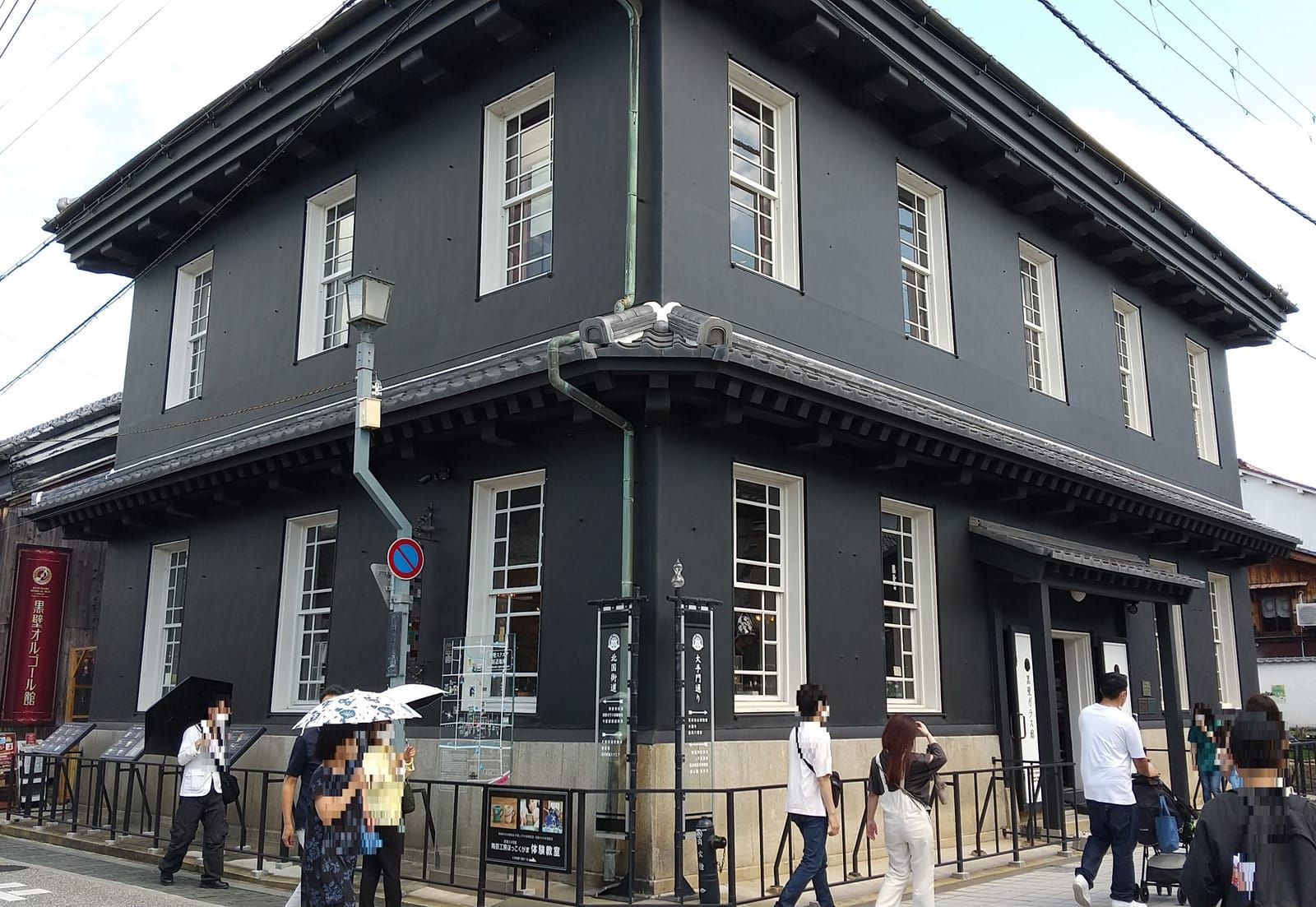
The centerpiece is the Kurokabe Glass House (黒壁ガラス館) — built in 1900 (Meiji 33) as the Nagahama branch of the 130th National Bank, nicknamed the “black-wall bank” for its black-plastered walls, and reborn in 1989 as a glass museum and shop. The building itself is the sight: a wooden Western-style bank with storehouse construction, listed in Japan’s cultural-heritage records, its two floors now filled with glasswork from delicate stemware to ornaments.
Around it spreads the square proper: glass studios, galleries, cafés and craft shops occupying the surrounding preserved buildings — the official lineup includes glassblowing, sandblasting, cut-glass and music-box decorating workshops where you make your own piece (book ahead on busy weekends; blown-glass pieces need cooling time, so plan pickup or shipping).
 The 1900 bank that started it all. Photo: 663highland / Wikimedia Commons, CC BY 2.5

The other reason to come: Kaiyodo
Two minutes’ walk into the arcade sits the Kaiyodo Figure Museum Kurokabe — the museum of the legendary figure maker whose capsule-toy sculpting turned a niche craft into a global collector culture. It’s small, dense, joyfully obsessive, and pairs bizarrely well with the glass quarter: two kinds of Japanese craftsmanship, one street. (Details on our spot page.)
Filling out the day
- The old streets themselves — the Hokkoku Kaidō merchant road and its arcades reward aimless wandering; this is snack-and-stroll territory.
- Nagahama Castle & Hō Park — the lakeside park holds the town’s reconstructed castle keep (a local-history museum inside) and the best Lake Biwa views of the day; sunset over the water is the natural closer.
- One stop down the line: the spring-water village of Samegai and its baikamo water blossoms is a short Tokaido-line hop away via Maibara — the natural summer pairing with this walk.
- Seasonal note: Nagahama’s famous festival is the Hikiyama Matsuri in mid-April (children’s kabuki performed on ornate festival floats — part of UNESCO’s intangible-heritage float-festival listing); the town books out around it — plan accordingly, in either direction.
- Winter seasonal note (Jan 10 – Mar 10 only): this is also when Nagahama hosts its long-running Plum Bonsai Exhibition (Bonbai-ten) at the Keiun-kan guesthouse. A private 120-minute Wabunka experience tours it with a professional bonsai gardener’s commentary, adds the Keiun-kan building and its Ogawa Jihei VII garden, and closes with a samurai-style tea ceremony under a master of the Enshū school — 2–10 guests, English-speaking guide included, from ¥30,450 per person, free cancellation to 3 days out (listing checked 2026-10-02). Outside those two months the exhibition doesn’t exist — plan the date first.
Seasonal · Wabunka
Nagahama Plum Bonsai Exhibition private tour & samurai tea ceremony (Jan 10 – Mar 10)
Jan 10 – Mar 10 only: a private tour of Nagahama’s plum-bonsai exhibition with an Enshū-school samurai tea ceremony, English guide included.
Check dates on Wabunka →Affiliate link — a small commission may go to Beyond Kansai at no extra cost to you. Disclosure.

Getting there
- The station is JR Nagahama — and the square is a 5-minute walk from it (per the official listings). That walkability is the whole charm: no buses, no logistics.
- From Kyoto/Osaka: JR’s Biwako line corridor runs north via Maibara — direct Special Rapid services reach Nagahama from Kyoto in roughly an hour (check a route app for your departure; not every train runs through).
- Pass note: Nagahama sits in the Otsu/Shiga coverage of JR West’s visitor passes — see our pass comparison for which tier makes sense; for a single day trip, plain IC-card fares often win.
- Combine it: Maibara is a shinkansen stop one station south — Nagahama slots neatly into a Kansai⇄Nagoya/Tokyo travel day.
Quick FAQ
- Is half a day enough? Yes — square + Kaiyodo + castle park is a comfortable 4–5 hours. A glass workshop adds an hour-plus.
- Do the workshops need Japanese? The processes are demonstration-led and staff are used to visitors; booking pages are Japanese-first — book via your hotel or the official site if unsure.
- Is it good in the rain? Better than most day trips — arcades, museums and studios are all indoors.
- Kurokabe or Hikone? Different days: Hikone has the original castle; Nagahama has the livelier street culture and craft. With one Shiga day and no castle obsession, Nagahama is the more distinctive choice.
- When is it crowded? April’s festival week and autumn weekends; summer weekdays are pleasantly quiet.
Editor’s note
This guide makes no personal-experience claims. The Glass House’s origin (1900, 130th National Bank Nagahama branch), its 1989 rebirth, the black-plaster nickname and heritage listing were checked against Japan’s official cultural-heritage database and the Kurokabe official site on 2026-07-28; the workshop lineup (glassblowing, sandblasting, cut glass, music boxes) is from the official site; the 5-minute station walk from official tourism listings. The Kaiyodo museum facts follow our verified spot entry. Train patterns, workshop schedules and festival dates change — confirm on the official pages below before you go. Drafted with AI assistance and editor-verified.
Sources
- Kurokabe official site (square, workshops; retrieved 2026-07-28)
- Kurokabe Glass House main building (former 130th Bank Nagahama branch, 1900) — Agency for Cultural Affairs heritage database / Japan Heritage portal entry
- Kaiyodo Figure Museum — Beyond Kansai spot entry (verified)
- JR pass comparison — Beyond Kansai
- Nagahama Plum Bonsai Exhibition tour — Wabunka listing (Jan 10–Mar 10 period, contents, price; retrieved 2026-10-02)