Awaji is the big island you cross on the way between Honshu and Shikoku, and most people do exactly that — cross it — without stopping. That’s a mistake. In Japanese mythology, Awaji is literally the first land of Japan — the place where the islands of the nation were born. It’s also a relaxed, sun-warmed island of coastal cafés, white beaches, world-class Tadao Ando architecture, the ferocious Naruto whirlpools, a 500-year-old puppet theatre, and a local food culture built on sweet onions and raw whitebait. It’s one of the easiest “real countryside” escapes from Osaka or Kobe, and it rewards a slow loop far more than a drive-through.
The island where Japan was born
Awaji’s deepest claim to fame is mythological. According to Japan’s creation story in the Kojiki and Nihon Shoki, the deities Izanagi and Izanami stood on the Heavenly Floating Bridge and stirred the ocean with a jeweled spear; the brine that dripped from its tip formed Onokoro Island, and the two gods then married and gave birth to the islands of Japan — Awaji first of all. For Japanese visitors, setting foot here carries a genuine sense of standing at the country’s origin point.
That myth is enshrined at Izanagi-jingū, considered the oldest shrine in Japan, built where Izanagi is said to have retired after entrusting the realm to his daughter, the sun goddess Amaterasu. In its grounds stands the Meoto-no-Ōkusu, a magnificent 900-year-old “husband-and-wife” camphor tree some 30 m tall, revered as a bringer of good fortune in marriage and relationships. Even if you’re not religious, it’s a serene, atmospheric stop that frames the whole island in a different light.
Getting there (and why you’ll want a car)
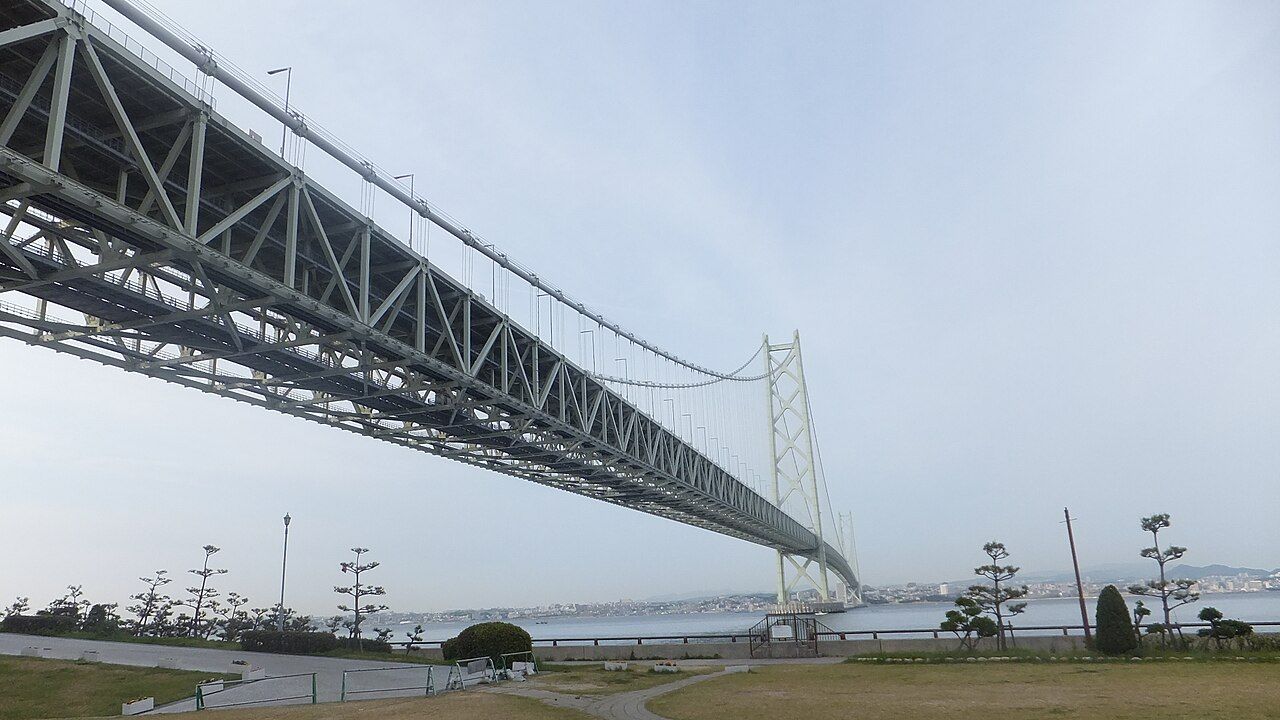
Awaji is linked to Honshu by the Akashi Kaikyō Bridge — a genuine engineering icon that held the record as the world’s longest suspension bridge from its 1998 opening until 2022 (when it was edged out by a bridge in Turkey). Its other end connects to Shikoku via the Ōnaruto Bridge, which spans the famous whirlpools.
- By car: 30–60 minutes across the bridge from Kobe — the most flexible option by far.
- By bus: highway buses run about 1.5 hours from Kobe and 2 hours from Osaka.
- By ferry: the fast Awaji Jenova Line crosses from Akashi to Iwaya Port in about 13 minutes (handy for cyclists).
Our take (opinion): rent a car. Awaji has no trains and taxis are genuinely hard to find, and the whole appeal — coastal cafés, scattered beaches, hilltop parks, Ando’s temples, the southern whirlpools — is spread around a large island. Without wheels (or a bike), you’ll see a fraction of it.
The Naruto whirlpools
At Awaji’s southern tip, the tide pouring through the narrow Naruto Strait creates some of the world’s largest tidal whirlpools — swirling vortices that can reach up to 20 m across, with currents hitting around 20 km/h. They’re at their most dramatic during the spring tides of spring and autumn, and the timing matters: aim for roughly 1.5 hours before or after a tide change (late March to April is often cited as the single best window). You can watch from the Uzu-no-Oka lookout on the Awaji side or, for the full effect, ride a whirlpool sightseeing boat out into the strait.
Tadao Ando’s island: concrete, water, and light
(The full architecture pilgrimage — every Ando site on the island, sequenced — is in our Awaji architecture guide.)
Awaji is, improbably, one of the best places in the world to experience the architecture of Tadao Ando, Japan’s most famous living architect.
- Honpukuji, the “Water Temple” (Mizumido): Ando’s radical 1991 reworking of a Shingon temple. Instead of a grand roof, he placed an oval lotus pond on top of the main hall — and you enter by descending a staircase straight down through the middle of the water into the vermilion hall below. It’s one of the most quietly astonishing religious spaces in Japan.
- Awaji Yumebutai: an ambitious terraced complex built on the scar left after earth was quarried here (famously used to build Kansai Airport). Its centerpiece, the Hyakudan-en (“100-Stepped Garden”), is a geometric cascade of seasonal flower terraces overlooking the sea.
Onion worship, sea bream, and raw whitebait
Awaji takes its food — and especially its onions — very seriously. Awaji onions are prized as unusually sweet and soft, planted in autumn, harvested in spring, and naturally dried to deepen their sweetness; you’ll find them in everything from burgers to ice cream. The island leans all the way into it: at Uzu-no-Oka in Fukura (southern Awaji), there’s a now-famous giant onion sculpture — 2.5 m tall, 2.8 m across, about 200 kg — that travelers line up to photograph, with sweeping views over the Naruto Strait behind it.
The other must-eat is nama-shirasu-don — a bowl of fresh raw whitebait (shirasu) over rice. Hyogo produces some of Japan’s best whitebait, much of it landed at Awaji’s Iwaya Port on the Akashi Strait. The island’s prized sea bream (tai) is the other local star, served grilled, as sashimi, or in rice.
Our take (opinion): raw whitebait on its own can get monotonous — go for a version where the shirasu sits on a mixed seafood bowl (kaisen-don) rather than a plain whitebait-only bowl. You get the delicate shirasu plus variety.
Awaji Ningyo Joruri: 500-year-old puppet theatre
One of Awaji’s most underrated experiences is its Ningyo Joruri — a traditional puppet theatre with roughly 500 years of history on the island, and a designated Important Intangible Folk Cultural Property. Its signature is scale: the puppets are noticeably larger than those of mainstream Bunraku — up to about 1.5–1.6 m tall — originally built big so they’d read clearly in open-air performances. The Awaji Puppet Theatre in Fukura runs daily shows, and even a short performance (with English explanation) is a memorable, genuinely local cultural stop.
Nojima Scuola and the slow coast
Not everything here is high design or high culture. Nojima Scuola is a former elementary school converted into a relaxed complex of restaurant, bakery, market, and a small animal corner, with the kind of nostalgic, distinctly-Japanese atmosphere that makes a perfect casual stop on a coastal drive. It’s emblematic of how Awaji travels: a string of independent cafés and restaurants along the coast road, sea views from resort villas and ocean-view hotels, and — once you turn inland — quiet farm country and hills full of unmarked photo spots.
Awaichi: cycling the whole island
Awaji is one of Japan’s great cycling destinations. The “Awaichi” — a full loop of the island’s coast — is about 150 km, mixing long flat coastal stretches with hillier terrain inland and in the mountainous south. Strong riders knock out the whole loop in around six hours; everyone else splits it over two days or rides one of the shorter, flatter northern sections. It’s popular enough to have its own events and a real cycling culture, with bike-friendly cafés and rental/transport options around the island.
Other ways to spend a day
- Awaji Hanasajiki: a vast hilltop flower park that changes with the seasons — poppies and rape blossoms in spring, sunflowers in summer, cosmos in autumn.
- Nijigen no Mori: an anime- and character-themed park (Naruto, Godzilla, Crayon Shin-chan attractions) inside Awaji Highland Park — a hit with families.
- Onsen and beaches dot the coast for an easy resort day, and oceanview baths catch Seto Inland Sea sunsets.
- Fishing: Awaji is a keen angling island — tackle shops are plentiful (though rarely English-speaking) and there are spots where casual fishing is welcome.
When to go
- Spring: onion season, Hanasajiki blooms, and prime whirlpool tides.
- Summer: beaches and the coastal café drive.
- Autumn: strong whirlpools again, cosmos at Hanasajiki.
- Year-round: Ando’s architecture, Izanagi-jingū, the puppet theatre, and the food.
Where to stay
Awaji has quietly become a low-key resort island: oceanview hotels and villas, design properties (including Ando-influenced architecture), and coastal ryokan with sunset baths. Staying overnight lets you enjoy the café-lined coast at golden hour and catch the whirlpools at the right tide the next morning.
Quick FAQ
- Do I need a car? Effectively yes — no trains, few taxis, sights spread out. Cycling (the Awaichi) is the other great option.
- How long? A full day minimum; an overnight unlocks the coast cafés, a sunset, and the right whirlpool tide.
- What must I eat? Awaji onions (in everything), nama-shirasu-don, and local sea bream.
- Best for architecture fans? The Water Temple + Yumebutai, easily.
- What’s the cultural highlight? Izanagi-jingū (Japan’s creation myth) and the Awaji puppet theatre.
- When are the whirlpools best? Spring/autumn spring tides, ~1.5 hours either side of a tide change.
Editor’s note
This guide is built from researched, sourced facts. The creation myth and Izanagi-jingū (including the 900-year camphor tree), the Akashi Kaikyō Bridge record (and that it was surpassed in 2022), the Naruto whirlpool figures and timing, Ando’s Water Temple and Yumebutai, the Fukura giant-onion dimensions, the nama-shirasu/onion food facts, the 500-year puppet theatre, and the 150 km Awaichi route were all verified against the sources below. The “rent a car,” the mixed-bowl shirasu tip, and the feel of the coast road are flagged as opinion. Nojima Scuola is a former-school complex (not an Ando work). Partially drafted with AI assistance and editor-verified.
Sources
- Japan’s Creation Myth — Awajishima Resort / Izanagi-jingu — Awaji Japan Heritage / Izanagi Shrine — Wikipedia / Japan’s oldest shrine — ANA
- Akashi Kaikyo Bridge — JNTO / Awaji access — Japan Highlights
- Naruto Strait — JNTO / Naruto Whirlpools — japan-guide
- Honpukuji Water Temple — JNTO / Ando architecture guide — Tokyo Weekender
- Awaji shirasu — Awajishima Resort / Giant onion / Uzu-no-Oka — official
- Awaji Ningyoza (official) / Awaji Puppet Theater — Japan Experience
- Awaichi cycling — JNTO / Awaji Island Cycle Tourism (official)