Our Awaji overview covers the island’s whole pitch — bridges, whirlpools, onions, sea bream. This is the deeper cut it promised: Awaji as Tadao Ando’s island. The Osaka-born architect’s most personal public works stand here, built into the scars of the 1995 Hanshin-Awaji earthquake — and around them has grown a island culture of reuse: a century-old school serving Italian lunch, a hilltop museum that turned the local onion into a monument. Growing up on the Osaka side of the bridge, Awaji was always the easy escape — close enough for a whim, far enough to feel like an island — and the architecture is the excuse the island deserves.
The Ando trail
1. Awaji Yumebutai (夢舞台). Ando’s sprawling masterpiece on the island’s northeast shore — conference center, hotel, chapel, greenhouses and, above all, the Hyakudan-en: one hundred stepped flower beds climbing the hillside, conceived as a garden of prayer for the victims of the 1995 earthquake (the site itself is land that was excavated to build Kansai’s artificial islands — the architecture heals a literal wound). The whole complex is a walkable sequence of concrete frames, water and sea views; entry to the gardens’ public areas makes an unhurried half-day.
 Yumebutai: Ando’s geometry stepped into a healed hillside. Photo: 663highland / Wikimedia Commons, CC BY 2.5

2. Honpukuji Water Temple (本福寺 水御堂). A short hop south: a Heian-era temple whose main hall, rebuilt by Ando in 1991, sits beneath an oval lotus pond — you descend a slot staircase through the water’s center into a womb-red hall below. It’s one of modern Japan’s most quietly radical religious buildings, and it still functions as an ordinary neighborhood temple (a small visitor fee applies; check locally for hours).
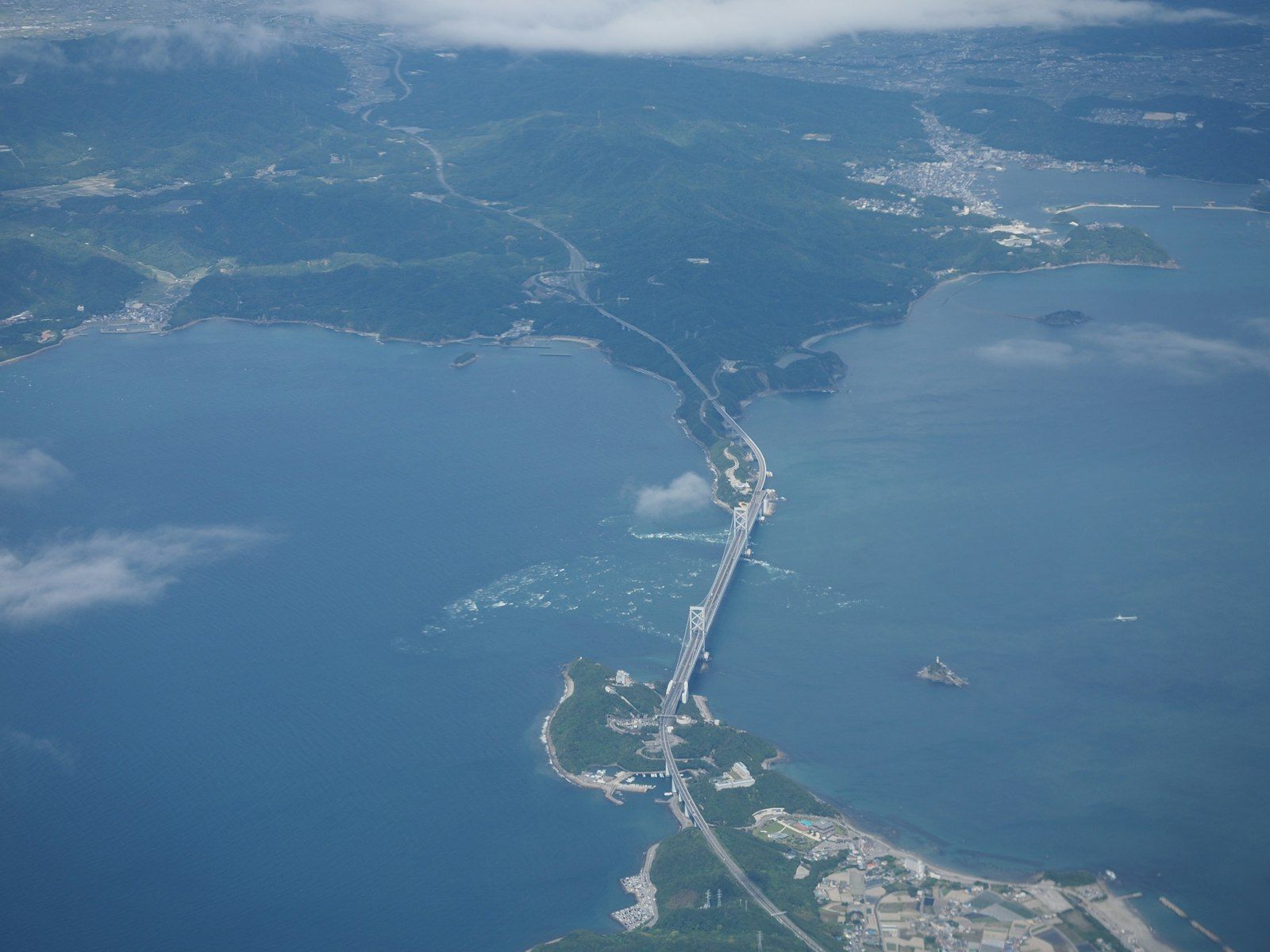
3. The connective tissue. The island’s gateway is itself an engineering icon — the Akashi Kaikyō Bridge, among the world’s great suspension spans, best appreciated from the northern coast parks looking back at Honshu.
The reuse generation
- Nojima Scuola — the shuttered Nojima Elementary School, reborn in 2012 as a marketplace-bakery-café-restaurant complex (casual café downstairs, Italian dining in the old classrooms upstairs, BBQ terrace above, a small animal yard outside). It’s the west-coast lunch stop, and the schoolhouse bones are the charm — per the island tourism association’s listing, it now draws on the order of 150,000 visitors a year.
- Uzunooka Ōnaruto Bridge Memorial (うずの丘) — at the island’s southern end, the hilltop complex overlooking the Naruto strait has turned Awaji’s onion pride into full entertainment: the giant “Ottama-negi” onion monument (2.8 m tall, ~250 kg, installed 2016) is the island’s defining photo op, backed by an onion-themed everything (catcher games, wigs, award-winning local burgers) and genuine strait views. (A note of correction from our own files: the onion monument stands here at Uzunooka — not at the expressway service area, as casual memory often places it.)
 Concrete, water, sea: the Ando vocabulary at island scale. Photo: Creative1222 / Wikimedia Commons, CC BY 4.0

Looping the island (the practical shape)
- By car (the honest recommendation): Awaji is a driving island — the coastal road strings Yumebutai → Water Temple (northeast), Nojima Scuola (northwest), and Uzunooka (south) into a natural one-day clockwise loop, with sea-view cafés thick along the west coast. From Osaka/Kobe, you’re over the bridge in under an hour.
- By bus: highway buses cross from Kobe/Osaka to the island’s main stops; island-internal transit is thin — plan around the few routes or use taxis for the Ando pair.
- By bicycle: the island circuit — the “Awaichi” — is an established riders’ challenge (roughly 150 km around); cyclists are a constant presence on the coastal roads in the cooler months. For non-cyclists, that mostly means: give riders room on the west coast curves.
- Eating: onions in everything (the island’s sweet variety is the point), sea-bream and — in season — raw shirasu (whitefin whitebait) bowls on the coast; availability of raw shirasu is seasonal, so check before setting your heart. Our overview covers the food story; the local-tip version: the shirasu-topped mixed seafood bowls beat the pure-shirasu purist bowls for most first-timers.
Quick FAQ
- Is Yumebutai worth it if I’m not an architecture person? Yes — it reads as a spectacular terraced garden with sea views; the earthquake-memorial story lands regardless of design literacy.
- How much time for the Ando pair? Half a day: 2–3 hours at Yumebutai, under an hour at the Water Temple, plus the drive between.
- Can I do Awaji without a car? The northeast (Yumebutai area) works by bus; the full loop with Scuola and Uzunooka realistically wants wheels.
- Best season? Spring and autumn for the gardens and cycling; summer for beaches (and crowds); the onion is photogenic year-round.
- Combine with what? The overview’s whirlpools on the south end pair naturally with Uzunooka; Kobe beef (or rather, Tajima) waits back across the bridge.
Editor’s note
First-person remarks are area-level impressions within our editor’s stated experience range (Awaji Island; Osaka side). Verified against official sources on 2026-07-28: Yumebutai’s Ando authorship, Hyakudan-en’s hundred stepped beds and earthquake-memorial conception (island tourism association and standard architectural records); the Water Temple’s 1991 Ando rebuild for the Heian-founded Honpukuji (island tourism association listing); Nojima Scuola’s 2012 schoolhouse conversion and facilities (official site + association listing); the Uzunooka onion monument’s size, weight, 2016 installation and location (Hyogo prefectural tourism listing) — including a correction of our own owner-notes memory that placed the onion at a highway service area. Raw-shirasu seasonality and facility hours change — check official pages before traveling for any single item; time-sensitive items are logged in our maintenance ledger. Drafted with AI assistance and editor-verified.
Sources
- Honpukuji Water Temple — Awaji Island Tourism Association official listing (Ando, 1991; retrieved 2026-07-28)
- Nojima Scuola — official site / tourism association listing (2012 conversion, facilities)
- Uzunooka Ōnaruto Bridge Memorial — Hyogo Prefecture official tourism listing (onion monument)
- Awaji Island — Beyond Kansai overview (bridges, whirlpools, food; audited)