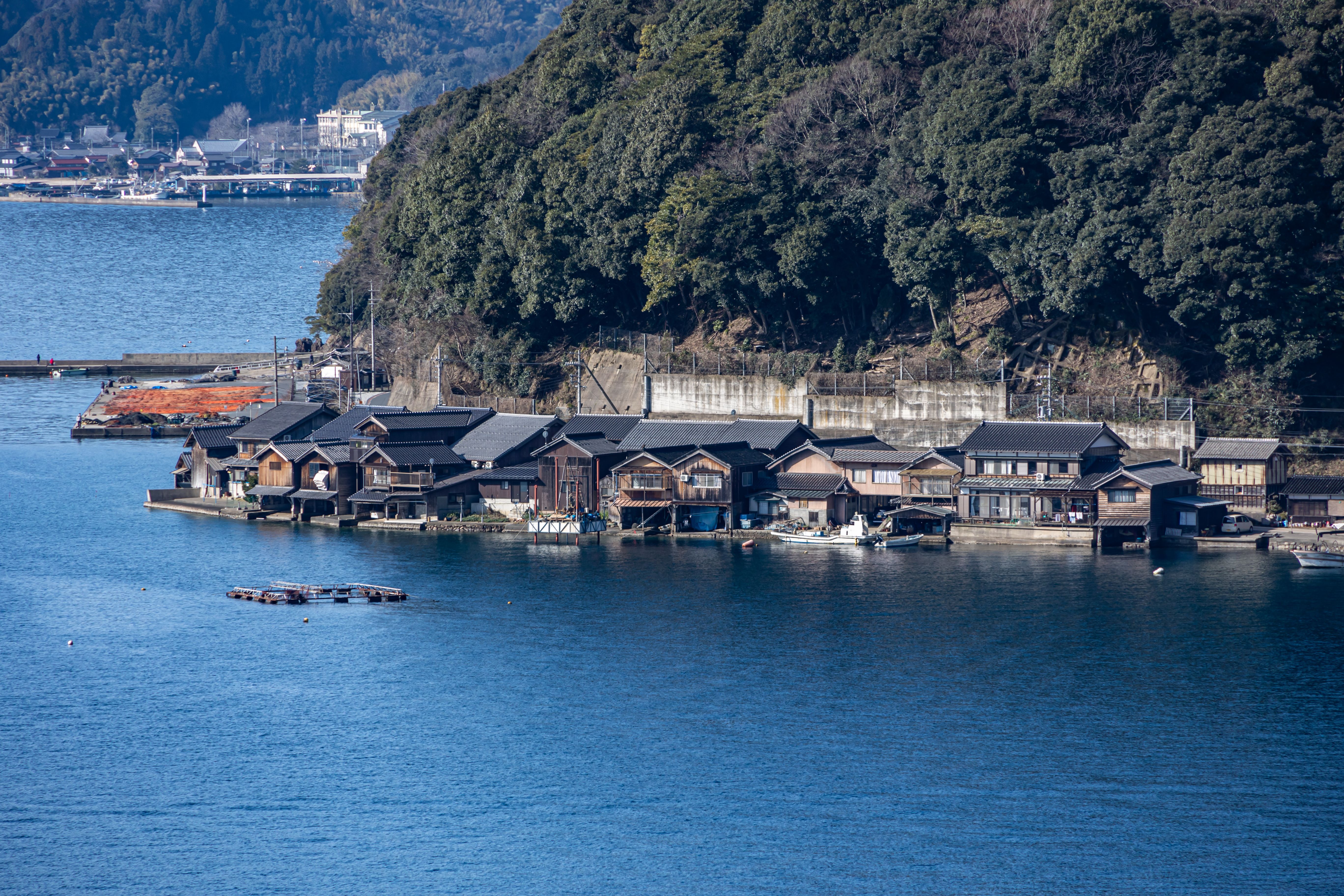
Most people see Ine in summer photos: blue bay, boathouses, sightseeing boats. The village’s own tourism association quietly tells a different story — that winter is when Ine is most itself. The air sharpens, the day-trip crowds thin to almost nothing, and the bay turns into one of Japan’s three great yellowtail fishing grounds, landing the fatty kan-buri (cold-season yellowtail) that the rest of the country pays premium prices for. If you’ve been looking for the reason to finally stay the night in a funaya, this is it. Here’s the season, the fish, and the honest fine print.
Kan-buri: the fish that justifies the trip
The facts, per the Ine tourism association’s official pages (checked 2026-10-02):
- Season: roughly November to February, varying by restaurant and by what the fixed nets land.
- Pedigree: Ine Bay is counted among Japan’s three great buri fishing grounds, alongside Toyama’s Himi and Nagasaki’s Gotō Islands — and the Edo-period food encyclopedia Honchō Shokkan rated this coast’s buri as Japan’s finest.
- Why winter: the yellowtail fatten as they migrate south through these waters when temperatures drop — kan-buri is prized precisely because it’s a cold-season fish.
- The dish: buri-shabu — yellowtail slices swished seconds through hot broth — and the village’s Aburaya inn is said to be the birthplace of it. In the wider Tango region buri is a celebration fish, served at New Year’s as a symbol of growth and success.
Where to actually eat it
The association’s current listing (2024 prices, checked 2026-10-02) names five places in the village serving buri courses in season, from a ¥3,500 buri-shabu set at Funaya Shokudō up to ¥11,000–¥12,000 courses at Wadatsumi and Kajiya — note Kajiya requires reservations three days ahead, and in winter it’s smart to treat every option as reservation-first. The deeper move is to eat where you sleep: funaya and onsen inns lean hard into the season — Aburaya, the claimed buri-shabu birthplace, promotes its own buri-shabu set — so a dinner-included winter booking turns the day’s catch into your evening plan. Confirm the buri plan when you book; it’s the whole point of the season.
 February in the village: boats below, living quarters above, nobody on the lane. Photo: Naokijp / Wikimedia Commons, CC BY-SA 4.0

The structural argument for staying overnight in winter
Our funaya overnight guide makes the general case; winter sharpens every line of it:
- The village empties. Ine after 5 p.m. is already a different place from the day-trip version — in winter, the quiet starts at lunch. You get the lanes and the water sounds to yourself.
- Dinner is the event. In buri season the meal plan isn’t a convenience, it’s the headline — the same kan-buri course that justifies a trip is simply what your inn serves.
- Daylight is short. The last buses back toward Amanohashidate leave early relative to a winter sunset bath of light — sleeping in the village deletes the clock.
- Rooms are easier to get. The summer-weekend booking scramble (the part our overnight guide warns about) relaxes in the off-season — the hardest village to book suddenly isn’t.
Browse Ine funaya stays on Booking.com for winter dates — the higher-end converted funaya we profiled, like Funaya Kura, pair sea-view rooms with private baths for exactly this season. (Accommodation links on Beyond Kansai are monetized via Stay22 — a booking may earn us a small commission at no extra cost to you. Disclosure.)
The honest winter fine print
Straight from the association’s winter page (checked 2026-10-02):
- Driving? Winter tires are a must — the association tells visitors to fit them regardless of the forecast, because conditions differ by place and hour on this coast.
- After snow, waterproof boots are recommended for the village lanes.
- Some shops run irregular winter hours — “different from usual operation” is the association’s own phrasing — so call ahead for any specific restaurant, and build your eating plan around your inn’s dinner.
- Coming by public transport stays the simple answer: the Kyoto → Amanohashidate → Ine route runs year-round, and the ¥400-capped coastal bus doesn’t care about tire chains. Pair the trip with a half-day at Amanohashidate on the way in or out.
 The sheltered bay is the whole premise — houses standing at the waterline, boats garaged beneath. Photo: Naokijp / Wikimedia Commons, CC BY-SA 4.0

Quick FAQ
- When is buri season in Ine? Roughly November to February, per the Ine tourism association (checked 2026-10-02) — availability varies by restaurant and by the day’s catch, so confirm when reserving.
- What is buri-shabu? Thin slices of winter yellowtail swished briefly through hot broth — rich from the fish’s cold-season fat. Ine’s Aburaya inn is said to be the dish’s birthplace, and several village restaurants serve buri courses from about ¥3,500 to ¥12,000 (association listing, 2024 prices).
- Is Ine worth visiting in winter? Yes — arguably at its best: kan-buri season, near-empty lanes, and easier funaya bookings. The trade-offs are short daylight, cold, and some shops on irregular hours, which is why the overnight-with-dinner pattern wins.
- Do I need a car for winter Ine? No — and the association’s own warnings (winter tires mandatory, variable road conditions) are a good argument for the train-and-bus route instead.
- Can I do Ine in winter as a day trip? You can — the bay cruise and lanes still work — but you’ll spend the best light in a bus queue. Winter is the season where staying the night changes the trip most.
Editor’s note
This guide describes winter Ine from official sources and makes no personal-experience claims — consistent with all our Ine coverage. Checked 2026-10-02 (Ine tourism association official): the buri season (November–February頃), Ine’s standing among Japan’s three great buri grounds with Himi and Gotō, the Honchō Shokkan citation, Aburaya’s claimed buri-shabu origin, the five-restaurant course listing with 2024 prices (¥3,500–¥12,000; Kajiya’s 3-day advance reservation), and the winter-practicalities page (winter tires regardless of forecast, waterproof boots after snow, shops on irregular hours, road-condition resources). Bus service levels in deep winter were not separately verifiable beyond the association’s general cautions — check the Tankai timetable close to travel. Prices are the association’s 2024 listing and will drift. Drafted with AI assistance and editor-verified.
Sources
- Ine-buri — Ine tourism association official (season, three-great-grounds, Honchō Shokkan, restaurant courses & prices; retrieved 2026-10-02)
- Winter in Ine — tourism association official (tires, boots, irregular hours; retrieved 2026-10-02)
- Aburaya buri-shabu set — association member listing (retrieved 2026-10-02)
- Staying overnight in Ine — Beyond Kansai (the funaya reality & booking)
- Kyoto to Ine — Beyond Kansai (the year-round route)